


The Fed's Bank Stress Test Results Are In. Here's What They Mean for Dividends and Buybacks.
Key Points
The largest U.S. banks recently passed the Federal Reserve's stress test.
Most have taken the opportunity to boost their dividends.
Here's why this is a good time to buy bank stocks.
- 10 stocks we like better than JPMorgan Chase ›
The Federal Reserve conducts an annual stress test of the 32 largest U.S. banks to assess how well they would withstand a severe recession or economic shock. These tests were borne out of the global financial crisis of 2008 as legislators took steps to shore up the banking system to avoid a similar meltdown.
This year, the large banks all passed the stress tests by varying degrees. According to the Fed, the banks proved they had sufficient capital to absorb nearly $708 billion in losses while continuing to lend to households and businesses under these hypothetical, stressful conditions.
Missed Nvidia in 2009? This Rare Signal Is Flashing Again. In 2009, a "Double Down" signal flashed for a little-known chipmaker called Nvidia. For the first time in years, that same "Total Conviction" signal is flashing for a company 1/100th the size of Nvidia. Continue »
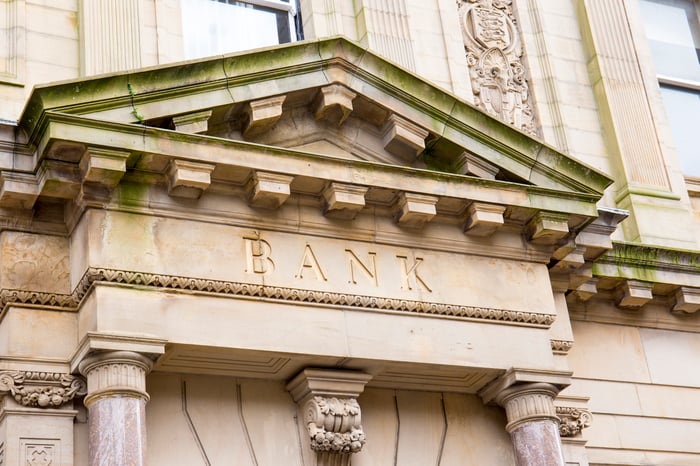
Image source: Getty Images.
Under the hypothetical scenario of a severe recession, the aggregate common equity tier 1 (CET1) capital ratio of the 32 banks fell from an actual 12.8% Q4 of 2025 to a low of 11.2% in the depths of the hypothetical recession. But this was still above the required minimum regulatory levels. Then the average recovered back to 12.7% by the end of the scenario.
The stress test results typically lead to the Federal Reserve setting stress capital buffers for banks, which is the amount of additional capital they would need beyond the regulatory minimum to absorb a shock. But this year, the buffers did not change, as the Fed is currently calculating new stress capital buffer requirements and awaiting public feedback on potential changes. So the buffers from last year will remain in place this year.
So, what is the upshot for investors?
Most top 10 banks boost dividends
Banks typically raise their dividends after the stress test results and initiate share buybacks. That's because if the results are good, this tells the banks they have plenty of capital to survive tough times, which gives them the green light to return capital to investors under normal conditions.
Immediately after the results came out last week, JPMorgan Chase (NYSE: JPM), Goldman Sachs (NYSE: GS), Wells Fargo (NYSE: WFC), Morgan Stanley (NYSE: MS), Citigroup (NYSE: C), PNC (NYSE: PNC), U.S. Bancorp (NYSE: USB), and BNY Mellon (NYSE: BNY) initiated dividend raises.
Of the 10 largest banks, only Bank of America (NYSE: BAC) and Truist (NYSE: TFC) have not.
But Bank of America has raised its dividend every year since 2021 in the third quarter following stress test results, so it's likely to do so again when it announces second-quarter results on July 14. Truist has neither raised nor lowered its dividend since 2022.
In addition, JPMorgan Chase, known for its fortress balance sheet, took the opportunity to initiate a $50 million share buyback post-stress test, while Morgan Stanley launched a $20 million repurchase plan. Further, both Bank of America and Citigroup said they will continue executing on their multibillion-dollar repurchase plans.
Why is this a good time to invest in banks
This is a particularly good time to consider investing in large banks for a few reasons.
First, most banks are raising their dividends, which provides additional income or adds to the stock's total return. Share buybacks are also good for the stock price, as they reduce the number of shares outstanding, which tends to raise the price of the remaining shares.
Second, banks are set to announce their second-quarter earnings starting the week of July 13, with most of the large banks reporting that week. If banks have strong quarters and beat expectations, stock prices usually rise. Of course, that all depends on how banks do.
But a reason for optimism is that the second quarter looks like a strong one for banks. As a bellwether, Jefferies (NYSE: JEF), an investment bank, reported its fiscal second-quarter earnings last week for the period ended May 31, posting record investment banking revenue.
Also, the stock market was soaring in Q2, with the S&P 500 (SNPINDEX: ^GSPC) rising about 13% from April 1 through June 29. This should help the large banks' asset management and institutional trading arms.
Finally, bank stocks are pretty cheap right now, with several, including Bank of America, Truist, Wells Fargo, U.S. Bancorp, and PNC, trading at less than 15 times earnings, and BNY Mellon, Citigroup, Goldman Sachs, JPMorgan Chase, and Morgan Stanley all trading below 20 times earnings.
Should you buy stock in JPMorgan Chase right now?
Before you buy stock in JPMorgan Chase, consider this:
The Motley Fool Stock Advisor analyst team just identified what they believe are the 10 best stocks for investors to buy now… and JPMorgan Chase wasn’t one of them. The 10 stocks that made the cut could produce monster returns in the coming years.
Consider when Netflix made this list on December 17, 2004... if you invested $1,000 at the time of our recommendation, you’d have $397,890!* Or when Nvidia made this list on April 15, 2005... if you invested $1,000 at the time of our recommendation, you’d have $1,196,664!*
Now, it’s worth noting Stock Advisor’s total average return is 902% — a market-crushing outperformance compared to 207% for the S&P 500. Don't miss the latest top 10 list, available with Stock Advisor, and join an investing community built by individual investors for individual investors.
See the 10 stocks »
*Stock Advisor returns as of July 1, 2026.
Citigroup is an advertising partner of Motley Fool Money. Bank of America is an advertising partner of Motley Fool Money. JPMorgan Chase is an advertising partner of Motley Fool Money. Wells Fargo is an advertising partner of Motley Fool Money. Dave Kovaleski has no position in any of the stocks mentioned. The Motley Fool has positions in and recommends Goldman Sachs Group, JPMorgan Chase, Jefferies Financial Group, Truist Financial, and U.S. Bancorp. The Motley Fool has a disclosure policy.
Recommended Articles


