


NZD/USD (NZDUSD) Surges 0.55% on Jul 29: What Does the Market Value?
NZD/USD (NZDUSD) is up 0.55% at Jul 29 14:50(ET), now at $0.5816, with a 7-day up of 0.03%.
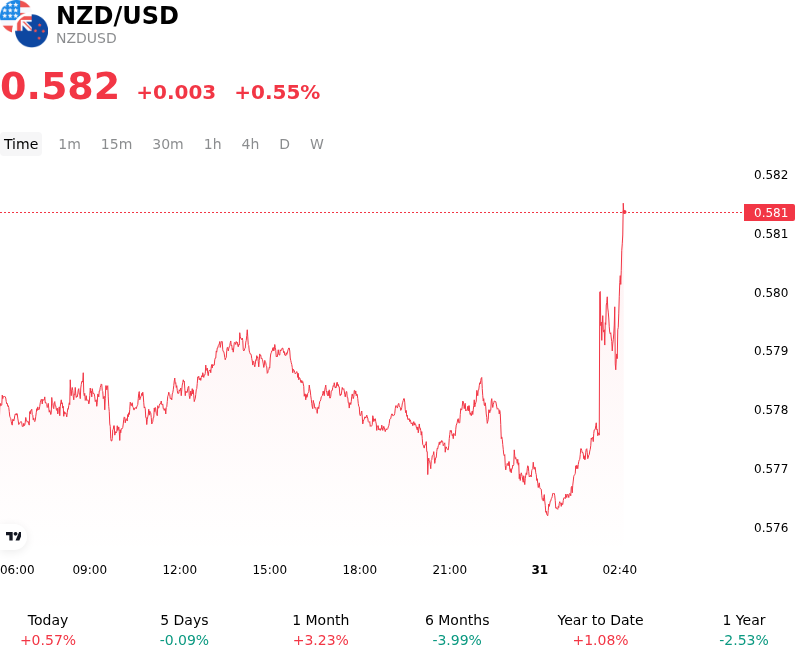
What is driving NZD/USD (NZDUSD)’s stock price up today?
The advance in NZDUSD is primarily driven by a shift in the relative trajectory of monetary policy between the Federal Reserve and the Reserve Bank of New Zealand, compounded by a broader improvement in global risk sentiment. The Federal Open Market Committee's latest policy communications have signaled a transition toward a more accommodative stance, suggesting that the peak in US interest rates has passed and that the focus is shifting toward supporting economic growth. This has led to a synchronized retreat in US Treasury yields, particularly at the front end of the curve, which has eroded the US dollar's yield advantage and triggered a broad-based softening of the greenback.
In contrast, the Reserve Bank of New Zealand has maintained a relatively hawkish posture, underpinned by persistent domestic inflationary pressures in the services sector and a resilient labor market. While other major central banks have begun to signal or implement easing cycles, the RBNZ's commitment to restrictive policy settings has supported the New Zealand dollar through widening interest rate differentials. This yield-gap expansion makes the Kiwi an attractive destination for carry-seeking capital, especially as volatility in the fixed-income markets begins to subside following the Fed’s clearer forward guidance.
External factors have further bolstered the New Zealand dollar’s performance. As a high-beta, commodity-linked currency, the Kiwi has benefited from a risk-on environment triggered by the Fed’s dovish pivot. The resulting rally in global equity markets and the stabilization of commodity prices, particularly in the agricultural sector, have provided a favorable backdrop for the currency. Improved economic data out of key Asia-Pacific trading partners has also played a critical role in supporting demand for the base currency, as investors price in a more robust outlook for regional trade volumes and export demand.
From a positioning perspective, the movement reflects a reduction in defensive US dollar holdings by institutional investors. As the market narrative shifts from a higher-for-longer regime in the United States toward a global easing cycle led by the Fed, capital is flowing back into pro-cyclical currencies that offer higher nominal yields and exposure to global growth. While the pair remains sensitive to shifts in global growth projections, the current upward momentum appears supported by the fundamental divergence in central bank policy paths and a general increase in risk appetite across international capital markets. Investors continue to monitor upcoming inflation prints and employment data to determine the durability of this move.
Technical Analysis of NZD/USD (NZDUSD)
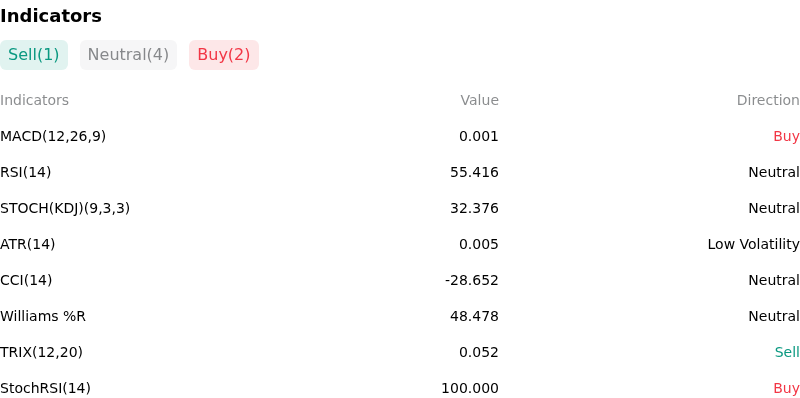
Technically, NZD/USD (NZDUSD) shows a MACD (12,26,9) value of 0.001, indicating a buy signal. The RSI at 55.416 suggests neutral condition and the Williams %R at 48.478 suggests neutral condition. Please monitor closely.
More details about NZD/USD (NZDUSD)
Recent Events and Risks:
- Chinese Macroeconomic Fragility: Persistent weakness in Chinese manufacturing and retail data continues to exert downward pressure on the New Zealand Dollar, as a slowdown in New Zealand's largest trading partner directly undermines export demand for dairy and agricultural commodities.
- Dovish RBNZ Policy Divergence: Increasing market speculation regarding aggressive interest rate cuts by the Reserve Bank of New Zealand, fueled by recent soft domestic inflation and employment indicators, is narrowing the yield spread against the US Dollar and triggering capital outflows.
- Safe-Haven US Dollar Demand: Escalating geopolitical tensions and global trade uncertainty have sparked a broad risk-off sentiment, leading market participants to favor the liquidity of the US Dollar over high-beta, risk-sensitive currencies like the NZD.
- Commodity Price Volatility: Recent fluctuations in global dairy prices and soft demand for industrial metals have weakened New Zealand's terms of trade, creating a fundamental headwind for the currency pair amid broader concerns over a global economic slowdown.
Recommended Articles


