


Banxico cuts rates by 50 bps to 9%, signals further easing
On Thursday, the Banco de México (Banxico) reduced its interest rate by 50 basis points, from 9.50% to 9%, and opened the door for additional adjustments to calibrate monetary policy and make similar adjustments.
The statement highlighted that the disinflation process is evolving, opening the door to continued easing of monetary policy. Banxico’s board expects inflation to reach its 3% target by Q4 2026.
Key takeaways:
Board estimates that looking forward it could continue calibrating the monetary policy stance and consider adjusting it in similar magnitudes
Balance of risks for the trajectory of inflation within the forecast horizon is biased to the upside
Board anticipates that the inflationary environment will allow to continue the rate cutting cycle, albeit maintaining a restrictive stance
Board anticipates that the inflationary environment will allow to continue the rate cutting cycle, albeit maintaining a restrictive stance
Changes in economic policy by the new US administration have added uncertainty to the forecasts
Effects could imply inflationary pressures on both sides of the balance
Disinflation process remains well on track
The environment of uncertainty and trade tensions poses significant downward risks
USD/MXN reaction to Banxico's decision
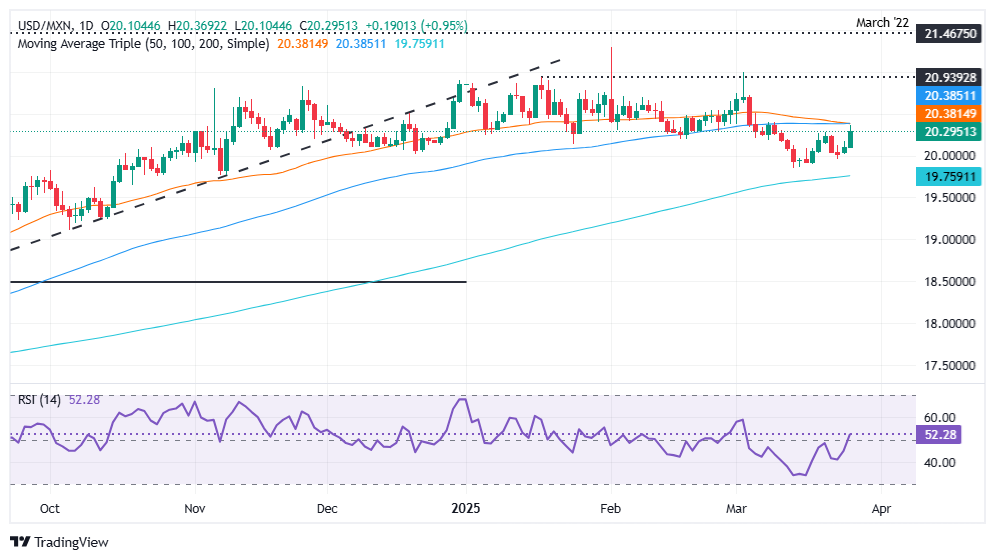
The USD/MXN rose to test the 50 and 100-day Simple Moving Averages (SMAs) near 20.35/36.
Banxico FAQs
The Bank of Mexico, also known as Banxico, is the country’s central bank. Its mission is to preserve the value of Mexico’s currency, the Mexican Peso (MXN), and to set the monetary policy. To this end, its main objective is to maintain low and stable inflation within target levels – at or close to its target of 3%, the midpoint in a tolerance band of between 2% and 4%.
The main tool of the Banxico to guide monetary policy is by setting interest rates. When inflation is above target, the bank will attempt to tame it by raising rates, making it more expensive for households and businesses to borrow money and thus cooling the economy. Higher interest rates are generally positive for the Mexican Peso (MXN) as they lead to higher yields, making the country a more attractive place for investors. On the contrary, lower interest rates tend to weaken MXN. The rate differential with the USD, or how the Banxico is expected to set interest rates compared with the US Federal Reserve (Fed), is a key factor.
Banxico meets eight times a year, and its monetary policy is greatly influenced by decisions of the US Federal Reserve (Fed). Therefore, the central bank’s decision-making committee usually gathers a week after the Fed. In doing so, Banxico reacts and sometimes anticipates monetary policy measures set by the Federal Reserve. For example, after the Covid-19 pandemic, before the Fed raised rates, Banxico did it first in an attempt to diminish the chances of a substantial depreciation of the Mexican Peso (MXN) and to prevent capital outflows that could destabilize the country.
Artigos Recomendados


