


Gold price surges to record high amidst US tariffs
- Gold rises 0.87%, maintaining gains as market navigates US tariff implications on global trade.
- US Dollar Index peaks at two-week high, later retreating as the US-Mexico tariff delay tempers momentum.
- Investors focus on upcoming US Nonfarm Payrolls and Fed communications.
Gold price hit a record high on Monday after the US initially scheduled tariffs on Canada, Mexico and China, sparking flows toward the non-yielding metal's safe-haven appeal. At the time of writing, XAU/USD trades at $2,821 above its opening price by 0.87%.
Market mood has improved, yet the golden metal holds to previous gains. Tariffs have been the main driver of the markets since US President Donald Trump took office. The Greenback began the week on the front foot after the US enacted 25% tariffs on two of its largest trading partners and 10% on China.
The US Dollar Index (DXY) hit a two-week high of 109.88, but news that the US is delaying tariffs on Mexico due to an agreement between both countries weighed on the Greenback, providing a leg-up in XAU/USD.
In the meantime, tariffs on Canada and China remain in place, set to begin on Tuesday. However, US President Trump said he would hold talks with Canada’s Prime Minister Justin Trudeau.
Moving to economic drivers, the Institute for Supply Management (ISM) revealed that US business activity in the manufacturing sector improved. Furthermore, traders will be eyeing US data, with the release of US Nonfarm Payrolls (NFP) for January and Federal Reserve (Fed) officials crossing the newswires.
Daily digest market movers: Gold price boosted by falling US Treasury yields
- The US 10-year T-note yield drops one and a half basis points to 4.537%. US real yields, as measured by the 10-year Treasury Inflation-Protected Securities (TIPS), are unchanged at 2.095%.
- The ISM Manufacturing PMI for January rose to 50.9, surpassing expectations of 49.8 and improving from December's reading of 49.2, signaling an enhancement in business activity. A closer look at the data shows the prices paid sub-component increased from 52.5 to 54.9, indicating higher input costs. Additionally, the employment index showed significant improvement, moving from 45.4 in December to 50.3, reflecting better employment conditions within the sector.
- Bart Melek, Head of Commodity Strategies at TD Securities, commented that the market is not fully aware of the extent of the trade war. "We haven't seen a complete response from Gold, and if this trade war continues for a considerable period, it could lead to significantly higher Gold prices down the road," he added.
- Boston Fed President Susan Collins said the Fed could be patient on rate cuts due to tariff uncertainty.
- Atlanta’s Fed President Raphael Bostic said the Fed needs to get inflation to 2% for the credibility of the institution. He added that the labor market is solid, and he wants to see what the 100 bps of easing last year translates into the economy.
- Money market futures now price in 44 basis points of Fed rate cuts in 2025, with traders anticipating the first move in June.
XAU/USD technical outlook: Gold price remains bullish as buyers eye $2,850
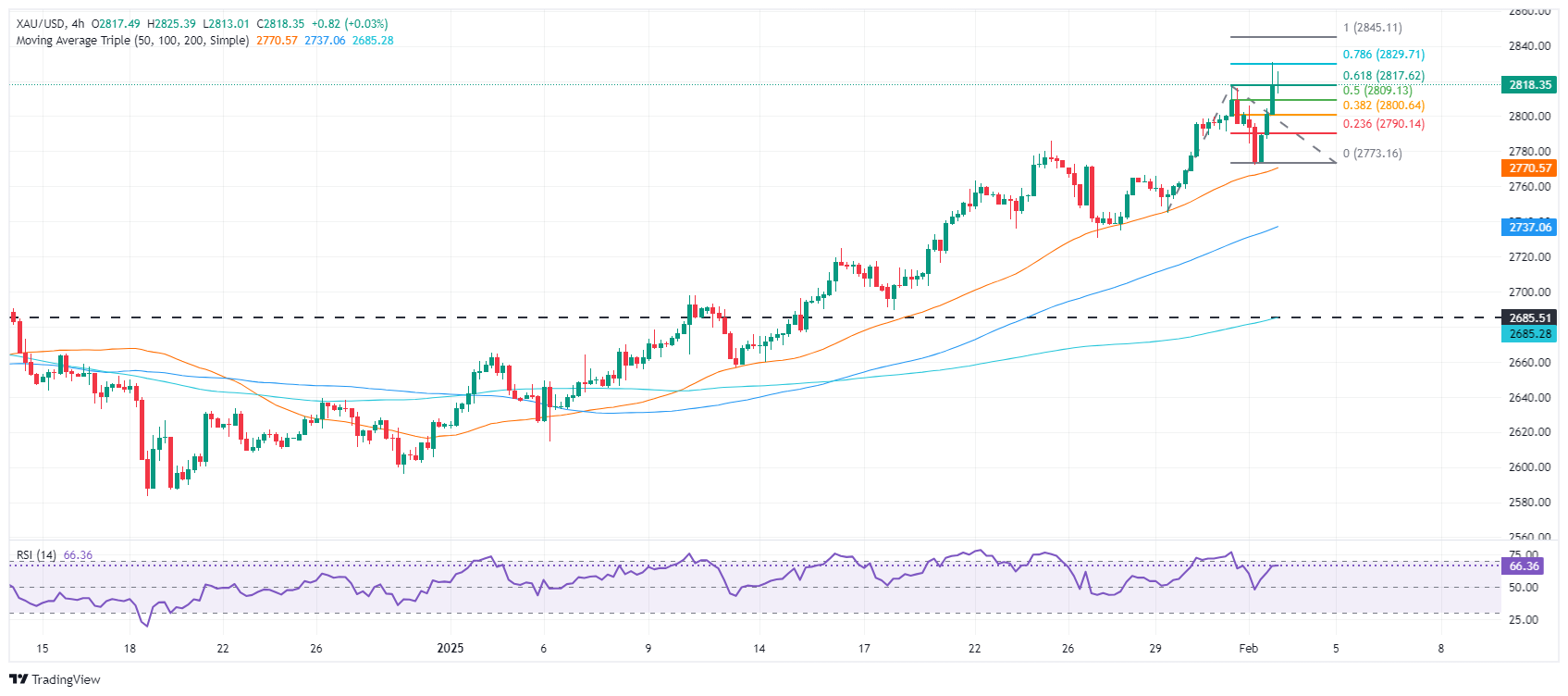
Gold price’s uptrend resumed on Monday as the yellow metal hit an all-time high (ATH) of $2,830. Further upside is seen amid geopolitical uncertainty due to the US imposing tariffs, the Middle East conflict, and the Russia-Ukraine war.
If XAU/USD rises past $2,830, the next resistance would be the 100% Fibonacci level near $2,844 as part of the January 25 to January 31 leg up, which can be seen in the 4-hour chart below. If surpassed, the next resistance will be the 161.8% Fib extension at $2,889, ahead of $2,900.
Conversely, if sellers clear the 50-period Simple Moving Average (SMA) at $2,770, this will be followed by the January 27 swing low of $2,730. The next stop below there would be $2,700.
Gold FAQs
Gold has played a key role in human’s history as it has been widely used as a store of value and medium of exchange. Currently, apart from its shine and usage for jewelry, the precious metal is widely seen as a safe-haven asset, meaning that it is considered a good investment during turbulent times. Gold is also widely seen as a hedge against inflation and against depreciating currencies as it doesn’t rely on any specific issuer or government.
Central banks are the biggest Gold holders. In their aim to support their currencies in turbulent times, central banks tend to diversify their reserves and buy Gold to improve the perceived strength of the economy and the currency. High Gold reserves can be a source of trust for a country’s solvency. Central banks added 1,136 tonnes of Gold worth around $70 billion to their reserves in 2022, according to data from the World Gold Council. This is the highest yearly purchase since records began. Central banks from emerging economies such as China, India and Turkey are quickly increasing their Gold reserves.
Gold has an inverse correlation with the US Dollar and US Treasuries, which are both major reserve and safe-haven assets. When the Dollar depreciates, Gold tends to rise, enabling investors and central banks to diversify their assets in turbulent times. Gold is also inversely correlated with risk assets. A rally in the stock market tends to weaken Gold price, while sell-offs in riskier markets tend to favor the precious metal.
The price can move due to a wide range of factors. Geopolitical instability or fears of a deep recession can quickly make Gold price escalate due to its safe-haven status. As a yield-less asset, Gold tends to rise with lower interest rates, while higher cost of money usually weighs down on the yellow metal. Still, most moves depend on how the US Dollar (USD) behaves as the asset is priced in dollars (XAU/USD). A strong Dollar tends to keep the price of Gold controlled, whereas a weaker Dollar is likely to push Gold prices up.
Artigos Recomendados


