


Gold dips below $2,600 amid buoyant US Dollar, rising US yields
- Gold prices affected by advancing US Dollar Index and rising Treasury yields following Trump's election victory.
- Market adjusts to less dovish Fed outlook with rate futures indicating lower chances of a December rate cut.
- Gold ETFs experience significant outflows, signaling investor shift toward riskier assets amid geopolitical tensions.
Gold prices dropped below $2,600 for the first time since mid-September on Tuesday as the Greenback extended its gains and hit a six-month high, according to the US Dollar Index (DXY). Rising US Treasury yields also weighed on Gold prices. At the time of writing, the XAU/USD trades at $2,599, down 0.77%.
Investors continued to digest former US President Donald Trump's victory. Attention turned to his first cabinet appointments, which would give some cues regarding pushing his policies of lowering taxes, imposing tariffs, and fighting illegal immigration.
On Tuesday, news emerged that Mike Waltz had been named the National Security Advisor and Marco Rubio would be appointed Secretary of State. Waltz and Rubio are known for their tough stances on China, hinting that tariffs would likely be imposed.
Meanwhile, market participants expect a less dovish Federal Reserve (Fed) and have raised the neutral or terminal rate to around 3.99%, according to fed funds rate futures data provided by the Chicago Board of Trade (CBOT).
The CME FedWatch Tool shows that odds for a quarter-point percentage interest rate cut at the December 2024 meeting were lowered from 65% to 58% and continue to decrease.
According to the World Gold Council's (WGC) November 2024 review, the non-yielding metal accumulates losses due to outflows from Gold ETFs.
“Global gold ETFs shed an estimated US$809mn (12t) during the first week of November, with the bulk of outflows stemming from North America, which were partially offset by strong Asian inflows. Potentially signaling renewed fears around the resumption of the trade war between the US and China. Additionally, COMEX net positioning also fell 74 tonnes, an 8% drop from the prior week,” the WGC wrote.
The WGC added that political risk-premium is out of the equation, leaving Gold’s price vulnerable as appetite for the US Dollar and strengthening US bond yields might hurt Bullion’s prospects.
In the meantime, Fed officials crossed the newswires. Richmond Fed President Thomas Barkin stated, "Inflation might be coming under control or might risk getting stuck above the Fed's 2% target.”
Minneapolis Fed President Neel Kashkari recently commented that a strong labor market and economy would continue. He added, “If inflation surprises to the upside between now and December, that might give us pause.”
This week, the US economic schedule will feature consumer and producer side inflation data, Fed speakers, Retail Sales and the release of Industrial Production data.
Daily digest market movers: Gold remains pressured by a firm US Dollar
- Gold prices fell as US real yields, which inversely correlate against Bullion, soar over ten basis points to 2.089%. The DXY registers gains of 0.45%, up to 105.99.
- The US Consumer Price Index (CPI), set for release on November 13, is expected to rise slightly from 2.4% to 2.6% YoY, with monthly figures expected to hold steady at 0.2%.
- Core CPI is forecasted to remain unchanged at 3.3% annually and 0.3% monthly.
- Data from the Chicago Board of Trade, via the December fed funds rate futures contract, shows investors estimate 24 bps of Fed easing by the end of 2024.
- Fed funds rate futures for 2025 imply just 47 bps in reductions, compared with about 67 bps a few weeks ago.
XAU/USD Technical Outlook: Gold price tumbles with sellers eyeing $2,600
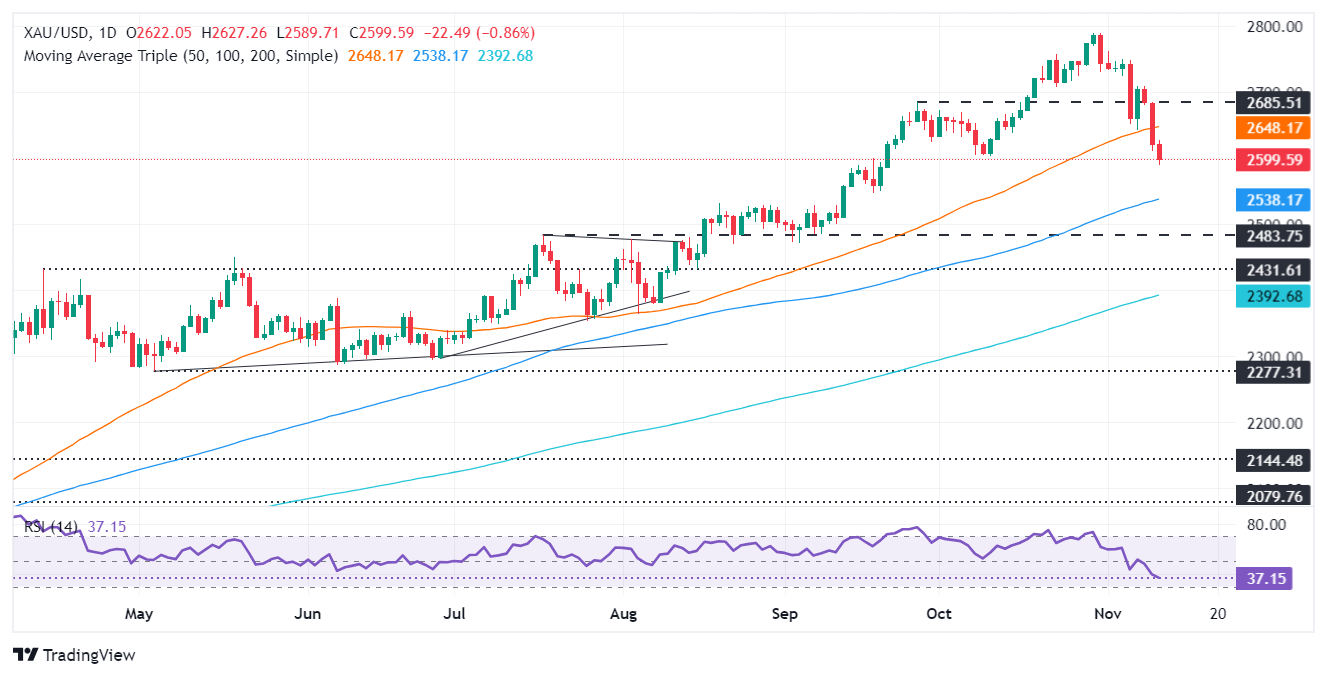
After XAU/USD fell below the October 10 swing low of $2,603, the yellow metal seems poised to extend its losses. If sellers achieve a daily close below $2,600, the next support would be the $2,550 psychological level, ahead of testing the 100-day Simple Moving Average (SMA) at $2,537. A breach of the latter will expose the $2,500 mark.
On the other hand, if Gold clings to $2,600, buyers will eye the 50-day SMA at $2,647, ahead of $2,650. Once surpassed, the next resistance would be the November 7 high at $2,710.
Momentum has shifted bearishly as the Relative Strength Index (RSI) distanced itself from its neutral line, a sign that XAU/USD might extend its losses.
Gold FAQs
Gold has played a key role in human’s history as it has been widely used as a store of value and medium of exchange. Currently, apart from its shine and usage for jewelry, the precious metal is widely seen as a safe-haven asset, meaning that it is considered a good investment during turbulent times. Gold is also widely seen as a hedge against inflation and against depreciating currencies as it doesn’t rely on any specific issuer or government.
Central banks are the biggest Gold holders. In their aim to support their currencies in turbulent times, central banks tend to diversify their reserves and buy Gold to improve the perceived strength of the economy and the currency. High Gold reserves can be a source of trust for a country’s solvency. Central banks added 1,136 tonnes of Gold worth around $70 billion to their reserves in 2022, according to data from the World Gold Council. This is the highest yearly purchase since records began. Central banks from emerging economies such as China, India and Turkey are quickly increasing their Gold reserves.
Gold has an inverse correlation with the US Dollar and US Treasuries, which are both major reserve and safe-haven assets. When the Dollar depreciates, Gold tends to rise, enabling investors and central banks to diversify their assets in turbulent times. Gold is also inversely correlated with risk assets. A rally in the stock market tends to weaken Gold price, while sell-offs in riskier markets tend to favor the precious metal.
The price can move due to a wide range of factors. Geopolitical instability or fears of a deep recession can quickly make Gold price escalate due to its safe-haven status. As a yield-less asset, Gold tends to rise with lower interest rates, while higher cost of money usually weighs down on the yellow metal. Still, most moves depend on how the US Dollar (USD) behaves as the asset is priced in dollars (XAU/USD). A strong Dollar tends to keep the price of Gold controlled, whereas a weaker Dollar is likely to push Gold prices up.
Artigos Recomendados


