


Canadian Dollar continues to grind it out in familiar territory
- The Canadian Dollar continues to find familiar ground near 1.3500 against the Greenback.
- A lack of data from Canada leaves the CAD at the mercy of market flows.
- US jobs preview figures outpace forecasts with NFP Friday looming ahead.
The Canadian Dollar (CAD) eased slightly on Wednesday as overall risk-off flows bump the Greenback higher. Middle East geopolitical tensions and overall investor outlook on upcoming US jobs figures dominate market attention during the midweek market session.
Canada released updated Purchasing Managers Index (PMI) to very little fanfare earlier this week, but precursor US Nonfarm Payolls (NFP) figures took center stage on Wednesday as investors grapple with hopes for further Federal Reserve (Fed) rate cuts.
Daily digest market movers
- The Canadian Dollar found little momentum on Wednesday, shedding a scant tenth of a percent against the US Dollar.
- Canada’s S&P PMI in September returned to positive territory above 50.0 for the first time since May of 2023 this week, printing at 50.4 and finding its highest value since March of 2023. Despite the upturned activity outlook, the CAD has found very little bullish momentum.
- Market participants are grappling with an upshot in US labor figures on Wednesday; US ADP Employment Change figures came in much higher than expected, crimping odds of further jumbo rate cuts from the Fed.
- While rising US labor figures ahead of Friday’s NFP labor print is a good thing, investors desperate for further 50 bps rate cuts from the Fed in 2024 are set to be disappointed as central planners hinge the size of future rate cuts on labor market performance.
- CAD traders will have to wait until Friday for any more Canadian economic data. Canada’s Ivey PMI figures are likely to be entirely eclipsed by the hotly-anticipated NFP release.
Economic Indicator
ADP Employment Change
The ADP Employment Change is a gauge of employment in the private sector released by the largest payroll processor in the US, Automatic Data Processing Inc. It measures the change in the number of people privately employed in the US. Generally speaking, a rise in the indicator has positive implications for consumer spending and is stimulative of economic growth. So a high reading is traditionally seen as bullish for the US Dollar (USD), while a low reading is seen as bearish.
Read more.Last release: Wed Oct 02, 2024 12:15
Frequency: Monthly
Actual: 143K
Consensus: 120K
Previous: 99K
Source: ADP Research Institute
Traders often consider employment figures from ADP, America’s largest payrolls provider, report as the harbinger of the Bureau of Labor Statistics release on Nonfarm Payrolls (usually published two days later), because of the correlation between the two. The overlaying of both series is quite high, but on individual months, the discrepancy can be substantial. Another reason FX traders follow this report is the same as with the NFP – a persistent vigorous growth in employment figures increases inflationary pressures, and with it, the likelihood that the Fed will raise interest rates. Actual figures beating consensus tend to be USD bullish.
CAD price forecast
The Canadian Dollar (CAD) continues to grind out a sideways technical pattern on daily candlesticks; USD/CAD is caught in a volatility trap just south of the 200-day Exponential Moving Average (EMA near the 1.3600 handle, but the Loonie remains unable to break into a fresh bullish rally against the Greenback.
USD/CAD daily chart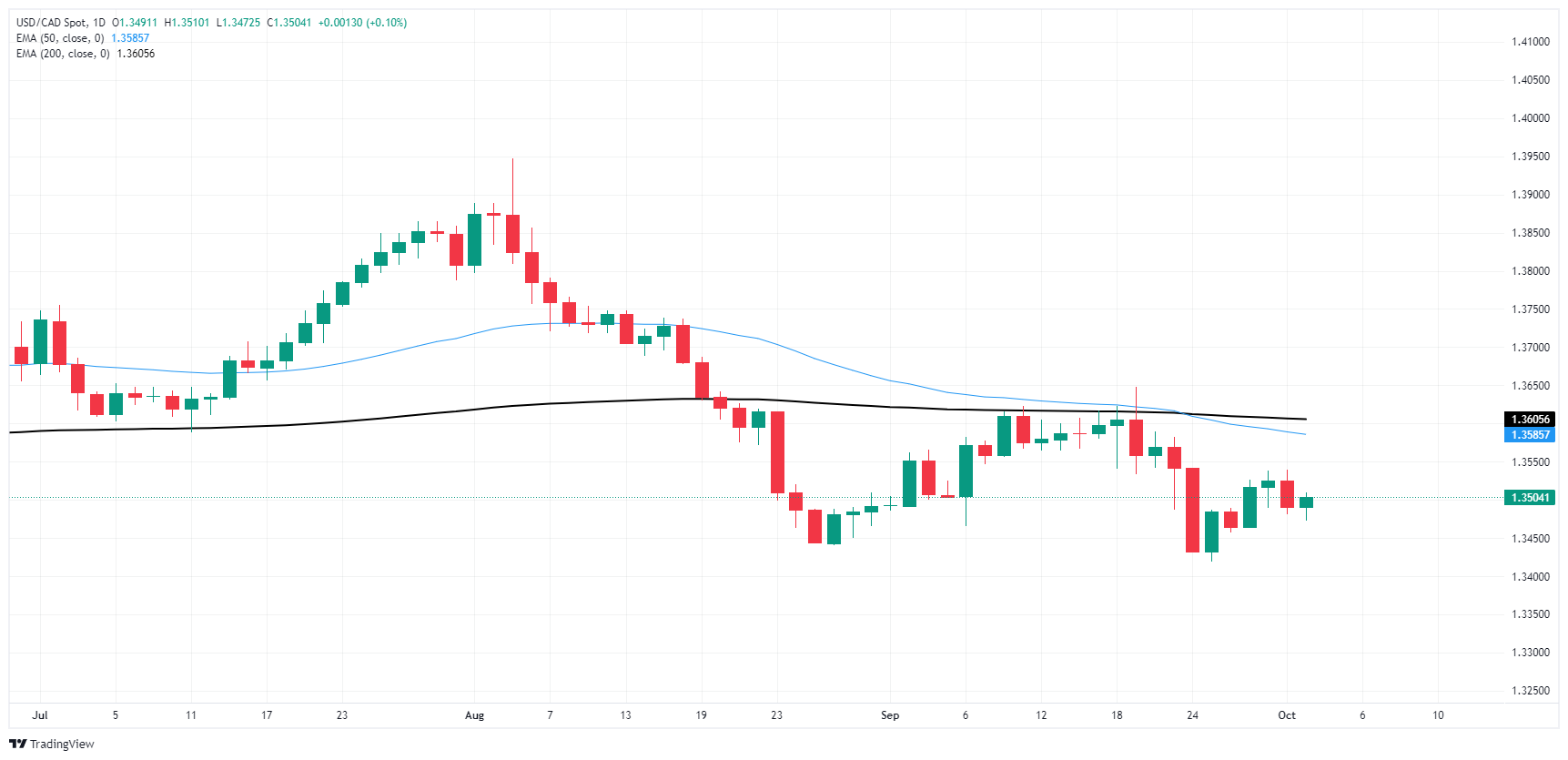
Canadian Dollar FAQs
The key factors driving the Canadian Dollar (CAD) are the level of interest rates set by the Bank of Canada (BoC), the price of Oil, Canada’s largest export, the health of its economy, inflation and the Trade Balance, which is the difference between the value of Canada’s exports versus its imports. Other factors include market sentiment – whether investors are taking on more risky assets (risk-on) or seeking safe-havens (risk-off) – with risk-on being CAD-positive. As its largest trading partner, the health of the US economy is also a key factor influencing the Canadian Dollar.
The Bank of Canada (BoC) has a significant influence on the Canadian Dollar by setting the level of interest rates that banks can lend to one another. This influences the level of interest rates for everyone. The main goal of the BoC is to maintain inflation at 1-3% by adjusting interest rates up or down. Relatively higher interest rates tend to be positive for the CAD. The Bank of Canada can also use quantitative easing and tightening to influence credit conditions, with the former CAD-negative and the latter CAD-positive.
The price of Oil is a key factor impacting the value of the Canadian Dollar. Petroleum is Canada’s biggest export, so Oil price tends to have an immediate impact on the CAD value. Generally, if Oil price rises CAD also goes up, as aggregate demand for the currency increases. The opposite is the case if the price of Oil falls. Higher Oil prices also tend to result in a greater likelihood of a positive Trade Balance, which is also supportive of the CAD.
While inflation had always traditionally been thought of as a negative factor for a currency since it lowers the value of money, the opposite has actually been the case in modern times with the relaxation of cross-border capital controls. Higher inflation tends to lead central banks to put up interest rates which attracts more capital inflows from global investors seeking a lucrative place to keep their money. This increases demand for the local currency, which in Canada’s case is the Canadian Dollar.
Macroeconomic data releases gauge the health of the economy and can have an impact on the Canadian Dollar. Indicators such as GDP, Manufacturing and Services PMIs, employment, and consumer sentiment surveys can all influence the direction of the CAD. A strong economy is good for the Canadian Dollar. Not only does it attract more foreign investment but it may encourage the Bank of Canada to put up interest rates, leading to a stronger currency. If economic data is weak, however, the CAD is likely to fall.
Artigos Recomendados


