




When is the US President Trump’s speech at WEF in Davos and how could it affect EUR/USD
United States (US) President Donald Trump is scheduled to deliver his speech at the World Economic Forum (WEF) in Davos after 13:00 GMT. Trump’s trip to Davos was delayed after Air Force One was forced to turn around due to a "minor electrical issue".
Trump’s speech will be closely watched by financial market participants as it will indicate what other measures the White House has at its disposal to intensify pressure on European Union (EU) members, who oppose Washington’s plans to acquire Greenland.
Greenland’s Prime Minister (PM) Jens-Frederik Nielsen has clarified in a joint statement with Denmark’s Mette Frederiksen that his economy prefers to remain a semi-autonomous Danish territory.
So far, President Trump has imposed 10% tariffs on several EU members: France, Germany, Denmark, Norway, Sweden, the Netherlands and Finland, and the United Kingdom (UK), which will become effective from February 1, for opposing US control of Greenland, and warned that additional duties could rise to 25% from the summer if no deal is done.
In response, EU members have warned of proportionate countermeasures against Trump’s tariff threats, calling them “blackmail”. French President Emmanuel Macron has stressed the need to deploy an anti-coercion tool, nicknamed a "trade bazooka", in retaliation to Trump’s tariff threats. In the WEF on Tuesday, Macron said that the world is reaching a time of “instability and imbalances,” and the answer is “more cooperation,” not a system that accepts “the law of the strongest”, The New York Times (YT) reported.
Officials across the globe have also condemned threats of additional import duties by Washington. Canadian Prime Minister Mark Carney affirmed support for EU members, citing “Middle powers must act together because if we're not at the table, we're on the menu", BBC reported.
Signs of Washington deploying military action on Greenland for forceful acquisition through comments from US President Trump would be unfavorable for the US Dollar, as they might escalate tensions between the world’s largest economies, potentially leading to a trade war. On the contrary, Trump’s gentle comments on the Greenland crisis would ease geopolitical tensions, boosting hopes of improvement in the appeal of risky assets, the US Dollar, and US assets.
How could Trump’s speech affect EUR/USD?
Signs of Washington deploying military action on Greenland for forceful acquisition through comments from US President Trump would be unfavorable for the US Dollar, as they might escalate tensions between the world’s largest economies, potentially leading to a trade war. On the contrary, Trump’s gentle comments on the Greenland crisis would ease geopolitical tensions, boosting hopes of improvement in the appeal of risky assets, the US Dollar, and US assets.
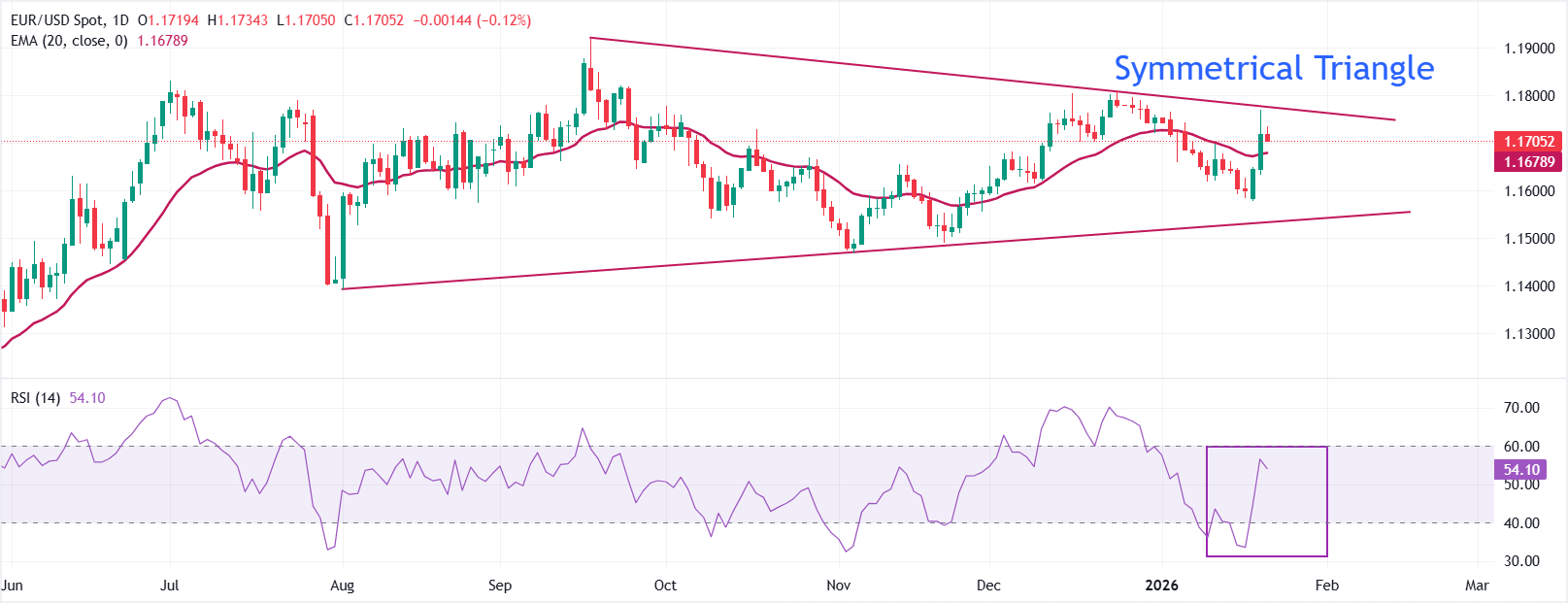
EUR/USD trades lower at around 1.1700 as of writing. The 20-day Exponential Moving Average (EMA) at 1.1679 edges higher beneath spot, supporting the short-term bias. A pullback would be expected to find initial demand around this dynamic level.
The 14-day Relative Strength Index (RSI) at 54 is neutral-to-firm, consistent with a measured upside impulse. A descending trend line from 1.1921 caps advances, with resistance at 1.1775. A daily close through this barrier could extend gains.
The rising trend line from 1.1393 underpins the broader structure, offering support near 1.1533. Failure to clear 1.1775 would keep rallies capped and leave scope for consolidation above the trend base. A sustained push beyond the descending barrier would shift focus higher, whereas holding below it would preserve a rangebound tone.
(The technical analysis of this story was written with the help of an AI tool.)
US Dollar FAQs
The US Dollar (USD) is the official currency of the United States of America, and the ‘de facto’ currency of a significant number of other countries where it is found in circulation alongside local notes. It is the most heavily traded currency in the world, accounting for over 88% of all global foreign exchange turnover, or an average of $6.6 trillion in transactions per day, according to data from 2022. Following the second world war, the USD took over from the British Pound as the world’s reserve currency. For most of its history, the US Dollar was backed by Gold, until the Bretton Woods Agreement in 1971 when the Gold Standard went away.
The most important single factor impacting on the value of the US Dollar is monetary policy, which is shaped by the Federal Reserve (Fed). The Fed has two mandates: to achieve price stability (control inflation) and foster full employment. Its primary tool to achieve these two goals is by adjusting interest rates. When prices are rising too quickly and inflation is above the Fed’s 2% target, the Fed will raise rates, which helps the USD value. When inflation falls below 2% or the Unemployment Rate is too high, the Fed may lower interest rates, which weighs on the Greenback.
In extreme situations, the Federal Reserve can also print more Dollars and enact quantitative easing (QE). QE is the process by which the Fed substantially increases the flow of credit in a stuck financial system. It is a non-standard policy measure used when credit has dried up because banks will not lend to each other (out of the fear of counterparty default). It is a last resort when simply lowering interest rates is unlikely to achieve the necessary result. It was the Fed’s weapon of choice to combat the credit crunch that occurred during the Great Financial Crisis in 2008. It involves the Fed printing more Dollars and using them to buy US government bonds predominantly from financial institutions. QE usually leads to a weaker US Dollar.
Quantitative tightening (QT) is the reverse process whereby the Federal Reserve stops buying bonds from financial institutions and does not reinvest the principal from the bonds it holds maturing in new purchases. It is usually positive for the US Dollar.
추천 기사


