


USD/INR starts the week strongly as US-Iran failed talks boost oil prices
- The Indian Rupee declines sharply at open against the US Dollar as oil prices rally, following the failure of US-Iran talks.
- US President Trump instructs the Navy to blockade Iranian ports
- US gas prices will stay elevated through the November elections.
The Indian Rupee (INR) falls sharply in the opening trade against the US Dollar (USD) at the start of the week. The USD/INR pair rises to near 93.35 as rallying oil prices due to the announcement of a complete blockade of the Strait of Hormuz, a passage to almost 20% of global energy supply, by the United States (US) Navy, as instructed by President Donald Trump, have weighed heavily on the Indian Rupee.
Currencies from economies, such as India, that rely heavily on oil imports to meet their energy needs tend to underperform in a high oil price environment.
Trump announces blockade of Hormuz
US President Trump announced, through a post on Truth Social, he has ordered the Navy for a complete blockade of Iranian ports, as part of retaliation against Iran after the failure of peace talks with them.
“Effective immediately, the United States Navy, the Finest in the World, will begin the process of BLOCKADING any and all ships trying to enter, or leave, the Strait of Hormuz.” Trump wrote. He added, “I have also instructed our Navy to seek and interdict every vessel in International Waters that has paid a toll to Iran. No one who pays an illegal toll will have safe passage on the high seas.”
In response, US Central Command (CENTCOM) announced that the “Forces will start blockade of all maritime traffic entering and exiting Iranian ports on Monday, 10 AM ET” (14:00 GMT).
Negotiations regarding the permanent ceasefire in the Middle East collapsed on Iran’s refusal to drop its nuclear ambitions, as per Trump’s Truth Social post. At the start of the week, WTI Oil price trades around $97.00.
Higher US Dollar also supports USD/INR
Renewed conflicts between the US and Iran have improved the safe-haven demand of the US Dollar. As of writing, the US Dollar Index (DXY), which tracks the Greenback’s value against six major currencies, trades 0.3% higher to near 99.00.
In addition to the risk-off impulse, growing expectations that a higher oil price outlook would keep encouraging the Federal Reserve (Fed) to maintain a hawkish stance on interest rates have also strengthened the US Dollar.
US President Trump’s acknowledgment, in an interview with Fox Business, that gas prices could remain elevated through the November elections, a contradictory verdict from the one who had called several times that higher energy prices due to Middle East conflicts would be temporary, has prompted fears of de-anchoring inflation expectations.
“I hope so, I mean, I think so. It could be, it could be, or the same, or maybe a little bit higher,” Trump responded when asked whether oil and gas prices would fall ahead of the midterm elections, which are expected to produce dire results for Republicans, The Daily Beast reported.
Technical Analysis: USD/INR returns above 20-day EMA
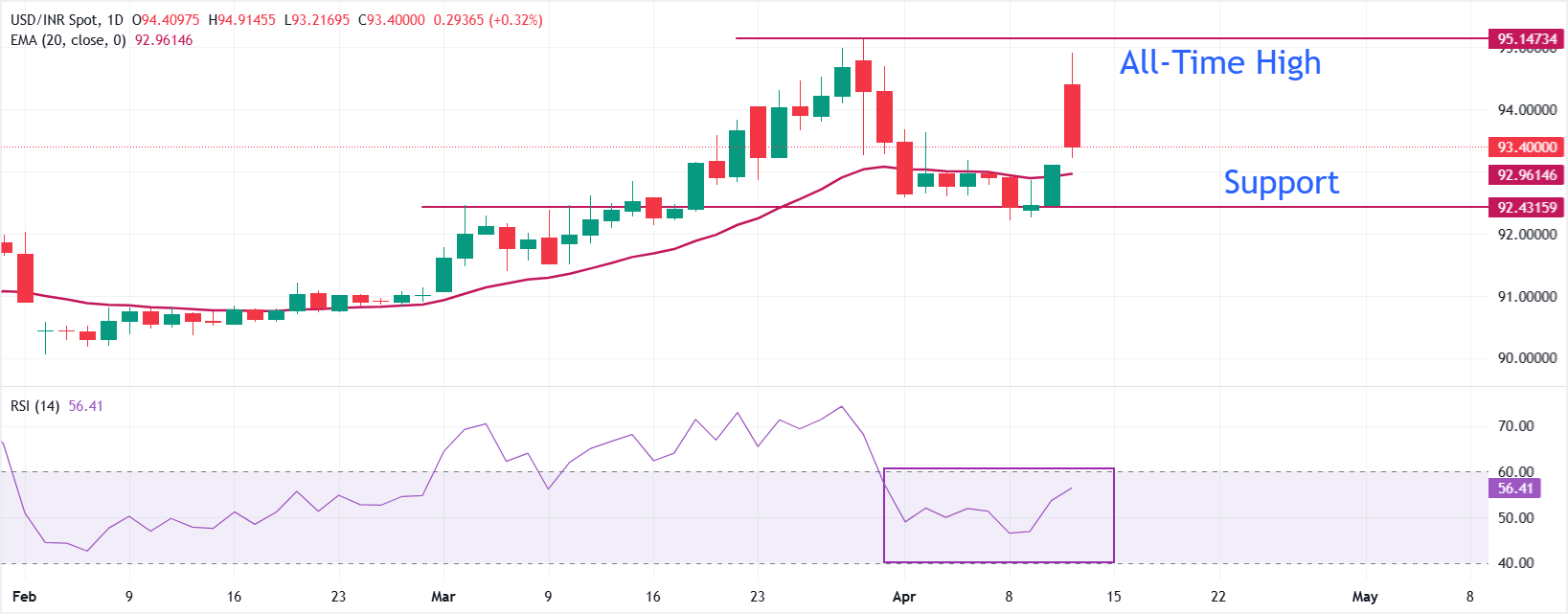
USD/INR trades higher at around 93.40 in the opening trade on Monday. With price returning above its 20-day exponential moving average (EMA), which is at 92.96, the short-term tone of the pair turns bullish, though the lack of nearby mapped resistance levels argues for a more neutral overall bias.
The Relative Strength Index (RSI) at 56.41 sits in neutral territory, suggesting steady rather than aggressive bullish momentum as the spot consolidates after its recent advance.
On the downside, the 20-day EMA at 92.96 is the first meaningful dynamic support, and a daily close back below this area would expose the pair to its key support zone around 92.43. On the topside, the pair could extend its recovery towards 94.00, and might try to reclaim its all-time high of 95.14 after breaking above that level.
(The technical analysis of this story was written with the help of an AI tool.)
Indian Rupee FAQs
The Indian Rupee (INR) is one of the most sensitive currencies to external factors. The price of Crude Oil (the country is highly dependent on imported Oil), the value of the US Dollar – most trade is conducted in USD – and the level of foreign investment, are all influential. Direct intervention by the Reserve Bank of India (RBI) in FX markets to keep the exchange rate stable, as well as the level of interest rates set by the RBI, are further major influencing factors on the Rupee.
The Reserve Bank of India (RBI) actively intervenes in forex markets to maintain a stable exchange rate, to help facilitate trade. In addition, the RBI tries to maintain the inflation rate at its 4% target by adjusting interest rates. Higher interest rates usually strengthen the Rupee. This is due to the role of the ‘carry trade’ in which investors borrow in countries with lower interest rates so as to place their money in countries’ offering relatively higher interest rates and profit from the difference.
Macroeconomic factors that influence the value of the Rupee include inflation, interest rates, the economic growth rate (GDP), the balance of trade, and inflows from foreign investment. A higher growth rate can lead to more overseas investment, pushing up demand for the Rupee. A less negative balance of trade will eventually lead to a stronger Rupee. Higher interest rates, especially real rates (interest rates less inflation) are also positive for the Rupee. A risk-on environment can lead to greater inflows of Foreign Direct and Indirect Investment (FDI and FII), which also benefit the Rupee.
Higher inflation, particularly, if it is comparatively higher than India’s peers, is generally negative for the currency as it reflects devaluation through oversupply. Inflation also increases the cost of exports, leading to more Rupees being sold to purchase foreign imports, which is Rupee-negative. At the same time, higher inflation usually leads to the Reserve Bank of India (RBI) raising interest rates and this can be positive for the Rupee, due to increased demand from international investors. The opposite effect is true of lower inflation.
추천 기사


