

Diverging Fortunes of Auto Giants: BYD Hits Record High, Tesla Halved, Toyota’s P/E at Historic Low

Mitrade
coverImg
Source: DepositPhotos

TradingKey — Technological advancements are reshaping the global automotive landscape, and capital markets are reacting starkly differently to leading automakers across regions. While China’s BYD surges to new highs, Tesla’s stock has halved in three months, and Toyota’s P/E ratio languishes near historic lows.


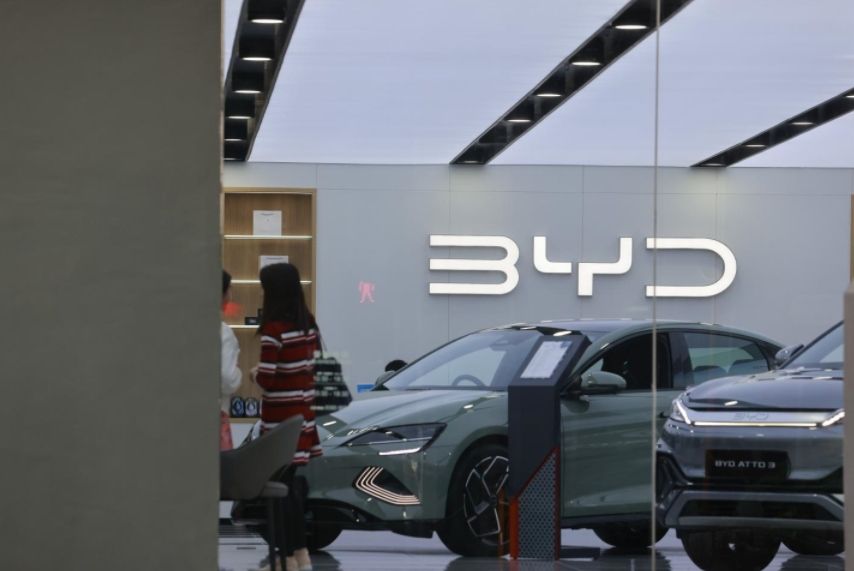
On March 19, BYD's Hong Kong stocks (1211.HK) hit a new all-time high of HK$418.1 during intraday trading and closed up nearly 4% at HK$417.


The rally followed the company’s launch of the world’s first mass-produced "Full-Domain 1000V High-Voltage Architecture"—a next-generation electric vehicle (EV) platform that integrates batteries, motors, power systems, and air conditioning at 1,000 volts, marking the arrival of the "kilovolt era" for EVs.


Morgan Stanley noted that the platform enables a 400 km range with just a 5-minute charge, addressing critical bottlenecks in EV adoption – charging speed and energy density. JPMorgan reiterated its Overweight rating on BYD, with a target price of HK$600.


In contrast, Tesla(TSLA.US), once the undisputed "EV king," is facing severe headwinds. Its stock has plunged roughly 50% over three months, battered by Trump-era tariffs, CEO Elon Musk’s cost-cutting drive, and weakening sales across key markets.


RBC Capital Markets analysts slashed Tesla’s price target, warning that its market share in China could halve to 10%. Mizuho Securities attributed Tesla’s "sales woes" to fading brand appeal in the U.S. and EU, geopolitical tensions, and cutthroat competition in China’s EV sector.

Wall Street observers remarked, "We struggle to think of anything analogous in the history of the automotive industry, in which a brand has lost so much value so quickly."


Meanwhile, Toyota, the world’s top-selling automaker, is also caught in the crossfire. As reported by Nikkei, Toyota’s P/E ratio has sunk to a record low, weighed down by U.S. tariff risks and yen volatility.


The valuation gap underscores the market’s divergent view of tradictional vs. EV players: Tesla trades at a forward P/E of 85x, BYD at 25x, while Toyota languishes at 6.7x—a stark reminder of the tectonic shifts reshaping the auto industry.

Read more

  • Gold Falls Below $4,100, Risks Dropping to $4,000 as High Oil Prices Reinforce Expectations of High Fed Rates
  • WTI drops to near 101.00 as Trump rules out immediate Iranian strikes
  • * The content presented above, whether from a third party or not, is considered as general advice only.  This article should not be construed as containing investment advice, investment recommendations, an offer of or solicitation for any transactions in financial instruments.

    goTop
    quote
    Related Articles
    placeholder
    Fed October Rate Decision Preview: Rate Hike Pause Has Become Consensus, How Will US Stocks, Dollar, and Gold React?The Federal Reserve will announce its October interest rate decision at 14:00 Eastern Time on October 28, and Fed Chair Warsh will hold a press conference at 14:30. Markets currently wide
    Author  TradingKey
    5 hours ago
    The Federal Reserve will announce its October interest rate decision at 14:00 Eastern Time on October 28, and Fed Chair Warsh will hold a press conference at 14:30. Markets currently wide
    placeholder
    Anthropic files for a $2 trillion IPO — the $80.7 billion loss is the decoy, the $450 billion compute bill is the riskAnthropic publicly filed its S-1 on October 26, revealing $16.29 billion of first-half revenue (+1,304% year over year) and a $80.7 billion net loss — of which $72.4 billion is a non-cash convertible-note charge. The real number is the $450 billion of signed, mostly non-cancelable compute commitments. Here is what the filing says, why NVDA, ARM and MU are the tradeable read-through, and the conditions that decide whether the AI trade passes its first public valuation test.
    Author  Irene Q.
    10 hours ago
    Anthropic publicly filed its S-1 on October 26, revealing $16.29 billion of first-half revenue (+1,304% year over year) and a $80.7 billion net loss — of which $72.4 billion is a non-cash convertible-note charge. The real number is the $450 billion of signed, mostly non-cancelable compute commitments. Here is what the filing says, why NVDA, ARM and MU are the tradeable read-through, and the conditions that decide whether the AI trade passes its first public valuation test.
    placeholder
    Tesla jumps 5% as Barclays puts a $450 target on the SpaceX merger — the chart was already pointing to 431Tesla closed at $391.62 on October 26, up 5.21%, after Barclays upgraded the stock to Overweight and lifted its target to $450 from $370, citing a sharp inflection in Robotaxi miles and a potential SpaceX merger. The move also completed a double bottom at $345.88 and $349.33, with a neckline at $388.56 and a measured target of $431.24. Here is what the upgrade actually says, why the chart and the analyst now point the same way, and what would break the target.
    Author  Irene Q.
    10 hours ago
    Tesla closed at $391.62 on October 26, up 5.21%, after Barclays upgraded the stock to Overweight and lifted its target to $450 from $370, citing a sharp inflection in Robotaxi miles and a potential SpaceX merger. The move also completed a double bottom at $345.88 and $349.33, with a neckline at $388.56 and a measured target of $431.24. Here is what the upgrade actually says, why the chart and the analyst now point the same way, and what would break the target.
    placeholder
    Big Tech's $800 billion AI bill faces its first real test — free cash flow is the judgeAlphabet and Microsoft report after the close on October 28, Amazon on October 29, with hyperscaler AI capex running near $800 billion a year. Meta's negative free cash flow and 9.40% drop on October 22 was the warning; this week's prints decide whether cloud growth and backlog can pay for the buildout. Here are the consensus numbers, the free-cash-flow table and the two-sided test.
    Author  Irene Q.
    Yesterday 05: 32
    Alphabet and Microsoft report after the close on October 28, Amazon on October 29, with hyperscaler AI capex running near $800 billion a year. Meta's negative free cash flow and 9.40% drop on October 22 was the warning; this week's prints decide whether cloud growth and backlog can pay for the buildout. Here are the consensus numbers, the free-cash-flow table and the two-sided test.
    placeholder
    Nasdaq closes at 26,008.86 — 8.9 points above 26,000, and the credit market never blinkedThe Nasdaq Composite fell 2.60% to 26,008.86 on October 22, its worst session since June, as Meta sank 6.98% on 2026 capex guidance of $135–145 billion. But the equal-weight S&P 500 rose 0.73%, high-yield credit was flat and 10-year yields fell 20 basis points. This was an AI de-rating, not a risk-off event — here is the transmission chain, the 29,000 / 28,200 levels and what would prove it wrong.
    Author  Irene Q.
    Oct 23, Fri
    The Nasdaq Composite fell 2.60% to 26,008.86 on October 22, its worst session since June, as Meta sank 6.98% on 2026 capex guidance of $135–145 billion. But the equal-weight S&P 500 rose 0.73%, high-yield credit was flat and 10-year yields fell 20 basis points. This was an AI de-rating, not a risk-off event — here is the transmission chain, the 29,000 / 28,200 levels and what would prove it wrong.
    Live Quotes
    Name / SymbolChart% Change / Price
    TSLA
    TSLA
    0.00%0.00

    US Stocks Related Articles

    • 10 Best Day Trading Platforms for Beginners and Active Traders in 2026: A Practical Guide
    • How To Invest in SpaceX Stock in 2026? Everything Investors Need to Know
    • Practice Trading Us Stocks? These Are 10 Best Stock Trading Demo Apps For Beginners
    • ​5 Best Paper Trading Platforms for 2026 (Free Demo Accounts for Beginners & Traders)
    • Wall Street’s Top 10 US Stocks for 2026 vs What Reddit Is Actually Buying
    • Is Mitrade Right for You? A Complete Guide on How to Start Trading CFDs in 5 Steps

    Click to view more