Is a Stock Market Crash Looming? Here's What I'm Doing to Protect My Investments Just in Case.

Mitrade
coverImg
Source: DepositPhotos

While the stock market is still surging right now, investor sentiment may be taking a turn. Around 34% of U.S. investors feel "bearish" about the next six months, according to a weekly survey from the American Association of Individual Investors released in late January. That's up from around 29% the week prior.


While nobody can predict what the market will do, especially in the short term, some metrics suggest that a downturn could be on the horizon.
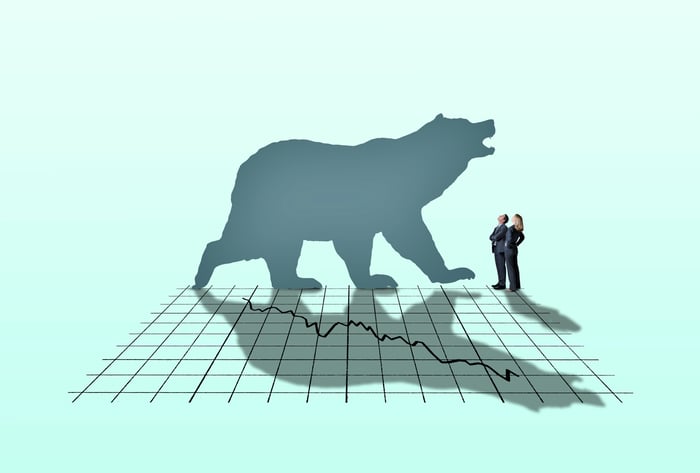

Bear silhouette against a stock market chart.

Image source: Getty Images.


The Buffett Indicator, for example, suggests that a slump could be ahead. This indicator, made famous by Warren Buffett, measures the ratio of the total market capitalization of all publicly traded companies to U.S. gross domestic product (GDP). In 1999, Buffett used this indicator to predict that the market would soon face a steep downturn -- a prediction that came true just a year later when the dot-com bubble burst.


"If the percentage relationship falls to the 70% or 80% area, buying stocks is likely to work very well for you," he explained in an essay published in 2001. "If the ratio approaches 200% -- as it did in 1999 and a part of 2000 -- you are playing with fire."


As of February 2025, the Buffett Indicator has reached 203.51%. While this metric alone doesn't necessarily mean that a crash is coming, it could be wise to start taking precautions just in case. To protect my personal portfolio, there are three things I'm doing right now.


1. I'm stocking up my emergency fund


It's always a good idea to have some cash stashed away for emergencies, but it's extra important when a market downturn could be looming.


If stock prices fall, your portfolio could lose substantial value in the short term. As long as you stay invested, though, you likely won't lose any money. The market will eventually rebound, and your portfolio should regain any value it lost.


However, if you pull your money out of the market after stock prices have dropped, you could end up selling your investments for far less than you paid for them -- potentially locking in steep losses. If you don't have an emergency fund and you face an unexpected expense during a market slump, it's more likely you'll need to tap your investments at a less-than-ideal time.


2. I'm combing through every investment in my portfolio


When the stock market is thriving, sometimes even shaky stocks can perform well. But a market downturn is the ultimate test of a company's fundamentals, and weak businesses will often struggle to survive tough economic times.


The best way to ensure your portfolio pulls through the next bear market is to double-check that every stock you own is still a solid investment. Companies can change over time, so even if one of your stocks was a fantastic buy when you first purchased it, that doesn't necessarily mean it's still a strong choice now.

Stock price alone doesn't necessarily reflect how strong a company is, so it's wise to look at metrics beyond this number -- like the business's price-to-earnings (P/E) ratio and its price/earnings-to-growth (PEG) ratio.


It's equally important to examine big-picture factors, too, like whether a company has a durable competitive advantage that can help it keep up with industry changes. A competent executive team is also critical, as bad leadership can cause even strong companies to struggle.


3. I'm keeping a long-term outlook


The future is uncertain, and that can be incredibly nerve-wracking for investors. If you're feeling scared about what may be in store for the market, that's normal, and you're not alone.


In times like these, looking back at the market's long-term history can be helpful. In the last 25 years alone, the market has faced the dot-com bubble burst (which became one of the longest bear markets in S&P 500 history), the Great Recession, the COVID-19 crash in 2020, and the most recent bear market throughout 2022.


^SPX Chart

^SPX data by YCharts

Despite all of that volatility, though, the S&P 500 is up by more than 300% since 2000. If you'd invested $10,000 in 2000, you'd have nearly $41,000 by today -- even after accounting for all of the severe ups and downs in that time.

As daunting as they are, downturns are a normal part of the stock market's cycle. While you can't avoid them or predict exactly when they'll begin, keeping your focus on the years ahead can make it a little easier to get through them.

Read more

  • Gold Price Forecast: Gold Returns to $4,200 Ahead of US September CPI, Can the Rally Continue?
  • * The content presented above, whether from a third party or not, is considered as general advice only.  This article should not be construed as containing investment advice, investment recommendations, an offer of or solicitation for any transactions in financial instruments.

    goTop
    quote
    Related Articles
    placeholder
    Bank earnings kick off tomorrow with the S&P 500 seven points from a record — what JPMorgan, Goldman, Citi and Wells Fargo must proveQ3 earnings season starts Tuesday with JPMorgan, Goldman Sachs, Citigroup and Wells Fargo reporting before the open — with the S&P 500 just 7 points from its record close, bank stocks down 7.5% over the past month, and September CPI landing the next day. Here are the numbers to watch, the two-sided setup and the levels that matter.
    Author  Irene Q.
    Yesterday 06: 03
    Q3 earnings season starts Tuesday with JPMorgan, Goldman Sachs, Citigroup and Wells Fargo reporting before the open — with the S&P 500 just 7 points from its record close, bank stocks down 7.5% over the past month, and September CPI landing the next day. Here are the numbers to watch, the two-sided setup and the levels that matter.
    placeholder
    Today’s Market Recap: 10-Year Treasury Yield Hits Highest Since 2002,U.S. Stocks Fall as Brent Barely Holds $100Tracking the Market TrendTradingKey - On October 7, U.S. Eastern Time, the 10-year Treasury yield climbed to an intraday high of 5.36%, its highest level since 2002, while all three major U.S. stock i
    Author  TradingKey
    Oct 08, Thu
    Tracking the Market TrendTradingKey - On October 7, U.S. Eastern Time, the 10-year Treasury yield climbed to an intraday high of 5.36%, its highest level since 2002, while all three major U.S. stock i
    placeholder
    Nvidia's $150 billion buyback landed — and the AI sector fell anyway. That's the signal worth tradingNvidia closed up 1.68% at $228.86 on 28 September after announcing a $150 billion share repurchase authorisation, the largest single corporate buyback on record, while the rest of the AI complex sold off: AMD -3.6%, Micron -2.6%, Meta -4.8% and the Philadelphia Semiconductor Index -1.61%. The divergence is not noise. Capital is rotating toward cash-flow certainty, not abandoning the AI theme. With Micron reporting after the close on 30 September, here is what the split means.
    Author  Irene Q.
    Sep 29, Tue
    Nvidia closed up 1.68% at $228.86 on 28 September after announcing a $150 billion share repurchase authorisation, the largest single corporate buyback on record, while the rest of the AI complex sold off: AMD -3.6%, Micron -2.6%, Meta -4.8% and the Philadelphia Semiconductor Index -1.61%. The divergence is not noise. Capital is rotating toward cash-flow certainty, not abandoning the AI theme. With Micron reporting after the close on 30 September, here is what the split means.
    placeholder
    Memory chips surge, Nasdaq notches a second straight record close — why the Dow fell 185 points anywayMicron gained 5%, SanDisk 6.8%, Seagate 4% and Western Digital 3% as the memory complex led the Nasdaq Composite to a second consecutive record close of 27,244.28. But the Dow fell 185 points as JPMorgan, Wells Fargo and Schwab slid more than 3% each — a split tape that says more about positioning than about the economy.
    Author  Irene Q.
    Sep 23, Wed
    Micron gained 5%, SanDisk 6.8%, Seagate 4% and Western Digital 3% as the memory complex led the Nasdaq Composite to a second consecutive record close of 27,244.28. But the Dow fell 185 points as JPMorgan, Wells Fargo and Schwab slid more than 3% each — a split tape that says more about positioning than about the economy.
    placeholder
    Today’s Market Recap: AI Chip Stocks Gain, SanDisk Surges Nearly 11%, Micron Rises Nearly 4%, Bitcoin Reclaims $80,000Tracking Market TrendsTradingKey - On September 18, Eastern Time, U.S. stocks capped off a volatile week with the three major benchmarks closing mixed. Tech and semiconductor stocks extended their reb
    Author  TradingKey
    Sep 21, Mon
    Tracking Market TrendsTradingKey - On September 18, Eastern Time, U.S. stocks capped off a volatile week with the three major benchmarks closing mixed. Tech and semiconductor stocks extended their reb

    US Stocks Related Articles

    • 10 Best Day Trading Platforms for Beginners and Active Traders in 2026: A Practical Guide
    • How To Invest in SpaceX Stock in 2026? Everything Investors Need to Know
    • Practice Trading Us Stocks? These Are 10 Best Stock Trading Demo Apps For Beginners
    • ​5 Best Paper Trading Platforms for 2026 (Free Demo Accounts for Beginners & Traders)
    • Wall Street’s Top 10 US Stocks for 2026 vs What Reddit Is Actually Buying
    • Is Mitrade Right for You? A Complete Guide on How to Start Trading CFDs in 5 Steps

    Click to view more