


Better Artificial Intelligence (AI) Stock: D-Wave Quantum vs. Nvidia
Key Points
D-Wave Quantum and Nvidia are building technology to drive the advancement of artificial intelligence.
D-Wave's quantum computing solutions catapulted Q1 revenue to $15 million, an incredible 509% year-over-year increase.
Nvidia is developing a quantum computing approach similar to how it conquered the market for AI semiconductor chips.
- 10 stocks we like better than Nvidia ›
The artificial intelligence (AI) market presents an excellent investment opportunity given AI's awesome technological potential. After all, AI-related sales propelled Nvidia (NASDAQ: NVDA) to a $4 trillion market cap, making it the first public company to reach that milestone.
D-Wave Quantum (NYSE: QBTS) could one day be a challenger to Nvidia. It's developing quantum computing technology that promises to supercharge AI using the power of quantum physics.
Where to invest $1,000 right now? Our analyst team just revealed what they believe are the 10 best stocks to buy right now. Continue »
One of these tech innovators may be a fabulous stock investment over the long haul. But which one looks like the better choice?

Image source: Getty Images.
A look into D-Wave Quantum
D-Wave has constructed quantum computers capable of solving complex problems in minutes that would take today's supercomputers 1 million years to complete. This powerful tech could elevate AI to new heights, such as its application in identifying individuals developing diabetes-induced blindness.
D-Wave shares took off this year, rising over 75% through the week ending July 11. The jump was driven by a 509% year-over-year increase in first-quarter revenue to $15 million.
This sum was a record for D-Wave, and, in fact, exceeded the $8.8 million in total sales made in all of 2024. The huge growth was due to the company selling one of its quantum computers for the first time. Typically, it makes the bulk of its income from fees for access to its quantum systems via the cloud.
At the end of Q1, D-Wave had 133 customers compared to 128 last year, including a dozen government clients. It's encouraging to see customer growth. However, the company isn't profitable. Its Q1 net loss totaled $5.4 million.
Nvidia and the future of AI
Nvidia is recognized as a leader in AI thanks to its powerful graphics processing units (GPUs). GPUs help to power AI supercomputers around the world, which includes one being built for the U.S. Department of Energy to drive breakthroughs in fusion energy, materials manufacturing, and other scientific areas.
This is just the start of the widespread technological transformation that is to come. According to Nvidia CEO Jensen Huang in a June statement, "We are entering a new industrial era -- one defined by the ability to generate intelligence at scale." He sees organizations updating their tech infrastructure to support AI, and that means more GPU sales for Nvidia.
To date, those sales have been spectacular. In its fiscal first quarter, ended April 27, revenue reached $44.1 billion, a jump of 69% over the prior year's $26 billion. That performance followed fiscal 2025's record revenue of $130.5 billion, which represented 114% year-over-year growth.
The company is also profitable with fiscal Q1 net income of $14.9 billion, a 628% year-over-year increase. Nvidia's success is poised to continue. Recognizing the potential of quantum computers, the company is developing quantum processing units (QPUs).
QPUs will work alongside Nvidia's GPUs to mitigate key limitations of quantum computers. Quantum machines are error-prone due to their reliance on atomic particles sensitive to the slightest disruption, such as a small bump in temperature. The company's GPUs can enable fixing errors as they come up, boosting the utility of quantum computers while reducing error correction costs.
Weighing whether to invest in D-Wave or Nvidia stock
Both D-Wave and Nvidia have assembled impressive technology. But technological prowess isn't the only factor to consider. One key component is share price valuation.
This can be assessed by looking at the price-to-sales (P/S) ratio for each company, a metric commonly used for unprofitable businesses such as D-Wave.
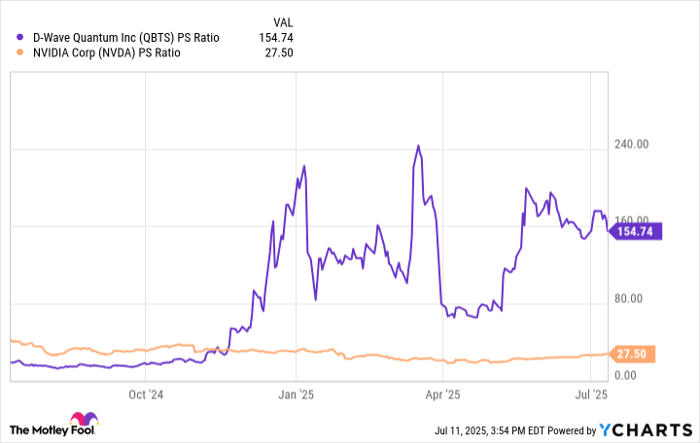
Data by YCharts.
The chart reveals D-Wave's P/S multiple is sky-high compared to where it was a year ago, and far above Nvidia's. This suggests D-Wave shares are overpriced, so now is not a good time to buy.
On top of that, while AI's evolution through quantum computing sounds exciting, the reality is that this could take years. Some industry forecasts estimate a fully scalable quantum computer may not happen until after 2040.
Over that time, any number of companies could take the lead in quantum computing. Tech giants with deep pockets, such as Microsoft, are working on their own solutions.
Against this backdrop, Nvidia's strategy of combining QPUs and GPUs offers a low-risk transition into quantum computing. It gives businesses investing in the space the flexibility to add Nvidia's QPUs to their quantum machines, much like how they incorporated GPUs into their current AI systems. These factors make Nvidia the better AI stock pick over D-Wave.
Should you invest $1,000 in Nvidia right now?
Before you buy stock in Nvidia, consider this:
The Motley Fool Stock Advisor analyst team just identified what they believe are the 10 best stocks for investors to buy now… and Nvidia wasn’t one of them. The 10 stocks that made the cut could produce monster returns in the coming years.
Consider when Netflix made this list on December 17, 2004... if you invested $1,000 at the time of our recommendation, you’d have $679,653!* Or when Nvidia made this list on April 15, 2005... if you invested $1,000 at the time of our recommendation, you’d have $1,046,308!*
Now, it’s worth noting Stock Advisor’s total average return is 1,060% — a market-crushing outperformance compared to 179% for the S&P 500. Don’t miss out on the latest top 10 list, available when you join Stock Advisor.
See the 10 stocks »
*Stock Advisor returns as of July 15, 2025
Robert Izquierdo has positions in Microsoft and Nvidia. The Motley Fool has positions in and recommends Microsoft and Nvidia. The Motley Fool recommends the following options: long January 2026 $395 calls on Microsoft and short January 2026 $405 calls on Microsoft. The Motley Fool has a disclosure policy.
Recommended Articles


