




Should You Buy Serve Robotics Stock After Its 55% Crash? This Recent Move by Nvidia Might Hold the Answer.
Nvidia supplies the world's most advanced artificial intelligence (AI) chips for data centers, but it also has a growing portfolio of other AI solutions. For example, Serve Robotics (NASDAQ: SERV) uses Nvidia's Jetson Orin hardware and software platform in its flagship Gen3 robots, giving them the capability to autonomously deliver food orders on behalf of platforms like Uber Technologies' Uber Eats.
Nvidia used to be one of the largest shareholders in Serve Robotics until it sold its entire stake during the final quarter of 2024. It's not clear why Nvidia exited the position, but Serve stock is down by almost 30% in 2025, and by 55% from its all-time high. It seems the chip giant has excellent timing.
Where to invest $1,000 right now? Our analyst team just revealed what they believe are the 10 best stocks to buy right now. Continue »
But Serve is on track to deploy 2,000 Gen3 robots this year under a major deal with Uber Eats, and Wall Street thinks it will lead to significant revenue growth. Should investors buy Serve stock while it's down, or should they sit on the sidelines with Nvidia?
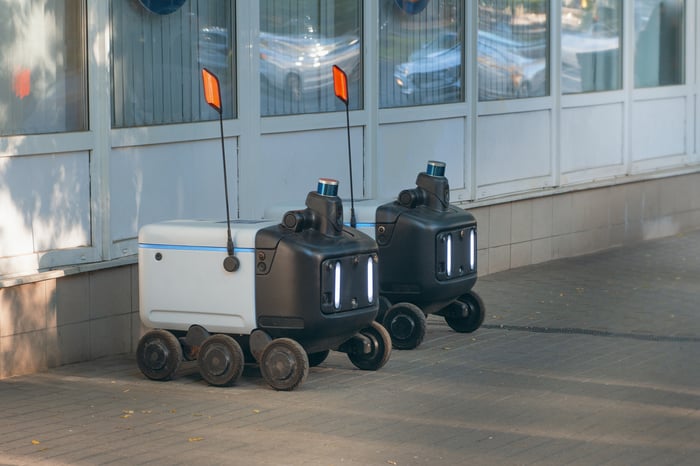
Image source: Getty Images.
Transforming last-mile logistics
Serve believes existing last-mile logistics solutions are inefficient, because they rely on cars with human drivers to deliver small food orders. The company is betting these deliveries will be handled by autonomous robots and drones in the future, creating a potential $450 billion market opportunity by 2030.
Serve's robots have achieved Level 4 autonomy, which means they can drive on sidewalks within designated areas without any human intervention. These robots have completed over 100,000 deliveries on behalf of restaurants primarily in Los Angeles since the start of 2022, with 99.8% accuracy, which makes them significantly more reliable than human delivery drivers.
Serve's latest Gen3 robot offers vast improvements in computing power (thanks to Nvidia's Jetson Orin systems), speed, range, and battery life compared to previous versions. It is also up to 65% cheaper to manufacture thanks to Serve's partnership with Magna International, which is a $14.5 billion producer of parts and components for the automotive industry. Serve is aiming to charge $1 per delivery across the board in all markets, and robots with greater capabilities combined with cheaper manufacturing costs will bring the company a step closer.
As I mentioned earlier, Serve is working to deploy 2,000 Gen3 robots this year under its deal with Uber Eats. The company launched 250 during the first quarter of 2025, with 700 more expected by the end of the third quarter, and the remainder to come during the fourth quarter. The new robots have already enabled Serve to expand into Miami and Dallas, with Atlanta to follow during the current quarter.
Revenue is forecast to soar, but losses are mounting
Serve generated just $440,465 in revenue during the first quarter of 2025, which was a 53% drop compared to the year-ago quarter -- but that prior result was inflated by a one-off software licensing fee Magna paid the company to use some of its technology.
Serve's first-quarter revenue was actually a 150% increase compared to the fourth quarter of 2024 three months earlier, which is a better indication of how quickly its delivery business is ramping up. In fact, Wall Street's consensus estimate (provided by Yahoo! Finance) suggests the company could generate $6.8 million in revenue for the whole of 2025, which means there could be massive growth over the next three quarters as more robots are deployed.
But Serve has a big issue. It lost $13.2 million on the bottom line during the first quarter, which puts the company on track to exceed its record annual loss of $39.2 million from last year. Building autonomous technologies isn't cheap -- Serve's biggest cost is research and development, which regularly accounts for half of the company's total operating expenses, and that probably won't change anytime soon.
Therefore, even if Serve generates $6.8 million in revenue during 2025, it won't be anywhere near enough to prevent another gigantic net loss. The company had $197.7 million in cash on its balance sheet at the end of the first quarter, so it can afford to sustain its current losses for the next couple of years. However, management will eventually have to turn its focus toward profitability; otherwise, it will have to raise more money from investors, which will significantly dilute existing shareholders.
Serve stock is very expensive, but is it a buy?
Based on Serve's trailing-12-month revenue of $1.3 million and its market capitalization of $599 million, its stock trades at an eye-popping price-to-sales (P/S) ratio of 460. That means it's a staggering 18 times more expensive than Nvidia stock, which trades at a P/S ratio of just 26.
I don't think Serve deserves to be trading at such a steep premium to one of the world's highest-quality companies, which has cemented a leadership position in AI and has a track record of success that spans decades.
With that said, Serve's valuation does look more reasonable if you measure it based on its future revenue, using Wall Street's forecasts. If you assume the company will generate $6.8 million in revenue this year, that means its stock is trading at a forward P/S ratio of 88. Moreover, if you assume Serve will deliver $57.8 million in revenue during 2026 as Wall Street expects, then its stock trades at a forward P/S ratio of just 10.3 based on that result.
However, there is absolutely no guarantee that Serve will meet Wall Street's estimates, so investors who buy the stock today are taking a very big leap of faith. Plus, even though we don't know exactly why Nvidia sold its 3.7 million shares in Serve (which would be worth $39 million at the current price), it does take some of the shine away from the investment case.
On the flip side, if investors think Serve will capture a significant portion of its estimated $450 billion addressable market by 2030, then its current stock price is probably a bargain. But it's important to keep the substantial risks in mind when buying into this story.
Should you invest $1,000 in Serve Robotics right now?
Before you buy stock in Serve Robotics, consider this:
The Motley Fool Stock Advisor analyst team just identified what they believe are the 10 best stocks for investors to buy now… and Serve Robotics wasn’t one of them. The 10 stocks that made the cut could produce monster returns in the coming years.
Consider when Netflix made this list on December 17, 2004... if you invested $1,000 at the time of our recommendation, you’d have $642,582!* Or when Nvidia made this list on April 15, 2005... if you invested $1,000 at the time of our recommendation, you’d have $829,879!*
Now, it’s worth noting Stock Advisor’s total average return is 975% — a market-crushing outperformance compared to 172% for the S&P 500. Don’t miss out on the latest top 10 list, available when you join Stock Advisor.
See the 10 stocks »
*Stock Advisor returns as of May 19, 2025
Anthony Di Pizio has no position in any of the stocks mentioned. The Motley Fool has positions in and recommends Nvidia, Serve Robotics, and Uber Technologies. The Motley Fool recommends Magna International. The Motley Fool has a disclosure policy.
Recommended Articles


