


Nvidia Stock Just Did This for the First Time in 3 Years. Here's What History Says Will Happen Next
Nvidia (NASDAQ: NVDA) amazed investors over the past few years, climbing with what seemed like nonstop momentum to reach record levels. The stock even soared beyond $1,000 last year before the company launched its stock split, a move to lower the per-share price. All of this is thanks to Nvidia's position in one of today's most-watched markets: artificial intelligence (AI).
Analysts expect this market to explode higher throughout the decade, and developments we've seen so far support this idea. Tech giants are investing billions of dollars in their AI programs -- and many already are starting to see the efforts bear fruit. For example, Amazon's cloud computing arm last year posted a $115 billion revenue run rate as customers opted for its AI products and services.
Where to invest $1,000 right now? Our analyst team just revealed what they believe are the 10 best stocks to buy right now. Learn More »
All of this has helped Nvidia's earnings to climb. The share price followed until recently, as concerns about the general economy outweighed optimism about Nvidia's financial results and future prospects. In fact, just last week, Nvidia stock did something it hasn't done for nearly three years. Let's take a look at this move, and consider what history says will happen next.

Image source: Getty Images.
Nvidia's "death cross"
Whether you're new to investing or have been buying stocks for years, you may have heard of technical analysis. It involves looking at historical market data to predict what a stock may do next. It's often associated with shorter-term investing as it could guide you to buy or sell at a specific moment to potentially benefit. Well, in the world of technical analysis, Nvidia stock just made a big move. Its 50-day moving average (an average price trend over a given period of time) last week passed below its 200-day moving average, forming what's known as a "death cross."
And a death cross suggests negative momentum is picking up and that it could become a lasting trend. Now let's consider how Nvidia stock performed following its last death cross -- back in April of 2022. The measure was an accurate predictor of what was to come, as Nvidia stock sank about 45% from that point through the rest of the year.

NVDA 50-Day Simple Moving Average data by YCharts
Another such move happened in November 2018, and Nvidia stock went on to drop more than 40% in the following nine months.
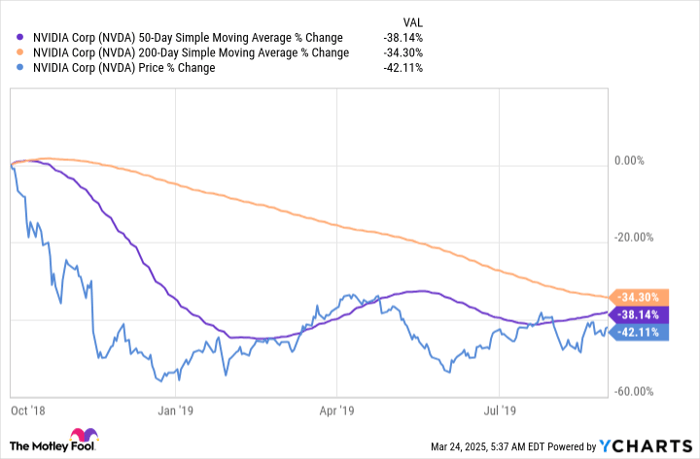
NVDA 50-Day Simple Moving Average data by YCharts
So, does this mean Nvidia absolutely is heading for a sustained period of losses and that you should stay away from the stock? Not necessarily. It's important to remember that though technical analysis may on many occasions successfully detect short-term trends, it doesn't take into account fundamentals -- such as a great earnings track record -- or positive news that the company may report at any moment. Day traders find these patterns useful as they buy and sell in a matter of hours or days, but long-term investors shouldn't let a technical trend affect their investing decisions -- for two key reasons.
The true value of a company
First, as mentioned, technical analysis doesn't consider the true value of a company as measured by its fundamentals. It basically indicates when you might buy or sell in the near term to post a gain. But, to potentially score an even bigger win, you're better off betting on a quality stock for a number of years so that you can benefit as the company grows and develops in its market.
Second, sentiment about a given stock -- in this case, Nvidia -- may shift overnight. At any point, if a key external element that's weighing on Nvidia changes, the stock could take off. For example, if the Trump administration loosens up the latest tariffs on imports or reaches an agreement with trade partners, that news may lift Nvidia shares. So, for the long-term investor, it's best to buy a stock when the valuation looks reasonable rather than attempting to wait for the very lowest level.
It's very difficult to time the market, and if you try, you may miss out on opportunities (and spend way too much time starting at your computer screen). It's important to note that Nvidia went on to roar higher after past death cross periods -- more than 85% in the 18 months following the 2022 death cross and about 140% in the two years following the 2018 event.
Why Nvidia could win
All of this means it's best to set aside concerns about potential short-term patterns and focus on a company's prospects over the coming years. In this case, Nvidia offers us plenty of reasons to be enthusiastic about what's to come.
The company is the AI chip leader, and its focus on innovation should keep this going. And Nvidia's not only generating standout revenue, but it's also doing this at a high level of profitability -- with gross margin of more than 70% each quarter. Considering these points, trading for 25 times forward earnings estimates down from 50 earlier this year, Nvidia stock looks very reasonably priced today.
So, even if history suggests Nvidia's negative momentum could continue, savvy investors may use this as an opportunity to get in on the stock for a good price -- then hold on and potentially win over the long term.
Don’t miss this second chance at a potentially lucrative opportunity
Ever feel like you missed the boat in buying the most successful stocks? Then you’ll want to hear this.
On rare occasions, our expert team of analysts issues a “Double Down” stock recommendation for companies that they think are about to pop. If you’re worried you’ve already missed your chance to invest, now is the best time to buy before it’s too late. And the numbers speak for themselves:
- Nvidia: if you invested $1,000 when we doubled down in 2009, you’d have $305,226!*
- Apple: if you invested $1,000 when we doubled down in 2008, you’d have $41,382!*
- Netflix: if you invested $1,000 when we doubled down in 2004, you’d have $517,876!*
Right now, we’re issuing “Double Down” alerts for three incredible companies, and there may not be another chance like this anytime soon.
Continue »
*Stock Advisor returns as of March 24, 2025
John Mackey, former CEO of Whole Foods Market, an Amazon subsidiary, is a member of The Motley Fool's board of directors. Adria Cimino has positions in Amazon. The Motley Fool has positions in and recommends Amazon and Nvidia. The Motley Fool has a disclosure policy.
Recommended Articles


