


Tesla Volatility Intensifies as Breakout Above $415 May Trigger Trend Reversal
TradingKey - Tesla (TSLA) shares have recently remained in range-bound consolidation amid sharp volatility. On Wednesday, TSLA fell to an intraday low of $357.64 before recovering most of its losses to close at $380.14, down 1.18%. The daily candlestick left a long lower shadow, indicating buying support near $360, although overhead selling pressure has yet to abate.
Over the past several months, Tesla's stock price rebounded from around $300 in late July to near $410 before entering a high-level consolidation. The current price sits near the midpoint of this rebound range, with bulls and bears repeatedly battling around $380.
Although the company has lagged the broader market year to date, mounting speculation regarding a potential merger with SpaceX has provided a fresh event-driven catalyst for the stock.
Elon Musk previously noted during a SpaceX third-quarter earnings call that housing artificial intelligence, robotics, electric vehicles, satellite communications, and aerospace within a single entity has certain appeal. Subsequently, both companies confirmed the formation of special committees to evaluate options for deepening their partnership, which could potentially include a business combination.
Regulatory filings from SpaceX stated that its special committee has not made a decision on a potential transaction, with no guarantee that an agreement will ultimately be reached. Tesla's filings similarly emphasized that any transaction would require a recommendation from its special committee and, if necessary, shareholder approval.
According to reports, the two companies have selected five directors to participate in negotiations: SpaceX is represented by Roelof Botha and Randy Glein, while Tesla is represented by Robyn Denholm, Kathleen Wilson-Thompson, and Jack Hartung. Advisors are currently evaluating a potential all-stock transaction that could value the combined enterprise at approximately $3.5 trillion.
Walter Isaacson, Elon Musk's biographer, publicly stated that the rationale for keeping the two companies separate over the long term is diminishing. This commentary, combined with the formation of the special committees, prompted prediction markets to rapidly price in higher odds of a deal.
Kalshi data showed that the probability of SpaceX and Tesla announcing a merger before March 2027 surged from 27% to 62%, reaching 67% as of November 24. Meanwhile, Polymarket traders estimated an 89% probability of the two companies announcing a merger by the end of 2027.
From an operational perspective, a merger does present strategic synergies. SpaceX is expanding its satellite communications, space launches, AI computing power, and orbital data centers, while Tesla possesses capabilities in energy storage, solar power, autonomous driving, robotics, and chip development. If combined, Tesla's energy storage systems, Optimus humanoid robots, and AI training technologies could be deployed across SpaceX's terrestrial and space infrastructure, and the two companies could consolidate certain R&D expenditures, procurement systems, and back-office costs.
However, a potential multi-trillion-dollar merger would inevitably involve complex issues of value distribution. If SpaceX were to acquire Tesla in an all-stock deal offering a 20% to 33% premium to Tesla shareholders, Tesla's stock price might receive a short-term boost; however, SpaceX would need to issue a massive amount of new shares, subjecting existing shareholders to substantial dilution.
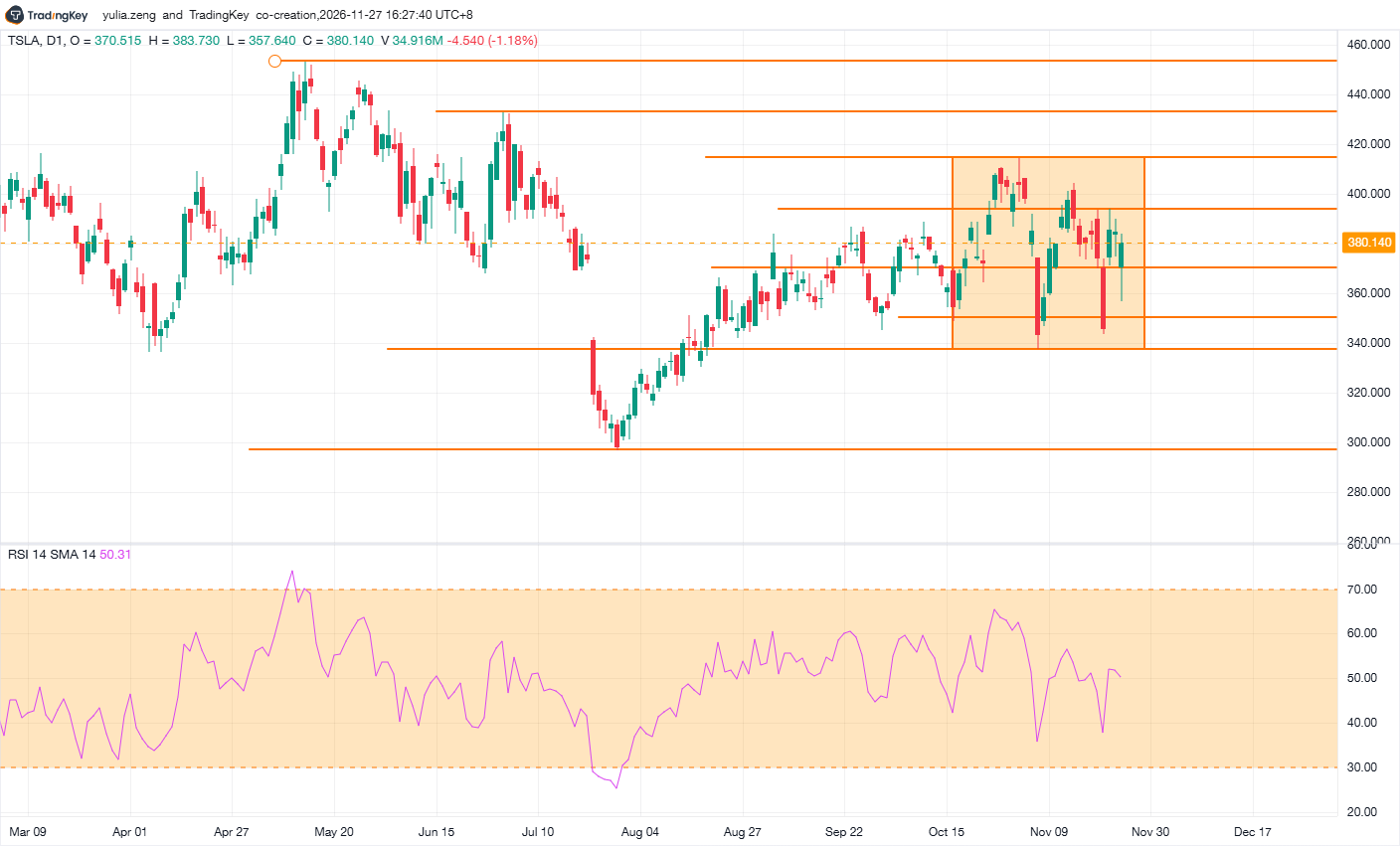
Source: TradingKey
From a daily chart perspective, Tesla remains within a broad trading range of approximately $340 to $415. TradingKey SmartPicks data and analytics show that Tesla's Volume indicator score reached 93.2, reflecting elevated recent trading activity in TSLA. During the latest session, the stock fell to an intraday low of $357.64 before rebounding to $380.14, leaving a pronounced lower shadow on the daily candlestick that indicates buying support near $360, though not yet enough to confirm a new uptrend.
The current $380 level sits near the midpoint of the range and serves as a short-term dividing line between bulls and bears. If the stock can hold above this level, immediate overhead resistance lies in the $394 to $400 zone; a decisive breakout above $415 would signal an upside breakout from the range, with subsequent targets sequentially at $433 and $450 to $453.
On the downside, $370 serves as the primary support; a break below it could lead to another test of the range's lower boundary at $350 to $340. If $340 is decisively broken, the consolidation structure will weaken, potentially triggering a decline toward $320 or even a retest of the $300 area.
Recommended Articles


