


Semiconductor Sales Will Soar to $2.6 Trillion in 2027. Buy This Top Stock Before It Skyrockets Next Year
Key Points
Lam Research gets a nice chunk of its business from sales of memory manufacturing equipment.
The company is well-positioned to capitalize on the growing investments in memory manufacturing equipment.
Lam stock can be bought at an attractive valuation right now, and analysts expect it to deliver healthy upside in 2027.
- 10 stocks we like better than Lam Research ›
Though semiconductor stocks have taken a beating lately, a closer look at the financial performance of companies in this sector clearly indicates that the sell-off isn't justified.
The semiconductor industry's revenue has been growing at an impressive pace, driven by rising demand for chips used in artificial intelligence (AI) applications, especially in data centers. This explains why the semiconductor industry's revenue in 2026 is anticipated to increase by 111% to $1.8 trillion, according to semiconductor intelligence provider TechInsights.
Missed AI’s "Act 1"? Act 2 Could Be 15x Bigger. Most investors think they missed the AI boat because they didn't buy Nvidia in 2005. But according to our analysts, we’re only at the end of "Act 1"—the R&D phase. "Act 2" is the global rollout. Continue »
What's more, TechInsights predicts that the industry's revenue will soar to $2.6 trillion next year. That's why now is a good time to take a closer look at a top semiconductor stock while it trades at an attractive valuation -- Lam Research (NASDAQ:LRCX) -- before it steps on the gas next year.

Image source: Getty Images.
Memory will account for the largest chunk of semiconductor revenue next year
TechInsights estimates that the memory market's revenue could hit $1.6 trillion next year, accounting for 61% of the overall semiconductor market. The firm adds that the memory market could clock higher revenue next year if there are no supply constraints.
Not surprisingly, memory manufacturers are ramping up capital expenditures. Micron Technology, for instance, is estimating $25 billion in capex for the first half of fiscal 2027, followed by higher spending in the second half. Micron spent $27.4 billion on capex in fiscal 2026, suggesting its spending could double this year.
Given that memory supply conditions are expected to tighten in 2027 and 2028, according to Micron, and other memory manufacturers expect the shortage to last until 2030, I won't be surprised to see memory capex jump higher in the coming years. This is great news for Lam Research, a semiconductor equipment company that's benefiting from the memory shortage.
Lam Research's revenue in the first quarter of fiscal 2027 shot up by 54% from the year-ago period. The company reported non-GAAP earnings per share (EPS) of $2.20, up 75% from the year-ago period. Investors should note that Lam Research gets 46% of its revenue from sales of memory manufacturing equipment, which explains the impressive growth in revenue and earnings. Specifically, Lam's revenue from sales of memory equipment increased by 120% year over year in the previous quarter.
Even better, Lam's growth is poised to accelerate in the current quarter. The company's $8.6 billion revenue estimate for the current quarter implies a 61% increase over the year-ago period. The adjusted EPS estimate of $2.33 would be an 83% improvement from the same quarter last year. As investments in memory manufacturing equipment increase in 2027 and beyond, Lam should be able to sustain its solid growth rate.
Analysts are forecasting a 66% increase in its EPS in the current fiscal year (which ends in June next year). They are expecting healthy double-digit growth over the next two fiscal years as well, though don't be surprised to see it outperform those expectations due to the tight memory supply, which will encourage manufacturers to invest in more capital equipment.
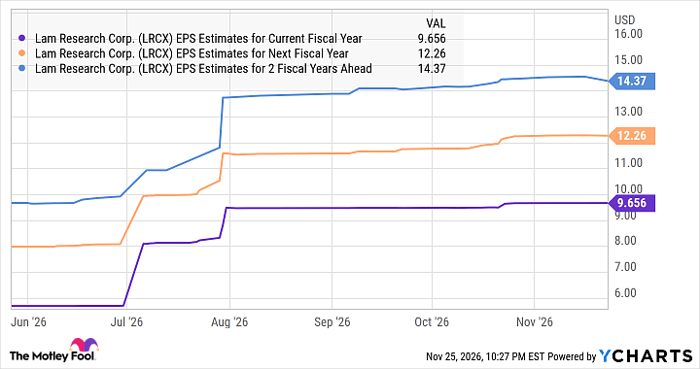
LRCX EPS Estimates for Current Fiscal Year data by YCharts
In fact, Lam estimates that spending on wafer and fabrication equipment (WFE) could increase from the mid-$150 billion range this year to more than $200 billion in 2027. That implies a potential increase of almost 30%.
Lam management noted on the recent earnings call that it has been gaining market share in the WFE space and sees opportunities for further share gains. So, there is a strong likelihood that Lam's growth will outpace analysts' expectations in 2027 and beyond.
Lam Research's valuation and upside potential make the stock a buy right now
Lam Research stock has lost 53% of its value since the beginning of July. The stock trades at just 19 times forward earnings, only a slight premium to the S&P 500 index's forward earnings multiple of 18.
We have already seen that Lam's EPS is on track to increase by 66% this year, well above the 34% growth that S&P 500 companies are expected to deliver. Analysts expect Lam to outperform the S&P 500's earnings growth next year as well. So, it is easy to see why this semiconductor stock is expected to soar by 89% over the coming year, based on the 12-month median price target of $350, according to CNN.
All this indicates that Lam Research is an AI stock worth buying hand over fist following its recent pullback, as it could step on the gas in 2027 amid strong semiconductor sales.
Should you buy stock in Lam Research right now?
Before you buy stock in Lam Research, consider this:
The Motley Fool Stock Advisor analyst team just identified what they believe are the 10 best stocks for investors to buy now… and Lam Research wasn’t one of them. The 10 stocks that made the cut could produce monster returns in the coming years.
Consider when Netflix made this list on December 17, 2004... if you invested $1,000 at the time of our recommendation, you’d have $320,394!* Or when Nvidia made this list on April 15, 2005... if you invested $1,000 at the time of our recommendation, you’d have $917,381!*
Now, it’s worth noting Stock Advisor’s total average return is 776% — a market-crushing outperformance compared to 199% for the S&P 500. Don't miss the latest top 10 list, available with Stock Advisor, and join an investing community built by individual investors for individual investors.
See the 10 stocks »
*Stock Advisor returns as of November 26, 2026.
Harsh Chauhan has no position in any of the stocks mentioned. The Motley Fool has positions in and recommends Lam Research and Micron Technology. The Motley Fool has a disclosure policy.
Recommended Articles


