


Bitcoin ETFs Just Posted Their Best Month of 2026. Is the Bitcoin Rally Here to Stay?
Key Points
Bitcoin has struggled for much of the year, as investors worried about blockchain technology and the Iran war.
However, the world's largest cryptocurrency has spiked recently, due to a massive short squeeze and some developments in the bond market.
Analysts are becoming more bullish, but it's still hard to predict the near-term future for a volatile asset like Bitcoin.
- 10 stocks we like better than Bitcoin ›
If there's one thing that remains consistent about cryptocurrencies, it's that the digital assets remain wildly inconsistent.
With Bitcoin (CRYPTO:BTC), the largest cryptocurrency in the world, coming off its best month of the year in August and its highest monthly gain (~25%) since November 2024, Bitcoin exchange-traded funds (ETFs) also just posted their best month of the year.
Missed Nvidia in 2009? This Rare Signal Is Flashing Again. In 2009, a "Double Down" signal flashed for a little-known chipmaker called Nvidia. For the first time in years, that same "Total Conviction" signal is flashing for a company 1/100th the size of Nvidia. Continue »
According to SoSoValue data reported by CoinTelegraph, Bitcoin ETFs saw over $3.5 billion in net inflows in August, up from just $172 million in July.
Is the Bitcoin rally here to stay?

Image source: Getty Images.
Why Bitcoin struggled this year
As of this writing, Bitcoin traded around $77,250 per token after briefly dipping below $60,000 at the very start of July.
Following President Donald Trump's election victory in late 2024, Bitcoin and most of the crypto sector surged, as Trump was the first President to be a strong advocate for crypto, saying he wanted to make the U.S. the crypto capital of the world.
Trump implemented numerous executive orders, including the creation of a U.S. Strategic Bitcoin Reserve and making it easier for people to invest their retirement assets in alternative assets, such as crypto.
Furthermore, Congress passed the GENIUS Act, which creates a regulatory framework for stablecoins. There is also still hope that Congress may eventually pass the Clarity Act, a proposed regulatory framework that would better define cryptocurrencies and blockchain.
But this year, Bitcoin and the rest of the crypto sector lost steam for several reasons.
There seemed to be concerns that new technologies, such as quantum computing and artificial intelligence, could penetrate crypto encryption. I think this siphoned some of the retail enthusiasm away from the crypto sector.
Furthermore, long-term Bitcoin whales that held substantial Bitcoin began taking profits. Additionally, the Iran war and higher inflation expectations, which led to higher bond yields, also seemed to impact Bitcoin, due to risk-off sentiment.
There has always been a push-and-pull dynamic for Bitcoin between being a risk asset and a potential inflation hedge, due to its finite supply of 21 million tokens, which allegedly makes it a form of digital Gold.
This theory has not panned out this year, although it's worth noting that Gold also struggled for much of the Iran war but has bounced back over the past month, similar to Bitcoin.
It's possible that both assets rose too far too fast in the near term.
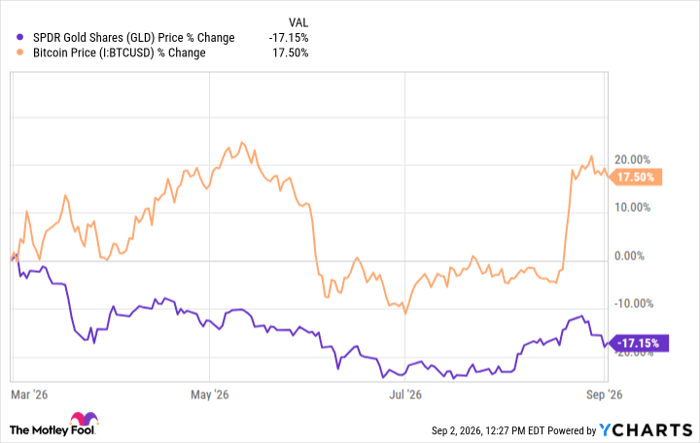
GLD data by YCharts
Only recently has Bitcoin rebounded due to a short squeeze and the U.S. Treasury's plan to increase bond repurchases.
Is the rally here to stay?
As the past year has demonstrated, making a near-term prediction about Bitcoin is likely to prove fruitless. Digital assets are even more volatile than stocks.
Analysts have grown bullish, predicting that the crypto winter may indeed be over. Again, I wouldn't put much stock into these calls.
I do think long-term investors can continue to have exposure to Bitcoin or Bitcoin ETFs, although I would avoid levered ETFs.
The most bullish development for Bitcoin is that it has shown a correlation with Gold since the Iran war began. No one disputes Gold as an inflation hedge, so if the price of Bitcoin is moving similarly, there's still a chance Bitcoin will be a form of digital Gold in the long term.
If this theory holds up, then Bitcoin is certainly a good long-term buy.
Should you buy stock in Bitcoin right now?
Before you buy stock in Bitcoin, consider this:
The Motley Fool Stock Advisor analyst team just identified what they believe are the 10 best stocks for investors to buy now… and Bitcoin wasn’t one of them. The 10 stocks that made the cut could produce monster returns in the coming years.
Consider when Netflix made this list on December 17, 2004... if you invested $1,000 at the time of our recommendation, you’d have $435,803!* Or when Nvidia made this list on April 15, 2005... if you invested $1,000 at the time of our recommendation, you’d have $1,334,577!*
Now, it’s worth noting Stock Advisor’s total average return is 966% — a market-crushing outperformance compared to 211% for the S&P 500. Don't miss the latest top 10 list, available with Stock Advisor, and join an investing community built by individual investors for individual investors.
See the 10 stocks »
*Stock Advisor returns as of September 2, 2026.
Bram Berkowitz has positions in Bitcoin. The Motley Fool has positions in and recommends Bitcoin. The Motley Fool has a disclosure policy.
Recommended Articles


