


Boeing Delivered 64 Jets in June. Here's What That Means for Future Free Cash Flow.
Key Points
While not a game changer, Boeing's ability to ramp up deliveries shows progress.
The company saw positive free cash flow in the second half of 2025
The aerospace company said it plans to produce 42 to 47 jets a month.
- 10 stocks we like better than Boeing ›
Boeing (NYSE: BA) delivered 64 jets in June, four more jets than it delivered in May and the same month last year. The number is part of the company's 314 jet deliveries in the first half of 2026. Its commercial delivery performance is a good sign of its financial recovery. Pushing out this volume of airline jets has a massive, direct impact on the company's free cash flow (FCF) trajectory.
While Boeing's overall operating margin remains lean (only 18.1% in the first quarter) as it navigates program overruns and defense drags, deliveries are the raw fuel for its balance sheet. A strong June demonstrates the manufacturing discipline required to chip away at its post-pandemic debt and secure sustainable, positive FCF.
Missed Nvidia in 2009? This Rare Signal Is Flashing Again. In 2009, a "Double Down" signal flashed for a little-known chipmaker called Nvidia. For the first time in years, that same "Total Conviction" signal is flashing for a company 1/100th the size of Nvidia. Continue »
Here is a breakdown of what these delivery numbers mean for Boeing's cash position moving forward.
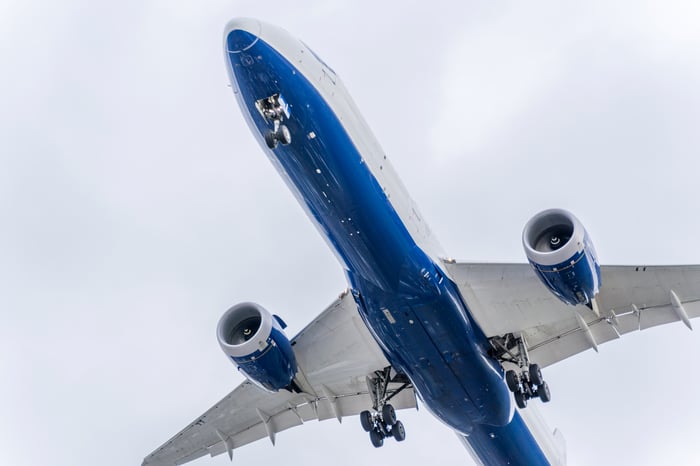
Image source: Getty Images.
Boeing is unlocking sunk inventory
The cash flow cycle is highly back-end loaded in aerospace manufacturing. Predelivery payments are generally around 30% of the purchase price, so manufacturers pay for much of the parts, labor, and supply chain overhead long before the plane leaves the tarmac. When the keys are actually handed over to the customer, the remaining 70% of the plane's total purchase price is collected.
Pushing 64 jets out the door in a single month means Boeing is successfully liquidating parked, fully built inventory and turning it into immediate cash. In the first quarter, it reported an earnings per share (EPS) loss of $0.11, and even that was a 31% improvement year over year.
Validating its free cash flow target
In the company's first-quarter earnings call, Boeing chief financial officer Jay Malave projected full-year 2026 FCF to finish between $1 billion and $3 billion. That's a big change from the $1.5 billion FCF loss in the first quarter, as the first half of the year saw heavy operational expenditures and narrower operating margins.
Strong June momentum serves as proof of concept for the Street, validating that the era of aggressive cash burn is fading and that the $1 billion to $3 billion FCF target is highly achievable if execution remains steady. The company had consecutive positive FCF quarters in the second half of 2025.
Malave said that because of cash outflows in the first half of the year, achieving the full-year FCF target depends on a back-end-loaded second half, driven heavily by increased delivery volumes. As it is, Boeing booked a net total of 113 new orders in June and a total of 408 new orders this year.
Supply chain and delivery health are improving
Investors are still playing a wait-and-see game with Boeing, as its shares are flat so far this year.
To generate robust, multibillion-dollar FCF plateaus in the coming years, Boeing needs volume stability. June's delivery numbers (which included 42 of the workhorse 737 MAX models) provide a critical insight into its operations. Delivering at this rate demonstrates that major supply chain and parts delays are no longer the absolute ceiling they were in previous quarters.
This operational rhythm sets the stage for Boeing's upcoming push to lift 737 production from 42 to 47 aircraft per month, now that the Federal Aviation Administration (FAA) has approved that change. A synchronized supply chain executing higher monthly production rates is the primary structural driver that will expand program-level cash margins moving forward.
Should you buy stock in Boeing right now?
Before you buy stock in Boeing, consider this:
The Motley Fool Stock Advisor analyst team just identified what they believe are the 10 best stocks for investors to buy now… and Boeing wasn’t one of them. The 10 stocks that made the cut could produce monster returns in the coming years.
Consider when Netflix made this list on December 17, 2004... if you invested $1,000 at the time of our recommendation, you’d have $397,351!* Or when Nvidia made this list on April 15, 2005... if you invested $1,000 at the time of our recommendation, you’d have $1,304,257!*
Now, it’s worth noting Stock Advisor’s total average return is 937% — a market-crushing outperformance compared to 211% for the S&P 500. Don't miss the latest top 10 list, available with Stock Advisor, and join an investing community built by individual investors for individual investors.
See the 10 stocks »
*Stock Advisor returns as of July 16, 2026.
James Halley has positions in Boeing. The Motley Fool has positions in and recommends Boeing. The Motley Fool has a disclosure policy.
Recommended Articles


