


Investors Just Got a Subtle Warning From the Federal Reserve. History Says the Stock Market Will Do This Next.
Key Points
This week, Fed Governor Christopher Waller said the Federal Open Market Committee (FOMC) must be ready to raise interest rates.
Last month, Fed Chairman Kevin Warsh acknowledged that inflation has run well above the central bank's target for several years.
The S&P 500 and Nasdaq Composite have usually fallen into correction territory following the first rate increase in a tightening cycle.
- 10 stocks we like better than S&P 500 Index ›
The U.S. stock market has delivered sizable returns this year despite economic uncertainty created by the Iran conflict. The S&P 500 (SNPINDEX: ^GSPC) and Nasdaq Composite (NASDAQINDEX: ^IXIC) have added 10% and 12%, respectively, year to date. The primary driver behind the stock market's upside has been surprisingly strong corporate earnings.
But investors recently got a subtle warning from the Federal Reserve. Earlier this week, Fed Governor Christopher Waller delivered a speech at the New York Association for Business Economics. "The FOMC has to be ready to tighten monetary policy to prevent a repeat of the 2021-to-2022 inflation episode," he said, referring to the Federal Open Market Committee. "I am committed to returning inflation to the FOMC's 2% goal."
Where to invest $1,000 right now? Our analyst team just revealed what they believe are the 10 best stocks to buy right now, when you join Stock Advisor. See the stocks »
That may not sound like a warning, but Waller's comments underscore a hawkish shift at the Fed. A few months ago, most policymakers expected to lower interest rates this year, but the median projection now implies higher rates. And new tightening cycles have often coincided with stock market corrections.
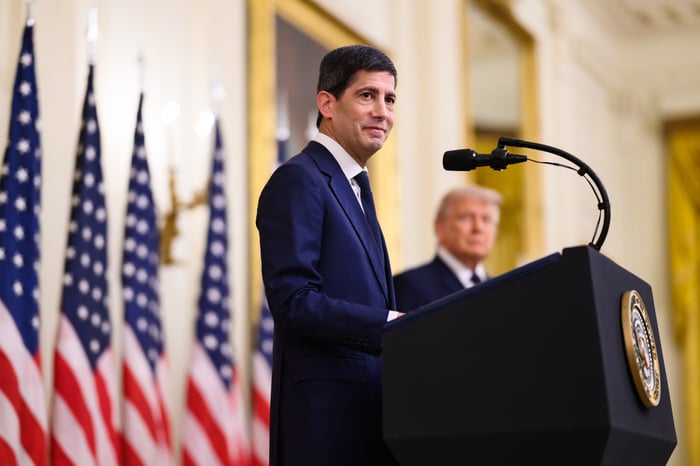
Kevin Warsh is sworn in as chairman of the Federal Reserve. Image source: Official White House Photo.
Fed Chair Kevin Warsh is committed to bringing inflation back to target
The FOMC held its benchmark federal funds rate steady in June. But Chair Kevin Warsh acknowledged a serious problem in a speech following the meeting. "We recognize that inflation has been running well ahead of the Fed's long-stated goal of 2%. That's been going on for more than five years."
Warsh made it clear that above-target inflation was unacceptable. "I am pleased to report that members of the FOMC are unambiguous and unanimous: This committee will deliver price stability," he said. "We have the capability and commitment to deliver on our price-stability objective of 2%. That's exactly what we're going to do."
Reporters tried to coerce Warsh into divulging more. "Under what circumstances would you support the Fed taking some action and raising rates?" asked Colby Smith of The New York Times. But Warsh, who has criticized the practice of providing forward guidance, did not take the bait.
Nevertheless, investors can read between the lines. Inflation has been running above target for years, so the Fed must make changes to bring inflation down. That could mean holding rates steady for an extended period, but that may be too passive, especially since oil prices are rising again amid renewed hostilities between the U.S. and Iran.
Policymakers have become much more hawkish in recent months. As of June, the median estimate among FOMC officials implies one quarter-point rate increase in 2026, but six of 18 members expect at least two rate increases. Comparatively, zero FOMC officials anticipated rate increases in March, and the consensus actually called for a quarter-point rate cut this year.
History says interest rate increases could lead to a stock market correction
Since 1999, the Federal Reserve has initiated four tightening cycles, meaning it has pivoted from rate cuts to rate increases four times in the past quarter-century. The following chart shows the maximum drawdown in the S&P 500 and Nasdaq Composite during the three-month period following the first interest rate increase in each cycle.
|
Fed Starts Raising Rates |
Max Drop in S&P 500 |
Max Drop in Nasdaq |
|---|---|---|
|
June 1999 |
(8%) |
(7%) |
|
June 2004 |
(7%) |
(14%) |
|
December 2015 |
(10%) |
(15%) |
|
March 2022 |
(17%) |
(22%) |
|
Average |
(10%) |
(15%) |
Data source: Federal Reserve, YCharts. The table shows the maximum drawdown in the S&P 500 and Nasdaq Composite during the three-month period following the Fed's first rate increase in a tightening cycle.
Following the first interest rate increase in a tightening cycle, the S&P 500 and Nasdaq have fallen by an average of 10% and 15%, respectively, at some point in the next three months. In other words, both major stock market indexes have historically dropped into correction territory when the Fed has pivoted from rate cuts to rate increases.
Of course, rate increases are not set in stone. Micheal Feroli, chief U.S. economist at JPMorgan Chase, thinks the Fed will stay on hold in the remaining months of 2026, before raising in the second half of 2027. David Mericle, chief U.S. economist at Goldman Sachs, also expects the Fed to hold rates steady this year, but he expects two rate cuts in 2027.
Here's the bottom line: The Federal Reserve is determined to bring inflation back to target, and the consensus among policymakers calls for a quarter-point rate increase this year. History says that rate increase could sink the stock market, so investors should be ready for a drawdown.
Should you buy stock in S&P 500 Index right now?
Before you buy stock in S&P 500 Index, consider this:
The Motley Fool Stock Advisor analyst team just identified what they believe are the 10 best stocks for investors to buy now… and S&P 500 Index wasn’t one of them. The 10 stocks that made the cut could produce monster returns in the coming years.
Consider when Netflix made this list on December 17, 2004... if you invested $1,000 at the time of our recommendation, you’d have $396,542!* Or when Nvidia made this list on April 15, 2005... if you invested $1,000 at the time of our recommendation, you’d have $1,299,961!*
Now, it’s worth noting Stock Advisor’s total average return is 931% — a market-crushing outperformance compared to 210% for the S&P 500. Don't miss the latest top 10 list, available with Stock Advisor, and join an investing community built by individual investors for individual investors.
See the 10 stocks »
*Stock Advisor returns as of July 16, 2026.
JPMorgan Chase is an advertising partner of Motley Fool Money. Trevor Jennewine has no position in any of the stocks mentioned. The Motley Fool has positions in and recommends Goldman Sachs Group and JPMorgan Chase. The Motley Fool has a disclosure policy.
Recommended Articles


