


If a Stock Market Crash Is Coming, 100 Years of History Says This Is the Best Move Investors Can Make
Key Points
Tech stocks have lifted major market indexes to new heights in recent years.
However, concerns around AI spending could result in more turbulence.
History shows that investing in strong stocks for the long haul is key to surviving volatility.
- 10 stocks we like better than S&P 500 Index ›
Stock prices are continuing to balloon, with major market indexes continuing to set records. The S&P 500 (SNPINDEX: ^GSPC) surged by more than 14% over the last three months -- its strongest quarter since 2020.
Much of this growth is fueled by the tech sector. Breakout stars such as Micron Technology have boosted major indexes, and the "Magnificent Seven" -- which includes Apple, Amazon, Alphabet, Microsoft, Meta Platforms, Nvidia, and Tesla -- have collectively earned total returns of around 132% over the last three years.
Where to invest $1,000 right now? Our analyst team just revealed what they believe are the 10 best stocks to buy right now, when you join Stock Advisor. See the stocks »
However, all of this growth also comes with a drawback. Major indexes are becoming increasingly concentrated in tech stocks, and if these companies face a pullback, it could drag down the entire market. With concerns growing about AI spending, it may be time to start preparing for a potential downturn.
Here's what history suggests investors should do right now.

Image source: Getty Images.
Your strategy will make or break your portfolio
Stock price alone isn't enough to determine whether a company is a strong investment. Rather, investors should focus on an organization's underlying fundamentals.
In the late 1990s, for instance, tech stocks surged to record highs. While many of those companies seemed unstoppable at the time, hundreds of them crashed hard and never recovered after the bubble popped.
The companies built on solid foundations, however, not only recovered, but also went on to earn lucrative long-term returns. Amazon, for instance, lost nearly 95% of its value between 1999 and 2001. Since 1999, however, it's earned total returns of more than 4,600%.
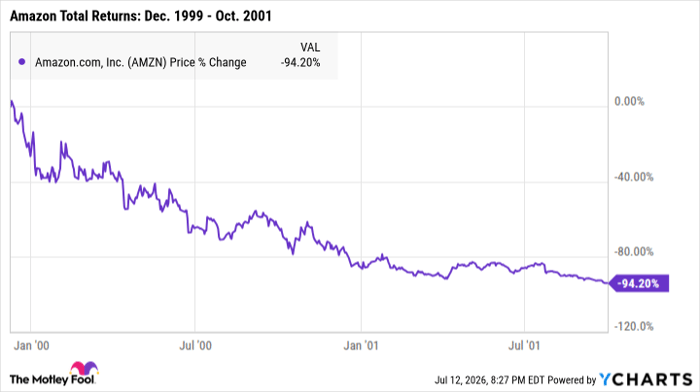
AMZN data by YCharts
This is a pattern that's repeated throughout history, too. Analysts at Crestmont Research studied the S&P 500's rolling 20-year total returns since 1919, and they found that every single period ended in positive total returns.
In other words, more than a century's worth of history proves that no matter how severe the short-term downturns are, holding strong stocks for at least a couple of decades dramatically improves your chances of building wealth over time.
What investors can do right now
There's no way to know for certain where the market is headed in the near term. With company valuations soaring, however, it's becoming increasingly likely that some stocks are overvalued. It's more important than ever, then, to research carefully when choosing investments.
A few of the most important factors to look for in a quality stock include:
- Healthy finances: Metrics such as the price-to-earnings (P/E) ratio and the price/earnings-to-growth (PEG) ratio can make it easier to determine whether a stock is valued fairly. Consistent revenue and a path to profitability can also set a company up for long-term success.
- An experienced leadership team: Even healthy companies can struggle if they're led by an executive team that consistently makes poor choices. If a recession or bear market is looming, competent leadership will be key to surviving economic rough patches.
- A competitive advantage: A company's competitive advantage is what sets it apart from its peers, and without one, it may struggle to achieve consistent growth over decades.
The market's short-term future will always be uncertain to a degree, and that can be daunting. However, history is clear that those who invest in quality stocks and hold them for the long haul will reap the rewards.
Should you buy stock in S&P 500 Index right now?
Before you buy stock in S&P 500 Index, consider this:
The Motley Fool Stock Advisor analyst team just identified what they believe are the 10 best stocks for investors to buy now… and S&P 500 Index wasn’t one of them. The 10 stocks that made the cut could produce monster returns in the coming years.
Consider when Netflix made this list on December 17, 2004... if you invested $1,000 at the time of our recommendation, you’d have $398,160!* Or when Nvidia made this list on April 15, 2005... if you invested $1,000 at the time of our recommendation, you’d have $1,249,202!*
Now, it’s worth noting Stock Advisor’s total average return is 918% — a market-crushing outperformance compared to 209% for the S&P 500. Don't miss the latest top 10 list, available with Stock Advisor, and join an investing community built by individual investors for individual investors.
See the 10 stocks »
*Stock Advisor returns as of July 15, 2026.
Katie Brockman has no position in any of the stocks mentioned. The Motley Fool has positions in and recommends Alphabet, Amazon, Apple, Meta Platforms, Micron Technology, Microsoft, Nvidia, and Tesla. The Motley Fool has a disclosure policy.
Recommended Articles


