


SK Hynix Has Traded at a Discount to Micron for Years. That May Be Changing.
Key Points
SK Hynix has been trading on the Korean Exchange for nearly two decades, but made its U.S. debut on July 10.
Companies producing memory and storage hardware have seen a boost in demand as companies build out data centers and other AI infrastructure.
Accessibility is partly why Micron has traded at a premium to SK Hynix.
- 10 stocks we like better than SK Hynix ›
For the past few years, artificial intelligence (AI)-related stocks have been the most lucrative stocks on the market. It began with major hyperscalers like the "Magnificent Seven" stocks, but attention has shifted to more niche companies, such as those in the memory hardware industry.
One of those companies is SK Hynix (NASDAQ: SKHY), which has been trading on the Korean stock market since 1996, but made its U.S. debut on July 10, listing on the Nasdaq.
Where to invest $1,000 right now? Our analyst team just revealed what they believe are the 10 best stocks to buy right now, when you join Stock Advisor. See the stocks »
The company raised $26.5 billion, the largest ever for a foreign listing in the U.S. That alone should give you an idea of the hype surrounding the company and its position in the AI ecosystem. But how does it compare to another key player in its industry?
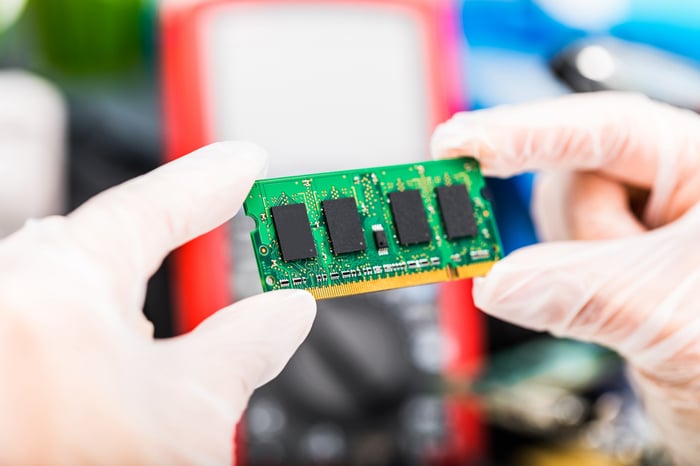
Image source: Getty Images.
Why SK Hynix has been receiving so much attention
SK Hynix is a semiconductor company that makes memory and storage hardware. For most of SK Hynix's existence, its hardware has been used in devices such as personal computers and smartphones. Now, the focus has completely changed with the current AI boom.
The AI tools many people use and enjoy today wouldn't be possible without lots of data processing and AI model training. And this data can't be stored on your standard external hard drive that everyday people use for things like backing up their laptops or storing videos and photos. It requires specialized memory and storage hardware, of which SK Hynix is one of the largest producers.
Data is the fuel of AI, and without ways to store and process it quickly, we wouldn't have the functional AI tools used today. Major data centers are filled with thousands of memory and storage hardware that ensures the AI wheel keeps spinning. That's why so much attention has been given to memory companies like SK Hynix and Micron (NASDAQ: MU).
SK Hynix's trading discount may not last much longer
SK Hynix and Micron are direct competitors in the pure-play memory semiconductor space, and for much of the time that they've both been public companies, Micron has traded at a premium compared to SK Hynix. There are two key reasons, both of which deal with geography.
To begin, Micron is an American company and has always been listed on the Nasdaq, so U.S. investors have been able to easily purchase Micron shares as they would any other stock. Since SK Hynix was trading on the Korean Exchange prior to its U.S. debut, it wasn't as straightforward for U.S. investors. It generally required investing in an ETF that included the company, but that was more of a workaround than anything else.
Micron is also included in major U.S. indexes like the S&P 500, Nasdaq Composite, and Dow Jones, which means much more institutional money is flowing into the stock, pushing its valuation up. SK Hynix hasn't had that luxury.
In many cases, international companies trade at a discount relative to their comparable American peers due to factors such as accessibility, differences in governing rules, and unique geopolitical risks. SK Hynix is no different, but now that accessibility is no longer a factor, we're likely to see much more money pour into the stock, wiping out the discount it had relative to Micron.
SK Hynix has some risk worth noting
SK Hynix is rolling right now, but investors should be aware of two concentration risks. The first is the concentration of SK Hynix's revenue that comes from Nvidia. SK Hynix and Nvidia have a deep partnership, with SK Hynix supplying most of Nvidia's high-bandwidth memory chips.
The second concentration risk concerns the share of SK Hynix's current revenue that comes from its DRAM products. Considering how cyclical the memory semiconductor industry can be, once it inevitably cools, having so much revenue from one source could put a major dent in SK Hynix's finances. The downside of the cycle may not occur for a couple of years, but it's almost guaranteed to happen at some point.
Luckily, there's no rush to invest in SK Hynix right now. It can be easy to let the fear of missing out (FOMO) lead you to make an impulsive decision, but SK Hynix's stock is likely to be extra volatile in the immediate aftermath of its U.S. debut. I would take a slow but sure approach versus investing a lump sum right now.
Should you buy stock in SK Hynix right now?
Before you buy stock in SK Hynix, consider this:
The Motley Fool Stock Advisor analyst team just identified what they believe are the 10 best stocks for investors to buy now… and SK Hynix wasn’t one of them. The 10 stocks that made the cut could produce monster returns in the coming years.
Consider when Netflix made this list on December 17, 2004... if you invested $1,000 at the time of our recommendation, you’d have $395,679!* Or when Nvidia made this list on April 15, 2005... if you invested $1,000 at the time of our recommendation, you’d have $1,294,805!*
Now, it’s worth noting Stock Advisor’s total average return is 929% — a market-crushing outperformance compared to 211% for the S&P 500. Don't miss the latest top 10 list, available with Stock Advisor, and join an investing community built by individual investors for individual investors.
See the 10 stocks »
*Stock Advisor returns as of July 14, 2026.
Stefon Walters has no position in any of the stocks mentioned. The Motley Fool has positions in and recommends Micron Technology and Nvidia. The Motley Fool has a disclosure policy.
Recommended Articles


