


Will Memory Giants Micron, Sandisk, and SK Hynix Continue to Soar? History Is Strikingly Clear About What Happens Next.
Key Points
These companies have seen revenue soar amid data center demand for memory.
Memory chips are greatly needed in the agentic AI era, which may be just beginning to unfold.
- 10 stocks we like better than Micron Technology ›
Artificial intelligence (AI) needs compute in order to develop and be put to use, and this has powered the share prices of chip designers from Nvidia to Advanced Micro Devices. They make the logic chips, such as graphics processing units (GPUs) and central processing units (CPUs), that fuel key AI tasks.
But logic chips aren't the only crucial ingredient in the AI story. Along with these, AI also requires memory and storage, elements provided by companies including Micron Technology (NASDAQ: MU), SK Hynix, and Sandisk (NASDAQ: SNDK). In fact, as AI platforms are now applied to real-world problems, the need for memory has become greater than ever.
Where to invest $1,000 right now? Our analyst team just revealed what they believe are the 10 best stocks to buy right now, when you join Stock Advisor. See the stocks »
All of this has buoyed the stock prices of these memory market leaders. Micron and Sandisk have soared nearly 700% and almost 4,000%, respectively, over the past year. And SK Hynix of South Korea just splashed onto the U.S. market, debuting on the Nasdaq on July 10. In their first day of trading, the American depositary receipts (ADRs) jumped 13%.
It's no surprise that investors now are asking: Will these memory giants continue to roar higher? History offers a strikingly clear answer.

Image source: Getty Images.
The importance of memory chips
So, first, let's consider the path of these players and the general AI market environment. Micron, SK Hynix, and Sandisk each offer the various types of memory needed across devices and industries. Memory chips are found in everything from smartphones to laptops, so they are broadly used in consumer products -- and today, AI data centers have become massive memory chip customers, driving prices higher and supply lower.
All of this has been a boon to memory chip leaders, with demand so high that each of these players has seen tremendous growth in earnings and stock price. For example, in the recent quarter, Micron reported a 345% increase in revenue to $41 billion and data center gross margin of 87%. And the company expects tight supply to continue beyond 2027 amid high AI demand.
SK Hynix and Sandisk have delivered similar messages as the data center demand for chips increased. And logic chip designers such as Nvidia have confirmed this pattern. Today, AI is shifting into the phase of agentic AI -- this is use of AI to handle real-world problems, and AI needs more and more memory and storage power to get the job done. So we actually could see an acceleration of memory demand in this stage of the AI growth story.
A cyclical past
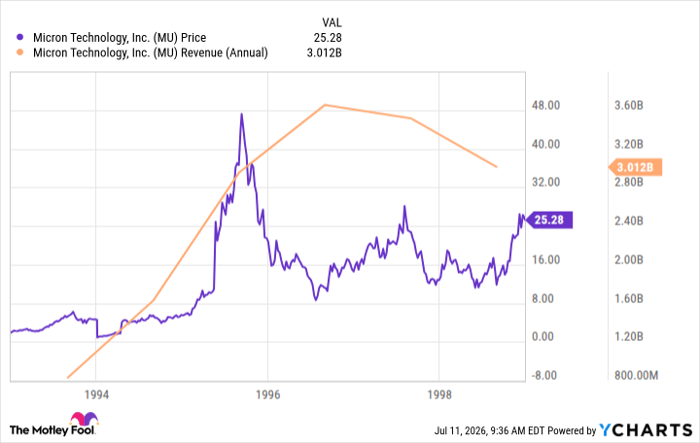
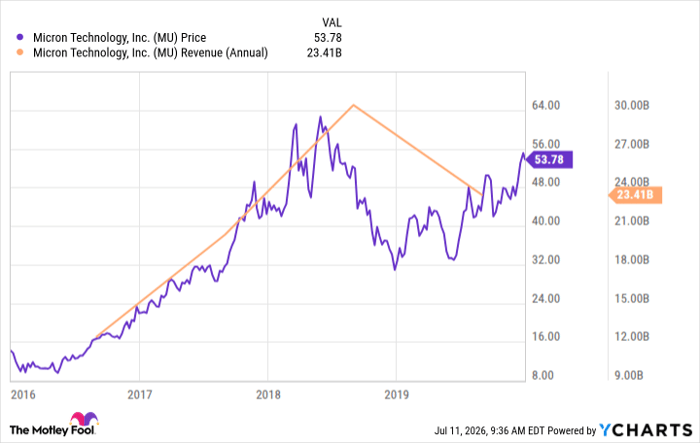
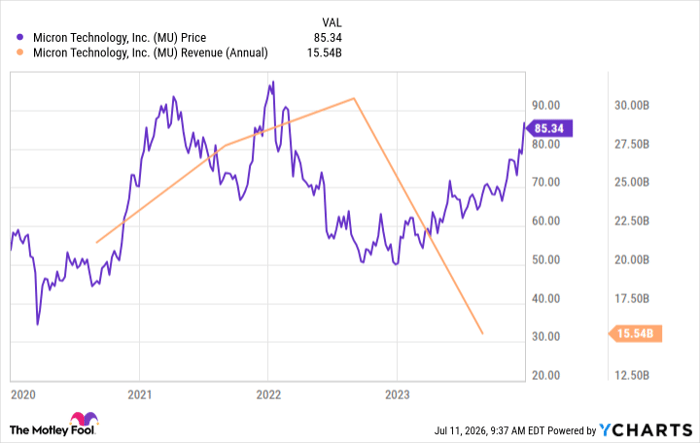
So does this mean memory stocks have much farther to run? Let's look to history for some clues. Memory stocks are cyclical: Demand rises, manufacturers increase output, supply returns, demand and prices decline.
Here's a look at Micron's stock price and revenue pattern during and following three of the last major memory cycles. The first is during the personal computing boom from 1993 through 1996.
MU data by YCharts
The next happened during the smartphone revolution, from 2016 through 2019.
MU data by YCharts
The following cycle, driven by remote work during the pandemic, spanned 2020 through 2023.
MU data by YCharts
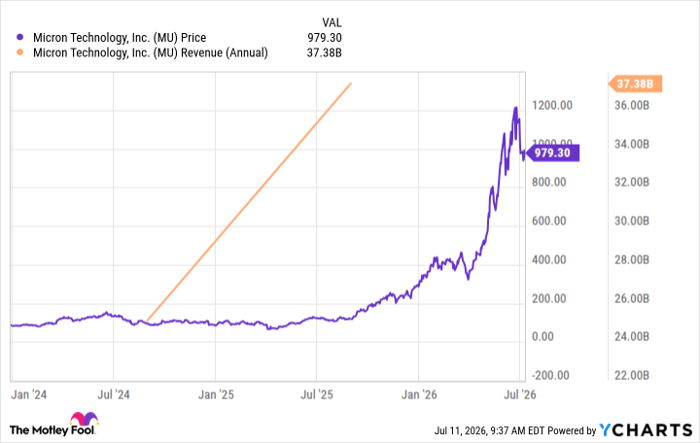
Now, here's a look at Micron during the current cycle. The stock has come down from its highs, and some may argue that it has peaked.
MU data by YCharts
What might be next
So the message is pretty clear: History shows that memory stocks have indeed been cyclical, with stock performance and revenue peaking, then going on for a period of declines. This could suggest that, after such enormous gains in revenue and share performance, we may be heading for the downward phase of the cycle. And if it isn't imminent, it could happen as the companies' manufacturing expansions result in greater supply over the next few years.
But it's important to keep in mind that the AI boom may be different from other periods we've encountered -- and that could alter the cycle in important ways. The downward phase may come much later, or it may not be as deep. And if one or both of those possibilities actually take place, revenue and stock performance might hold up much better than they did in the past. Considering the need for memory in agentic AI and in future AI phases such as robotics, this scenario could play out.
All of this means that, though history says memory companies like SK Hynix and Micron may be heading for a dip, it might not be as pronounced or long-lasting as it was in the past. And that's positive news for long-term investors, who don't mind waiting out any down periods.
Should you buy stock in Micron Technology right now?
Before you buy stock in Micron Technology, consider this:
The Motley Fool Stock Advisor analyst team just identified what they believe are the 10 best stocks for investors to buy now… and Micron Technology wasn’t one of them. The 10 stocks that made the cut could produce monster returns in the coming years.
Consider when Netflix made this list on December 17, 2004... if you invested $1,000 at the time of our recommendation, you’d have $395,679!* Or when Nvidia made this list on April 15, 2005... if you invested $1,000 at the time of our recommendation, you’d have $1,294,805!*
Now, it’s worth noting Stock Advisor’s total average return is 929% — a market-crushing outperformance compared to 211% for the S&P 500. Don't miss the latest top 10 list, available with Stock Advisor, and join an investing community built by individual investors for individual investors.
See the 10 stocks »
*Stock Advisor returns as of July 13, 2026.
Adria Cimino has no position in any of the stocks mentioned. The Motley Fool has positions in and recommends Advanced Micro Devices, Micron Technology, and Nvidia. The Motley Fool has a disclosure policy.
Recommended Articles


