


Wall Street Veteran Strategist James E. Thorne Says S&P 500 Could Reach 14,000 in Five Years: "You Are Not Bullish Enough Right Now"
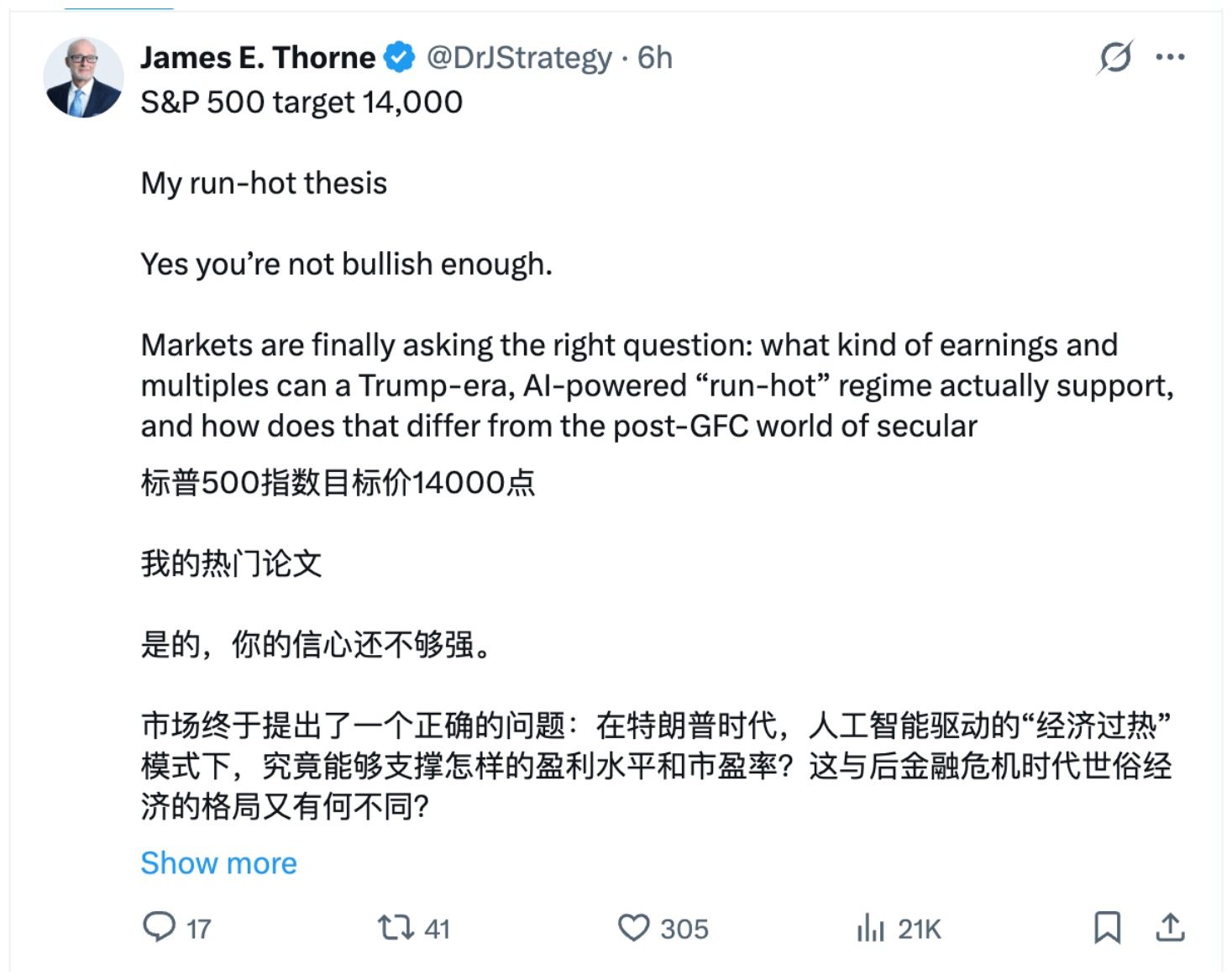
TradingKey - On July 12, Eastern Time, just as mainstream investment banks were raising their 2026 S&P 500 Index targets to the 7,500-8,100 range, James E. Thorne, Chief Market Strategist at Wellington-Altus Private Wealth, delivered a much bolder long-term forecast: the S&P 500 is poised to reach the 14,000 milestone within the next five years (by 2031), representing a near-doubling from its current level of around 7,500.
[Source: X]
Thorne asserted on the social media platform X: "Yes, you are not bullish enough." He believes the market is only beginning to realize the earnings potential that an AI-driven economy could unleash. This argument is rooted in his assessment of the U.S. macro environment: the U.S. is heading toward a new "running hot" paradigm that is vastly different from the post-2008 financial crisis era.
Thorne described this as a "Trump-era, AI-driven running-hot regime," characterized by nominal GDP growth of around 7% annually, significantly higher than approximately 5% at the end of 2025. He does not view this as a rerun of the secular stagnation of the 2010s, but rather as something closer to "a modernized version of the late 1980s and 1990s, when growth, productivity, and valuations rose in tandem."
In terms of specific projections, Thorne presented several scenarios. His base case assumes S&P 500 EPS will grow to about $600 by 2031, which, at a P/E ratio of around 22x, would place the index in the low-to-mid 13,000 range. Under a more optimistic scenario, if investors view the AI-driven productivity boost as a lasting structural shift, a P/E ratio of 25x could push the index to the 15,000-16,000 range.
The cornerstone of this forecast is explosive corporate earnings growth. Thorne expects S&P 500 EPS to reach around $400 in 2027 and climb further to $600-$650 by 2031, representing an annual growth rate as high as 10.5%-14%. He firmly believes this growth will be driven by a combination of "an AI capex supercycle, full expensing, and the deliberate rebuilding of productive capacity."
Thorne's view is not isolated, but its timeframe and degree of optimism exceed Wall Street's current consensus outlook for 2026. For instance, institutions like Deutsche Bank, Morgan Stanley ( MS) and Goldman Sachs ( GS) recently set their year-end 2026 S&P 500 targets at around 8,000.
Thorne's argument also addresses ongoing market concerns about valuations and bubbles. He describes the current wave of AI infrastructure buildout as "industrial retooling" rather than mere "software hype." Meanwhile, in the first quarter, S&P 500 companies beat earnings expectations by about 27%, far exceeding Wall Street's expectation of 12%. He believes this gap proves that analysts are still underestimating the penetration effect of AI on profit margins across various industries.
Recommended Articles


