


It's Been Over 7 Weeks, and Fed Chair Kevin Warsh Has Failed to Make Any Headway on a Key Central Bank Reform
Key Points
Kevin Warsh was sworn in as the 17th head of the Federal Reserve on May 22.
Warsh promised a laundry list of reforms, several of which he's already acted on.
However, Warsh has made no progress on the reform he's been most vocal about, and which has the potential to shake a historically pricey stock market to its core.
- 10 stocks we like better than S&P 500 Index ›
This has been a momentous year for Wall Street. We've watched the Dow Jones Industrial Average (DJINDICES: ^DJI), S&P 500 (SNPINDEX: ^GSPC), and Nasdaq Composite (NASDAQINDEX: ^IXIC) climb to record highs, observed the largest-ever initial public offering, and have borne witness to a rare shift in power at the Federal Reserve.
On May 22, President Donald Trump's handpicked successor to Jerome Powell, Kevin Warsh, was officially sworn in as the 17th Fed chair. Warsh wasted little time outlining the laundry list of changes he'd like to implement at America's foremost financial institution. While some of these reforms have taken effect, Warsh has made no progress on his most vocal proposal.
Missed Nvidia in 2009? This Rare Signal Is Flashing Again. In 2009, a "Double Down" signal flashed for a little-known chipmaker called Nvidia. For the first time in years, that same "Total Conviction" signal is flashing for a company 1/100th the size of Nvidia. Continue »
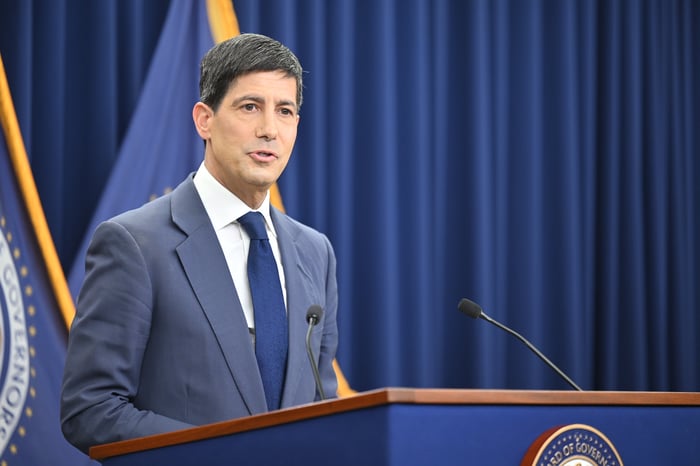
Fed Chair Kevin Warsh delivering remarks. Image source: Official Federal Reserve Photo.
The Fed's bloated balance sheet continues to expand
When testifying before the Senate Banking Committee in April, Kevin Warsh outlined several reforms he'd implement. He discussed changing how the Federal Open Market Committee (FOMC) thinks about inflation and has since launched five specialized task forces, one of which reassesses the criteria and modeling for inflation.
Warsh also railed against the use of forward-looking guidance, arguing that it pigeonholes the central bank into specific monetary policy decisions. At his first FOMC meeting as Fed chair in mid-June, Warsh presented a considerably shorter FOMC statement that was devoid of forward-looking guidance on interest rates.
But the reform Warsh has been most vocal about, deleveraging the central bank's balance sheet and making the Fed a passive observer, is the one he's made no progress on.
Between August 2008 and March 2022, the Fed's balance sheet, comprised primarily of long-term U.S. Treasury bonds and mortgage-backed securities, ballooned from nearly $900 billion to almost $9 trillion. Though a period of quantitative tightening reduced the balance sheet to approximately $6.54 trillion in late 2025, it's been expanding since the start of 2026.
Kevin Warsh Nomination: one reason why market players are interpreting it as a hawkish pick- I agree-is because of his views on the need for a radical balance sheet reduction.
-- Joseph Brusuelas (@joebrusuelas) January 30, 2026
The $31 trillion-dollar American economy demands liquidity & financing needs that are larger than what... pic.twitter.com/zYunGAItV8
As of May 27, the Federal Reserve's banks collectively held $6.704 trillion in assets. By July 1, this figure has grown by roughly $20 billion to $6.725 trillion. Over more than seven weeks, the new Fed chair hasn't made any headway in shrinking the central bank's balance sheet or, in his words, getting "out of the fiscal business."
Any adjustments made to the Fed's balance sheet can have significant consequences for Wall Street. Since bond prices and yields are inversely related, paring down the Fed's balance sheet (i.e., selling trillions of dollars in U.S. Treasury bonds) would be expected to weigh down bond prices, boost yields, and therefore increase long-term borrowing costs.
Additionally, the FOMC doesn't even have to adjust its federal funds target rate to boost interest rates. Simply paring down its balance sheet would be enough to move the needle and somewhat pump the brakes on an inflation rate that jumped to a three-year high of 4.2% in May.
Reasonably low interest rates are the fuel powering the partially debt-financed artificial intelligence (AI) data center build-out. If borrowing becomes costlier and AI infrastructure expansion slows, Wall Street's historically pricey stock market may tumble as valuations and growth expectations are reset.
Should you buy stock in S&P 500 Index right now?
Before you buy stock in S&P 500 Index, consider this:
The Motley Fool Stock Advisor analyst team just identified what they believe are the 10 best stocks for investors to buy now… and S&P 500 Index wasn’t one of them. The 10 stocks that made the cut could produce monster returns in the coming years.
Consider when Netflix made this list on December 17, 2004... if you invested $1,000 at the time of our recommendation, you’d have $395,679!* Or when Nvidia made this list on April 15, 2005... if you invested $1,000 at the time of our recommendation, you’d have $1,294,805!*
Now, it’s worth noting Stock Advisor’s total average return is 929% — a market-crushing outperformance compared to 211% for the S&P 500. Don't miss the latest top 10 list, available with Stock Advisor, and join an investing community built by individual investors for individual investors.
See the 10 stocks »
*Stock Advisor returns as of July 13, 2026.
Sean Williams has no position in any of the stocks mentioned. The Motley Fool has no position in any of the stocks mentioned. The Motley Fool has a disclosure policy.
Recommended Articles


