


A Smarter Alternative to the Vanguard S&P 500 ETF for Risk-Aware Investors
Key Points
The Vanguard U.S. Minimum Volatility ETF may be a friend to risk-averse investors.
It's an actively managed, low-cost ETF offered by the mutual funds giant.
However, there are trade-offs that investors need to be mindful of, too.
- 10 stocks we like better than Vanguard Wellington Fund - Vanguard U.s. Minimum Volatility ETF ›
In the stock market, many things are true, and new investors can and do learn at least two of them. First, stocks offer significant potential for growing wealth. Second, there is no free lunch.
It's often said that equities don't move up in straight lines. In fact, dating back to 1980, the S&P 500 averages an intra-year drawdown of 14%. Look at a 14% pullback this way. If I pay $100 for a stock today and it declines 14%, it's worth $86. Given that recovery math is even more brutal than high school algebra, I need a 16.3% increase just to reach breakeven.
Missed Nvidia in 2009? This Rare Signal Is Flashing Again. In 2009, a "Double Down" signal flashed for a little-known chipmaker called Nvidia. For the first time in years, that same "Total Conviction" signal is flashing for a company 1/100th the size of Nvidia. Continue »

This Vanguard ETF helps investors avoid some of the S&P 500'[s risks. Image source: Getty Images.
That's why some investors actively avoid volatility while embracing defensive stocks. Plenty of exchange-traded funds (ETFs) emphasize reduced volatility, including the Vanguard U.S. Minimum Volatility ETF (NYSEMKT: VFMV). For investors looking to limit portfolio turbulence, this may be one of the best Vanguard ETFs, but they need to know what they're getting into before hitting the "buy" button.
Understanding the quirks
Minimum volatility investing isn't new. It's been around for years, and it's backed by scores of studies and market performance data. However, not everyone is an expert in this style. For those considering it or the Vanguard ETF, it pays to understand how "min vol" investing works.
These funds present investors with a basket of stocks that are less volatile than the broader market. This Vanguard ETF holds 186 names, which is fairly broad among the funds in this category. Something else for investors to note is the primary objective of a minimum volatility ETF. It's not to capture all the upside of a raging bull market, but rather to ensure that investors experience less downside when markets tumble. The trade-off is that when stocks rally, minimum-volatility ETFs can lag the broader market.
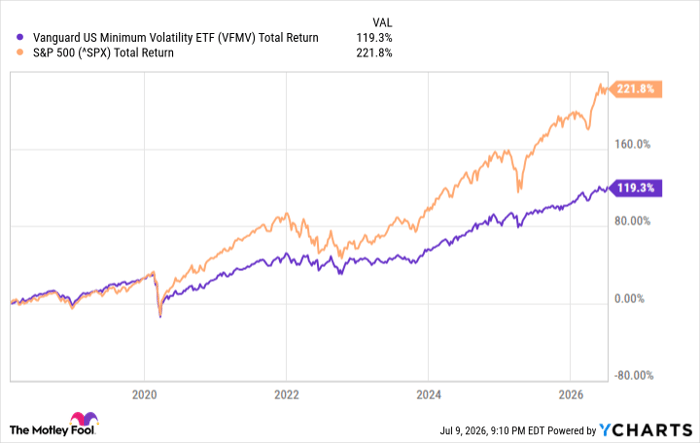
VFMV Total Return Level data by YCharts
All that said, the Vanguard fund has merits. Some of those advantages stem from the differences between this style and low-volatility investing. Yes, they're different concepts with different outcomes. For example, the Vanguard fund returned 49.3% over the past three years, while the S&P 500 Low Volatility index gained 28%, and this ETF achieved that return with lower annualized volatility than the "low vol" gauge.
Risk-aware investors might like this $426 million actively managed Vanguard offering for other reasons. The fund keeps them in the game without placing significant reliance on defensive sectors such as consumer staples and utilities. Yes, those groups combine for 15.3% of this ETF's roster, well above the S&P 500's exposure, but the minimum volatility fund still has a 30.2% weight to tech stocks, so it's not as boring per se.
Know your preferences
Even a basic S&P 500 index fund subjects investors to pullbacks, occasionally deep. That's how investing works. On the other hand, bear markets aren't everyone's cup of tea, but sitting in cash isn't a way to build long-term wealth.
The Vanguard U.S. Minimum Volatility ETF can split the divide between full-on equity market risk and the no upside exposure that comes from sitting on the sidelines. So this ETF isn't for everyone, but it is relevant to a fair amount of investors.
And it's cost-effective. The fund's annual fee of 0.13%, or $13 on a $10,000 investment, puts it in the cheapest quintile of comparable offerings.
Should you buy stock in Vanguard Wellington Fund - Vanguard U.s. Minimum Volatility ETF right now?
Before you buy stock in Vanguard Wellington Fund - Vanguard U.s. Minimum Volatility ETF, consider this:
The Motley Fool Stock Advisor analyst team just identified what they believe are the 10 best stocks for investors to buy now… and Vanguard Wellington Fund - Vanguard U.s. Minimum Volatility ETF wasn’t one of them. The 10 stocks that made the cut could produce monster returns in the coming years.
Consider when Netflix made this list on December 17, 2004... if you invested $1,000 at the time of our recommendation, you’d have $395,679!* Or when Nvidia made this list on April 15, 2005... if you invested $1,000 at the time of our recommendation, you’d have $1,294,805!*
Now, it’s worth noting Stock Advisor’s total average return is 929% — a market-crushing outperformance compared to 211% for the S&P 500. Don't miss the latest top 10 list, available with Stock Advisor, and join an investing community built by individual investors for individual investors.
See the 10 stocks »
*Stock Advisor returns as of July 12, 2026.
Todd Shriber has no position in any of the stocks mentioned. The Motley Fool has no position in any of the stocks mentioned. The Motley Fool has a disclosure policy.
Recommended Articles


