


Stablecoin Issuer Circle Rises Over 16% at One Point. Authorized to Conduct Digital Currency Banking Operations, but Institutions Say Market Reaction Is Too Optimistic
TradingKey - On July 10, Eastern Time, leading stablecoin company Circle ( CRCL) received a major regulatory boost. The company officially announced that it has obtained formal approval from the U.S. Office of the Comptroller of the Currency (OCC) to establish Circle National Trust, a national digital currency trust bank.
Spurred by the news, Circle shares surged over 16% intraday to a high of $72.85, marking its largest single-day gain in two months. As of press time, Circle's gain narrowed to 4.4%, trading at $65.80.
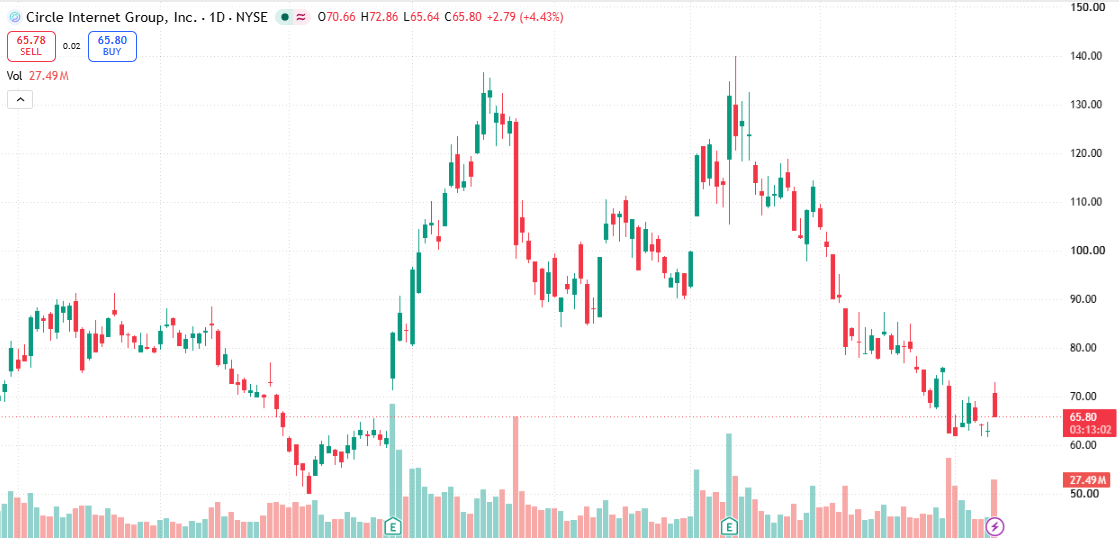
[Source: TradingView]
Currently, the overall global market capitalization of stablecoins has surpassed $310 billion. Applications such as cross-border payments and cross-border remittances continue to broaden industry demand. Morningstar predicts that the circulation of stablecoins is expected to climb to $1.45 trillion by 2035.
The vast industry potential has also kept the market focused on the compliance progress of leading issuers. Institutions predict that, supported by unified federal regulation, self-owned reserve custody business, and newly added institutional asset custody services, Circle's stablecoin-related revenue will rise steadily from 2026 to 2028, with cross-border payments and institutional custody services becoming the company's new growth curves.
Currently, competition in the stablecoin sector has entered a fever pitch, with multiple external rivals continuously diverting USDC's original market share. As the implementation of the GENIUS Act brings clear regulatory expectations, various large traditional financial institutions plan to launch their own stablecoins. By relying on their own channels to capture payment flows and cultivate their own customer ecosystems, they will no longer depend on third-party issuance service providers like Circle, compressing USDC's market living space in the long run.
In June this year, more than 140 companies spanning the payment, finance, technology, and crypto sectors—including BlackRock, Coinbase, Mastercard, Stripe, and Visa—jointly launched the consortium stablecoin OpenUSD, bringing significant competitive shockwaves to the industry.
The project innovatively designs a reserve asset yield distribution mechanism, breaking the traditional model where a single stablecoin issuer monopolizes profits. By opening the distribution of yields generated by reserves to all cooperating participants, this mechanism has quickly captured institutional customer resources, which was also the core driver behind a significant correction in Circle's stock price in late June.
Despite the sharp short-term surge in Circle's stock price, the stock has still fallen by approximately 16% overall year-to-date.
Mizuho Securities stated that while the trust bank license is a major positive, the short-term market surge reflects a tendency toward over-optimism. This positive development cannot fundamentally resolve the core fundamental issues that continue to drag down the company's stock price.
Currently, USDC remains the mainstream USD stablecoin product in the institutional market, but the industry's competitive landscape continues to deteriorate. The OCC has recently and intensively granted national trust bank licenses to several digital asset enterprises, with major crypto giants vying for dominance in the compliant financial infrastructure sector, officially pushing the stablecoin industry into a cycle of competition for existing market share.
Recommended Articles


