


The Likelihood of a Bear Market Under President Donald Trump in 2026 Is Not Very High -- but Investors Aren't in the Clear Yet
Key Points
Due to factors such as the Iran war, investors have wondered if a market crash is on the table.
The market faced numerous challenges prior to the Iran war that remain prevalent today.
- 10 stocks we like better than S&P 500 Index ›
When repercussions from the Iran war sent the S&P 500 (SNPINDEX: ^GSPC) down 9% earlier this year, investors feared the onset of a bear market. But the selloff didn't last long, and the benchmark index has recovered to all-time highs.
People betting on the prediction market platform Kalshi see only a moderate chance of a bear market this year. But that doesn't mean investors should breathe a sigh of relief. They aren't in the clear just yet.
Will AI create the world's first trillionaire? Our team just released a report on the one little-known company, called an "Indispensable Monopoly" providing the critical technology Nvidia and Intel both need. Continue »
The market still faces numerous hurdles this year
As of Monday morning, the S&P 500 is sitting right around 7,400, which would be a new all-time high. If the market entered a bear market from here -- in other words, a 20% decline from its highs -- that would mean falling to a level of slightly below 5,900.
Based on recent price action, bettors on Kalshi see a 20% likelihood that the S&P 500 will fall into a bear market this year, as tensions between the U.S. and Iran and other Middle Eastern countries have settled down in recent weeks -- although the situation remains far from resolved.
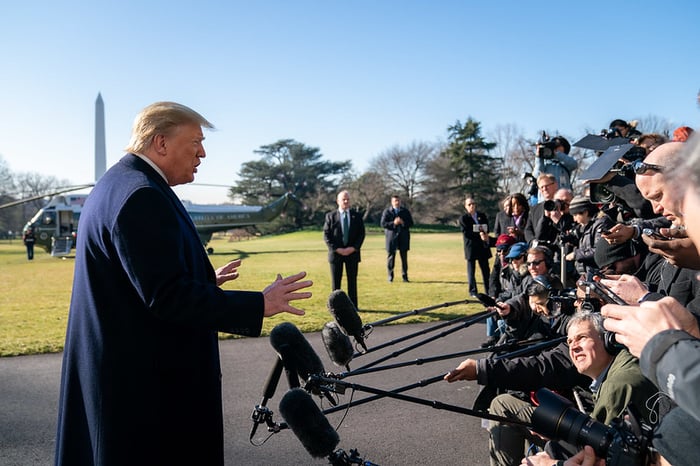
Official White House photo by Tia Dufour.
The Iran war is not officially over, and even the current ceasefire remains fragile. Furthermore, the closure of the Strait of Hormuz has also pushed gasoline prices much higher, stoking inflation concerns. Even if the conflict resolves shortly, gas prices are likely to remain high for some time until supply chain issues normalize.
The market also sees little chance of an interest rate cut anytime soon, another big change from the start of the year. Elevated gas prices and interest rates will continue to put pressure on the consumer through higher expenses during the year and higher borrowing costs.
We could see the economy go one of three ways this year: It could remain resilient, continuing to fuel the market rally. Inflation could also persist, prompting concerns that the Federal Reserve will raise rates, which, although seemingly unlikely right now, would not be a good scenario for the S&P 500.
Finally, the consumer could crack, tipping the economy into a recession. The University of Michigan's Consumer Confidence Index ticked down again in its latest release Friday, staying around all-time lows. While a recession is likely to prompt initial concerns, if it is short-lived and leads to interest rate cuts, the market could bounce back fairly easily.
Other concerns regarding private credit and artificial intelligence (AI), which do not appear to be going away. While private credit does not seem to pose systemic risk right now, the economy hasn't had a real credit downturn since the Great Recession, so elevated losses in private credit could spook investors quickly.
Finally, any serious threats to the AI cycle could also slow the market, given that AI has been driving the S&P 500 higher for multiple years and is powering the economy in many ways.
Recently, reports suggested that OpenAI is struggling to hit revenue targets. OpenAI is at the center of the AI revolution, so more reports like these, or other issues affecting critical companies in the AI ecosystem, are likely to drive the broader market lower.
Don't be complacent, and try to block out the noise
While the S&P 500 has rebounded from its recent decline, now is not the time to get complacent. The situation in the Middle East remains unresolved, and higher oil and gas prices are likely to continue negatively affecting consumers.
Several concerns from before the war remain, including private credit, AI, persistent inflation, and the threat of a recession.
While investors should remain alert, long-term investors should also remain calm. They don't need to significantly change their portfolios, and most don't need to make any changes at all.
However, good investors are always aware of forces that could impact the market, so they can act rationally, even if the market suddenly collapses into bear-market territory.
Should you buy stock in S&P 500 Index right now?
Before you buy stock in S&P 500 Index, consider this:
The Motley Fool Stock Advisor analyst team just identified what they believe are the 10 best stocks for investors to buy now… and S&P 500 Index wasn’t one of them. The 10 stocks that made the cut could produce monster returns in the coming years.
Consider when Netflix made this list on December 17, 2004... if you invested $1,000 at the time of our recommendation, you’d have $471,827!* Or when Nvidia made this list on April 15, 2005... if you invested $1,000 at the time of our recommendation, you’d have $1,319,291!*
Now, it’s worth noting Stock Advisor’s total average return is 986% — a market-crushing outperformance compared to 207% for the S&P 500. Don't miss the latest top 10 list, available with Stock Advisor, and join an investing community built by individual investors for individual investors.
See the 10 stocks »
*Stock Advisor returns as of May 11, 2026.
Bram Berkowitz has no position in any of the stocks mentioned. The Motley Fool has no position in any of the stocks mentioned. The Motley Fool has a disclosure policy.
Recommended Articles


