


3 AI Stocks You Should Not Buy Until the Iran War Ends
Key Points
The production of TSMC's most advanced chips requires large amounts of helium.
Micron's facilities in Asia depend on the Middle East for helium supplies.
Any production delay in advanced semiconductors will profoundly affect Nvidia.
- 10 stocks we like better than Taiwan Semiconductor Manufacturing ›
Semiconductor investors, particularly in the AI space, have earned outsized returns amid insatiable demand for chips. However, the chip-manufacturing process requires helium, and an estimated 30% of the world's production is offline because it has to go through the Strait of Hormuz, the flashpoint of the U.S. conflict with Iran.
Although this also means that 70% of the supply is unaffected, the probable effects are higher helium prices and less available supply. This is likely to slow production and could mean investors turn on such stocks, at least for a time.
Will AI create the world's first trillionaire? Our team just released a report on the one little-known company, called an "Indispensable Monopoly" providing the critical technology Nvidia and Intel both need. Continue »
Ultimately, we do not know how long the shortage will last, and due to the massive demand, investors still have good reason to hold on to their AI chip stocks. Still, it may be wise to hold off investing more in AI chip stocks until the crisis ends, and be particularly cautious with these three names.
Image source: Getty Images.
1. Taiwan Semiconductor
Not surprisingly, a helium shortage affects the leading AI chip manufacturer, Taiwan Semiconductor Manufacturing (TSMC) (NYSE: TSM). As most AI investors know, AI applications depend heavily on the 2-nanometer and 3nm chips manufactured by TSMC.
Unfortunately, the extreme ultraviolet lithography (EUV) process depends heavily on large quantities of helium. Although it sources helium from numerous areas, East Asia tends to depend heavily on the Middle East for helium, which could slow production.
In the first quarter of 2026, revenue rose 35%, exceeding sales growth recorded in the previous two quarters. Importantly, net income grew a solid 65% year-on-year, TSMC's highest profit growth over the previous 14 quarters, which also pushed up the P/E ratio to a multi-year high.
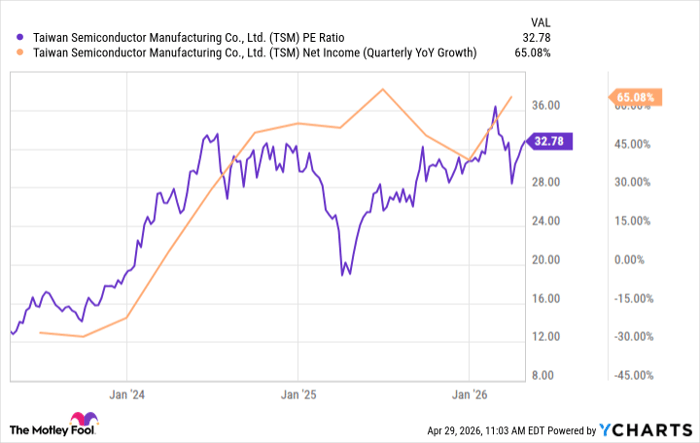
TSM PE Ratio data by YCharts.
However, investors may want to tread carefully here. The stock doesn’t look like a bargain at the current valuation, especially when you consider a key risk: if the supply of a critical raw material from a geopolitically volatile region gets disrupted, actual chip production volumes could take a hit. And that’s not the kind of surprise shareholders like to see.
Moreover, advanced chips account for more than 60% of TSMC's revenue. A helium shortage has the potential to dramatically slow down growth.
According to TrendForce, TSMC accounts for more than 70% of the world's chip production, and it should be well-positioned to keep producing as long as it can obtain helium. Nonetheless, until investors can fully assess the damage to the AI chip supply chain, staying on the sidelines could be a wise course of action.
2. Micron
Micron (NASDAQ: MU) also faces many of the challenges TSMC faces. Its stock has struggled for years before fast-growing demand for high-bandwidth memory (HBM) sent revenues and, ultimately, its stock price to record levels.
Unlike most chip companies, it also operates fabs and makes its own chips. Still, the company depends heavily on its production facilities in Asia. These facilities source their helium supply from the Middle East, a factor that could hamper production.
Indeed, Micron looks like a strong buy at first glance. Revenue for the first half of fiscal 2026 (ended Feb. 26) was up by 123% yearly. Knowing that, its P/E ratio of 25 makes the stock appear very inexpensive.
But here's the problem: Micron stock tends not to sustain premium valuations for long. That’s because memory chips are a cyclical business -- and when the cycle inflects, Micron’s earnings (and share price) can fall quickly. So if the current supply issues hamper Micron's production abilities, the stock could sustain a sharp pullback, despite its recent run.
The good news for Micron is that it will likely sell what it makes in today's environment. Still, as long as its ability to utilize its full production capacity is in question, it is arguably prudent not to buy additional shares.
3. Nvidia
As the dominant player in the AI chip industry, few companies have benefited from the technology more than Nvidia (NASDAQ: NVDA). The AI chip has been so transformational to this company that its data center segment drives 91% of its revenue. That compares to four years ago, when gaming was still Nvidia's largest revenue source.
Still, the downside to this growth is that Nvidia has become disproportionately dependent on its data center segment. As previously mentioned, 2nm and 3nm chips require enormous quantities of helium for production, meaning it may ultimately be selling fewer of these chips than anticipated.
Investors may recall that revenue rose by 65% in fiscal 2026 (ended Jan. 25), and the stock currently trades at 44 times earnings. That may seem cheap considering its most recent growth rate. However, if the helium shortage causes growth to slow (or possibly reverse), Nvidia stock may appear less attractive at that earnings multiple.
Admittedly, the shortage could end at any time, and growth should reaccelerate at that point. Still, with conditions uncertain, it may make sense to preserve one's capital for now.
Should you buy stock in Taiwan Semiconductor Manufacturing right now?
Before you buy stock in Taiwan Semiconductor Manufacturing, consider this:
The Motley Fool Stock Advisor analyst team just identified what they believe are the 10 best stocks for investors to buy now… and Taiwan Semiconductor Manufacturing wasn’t one of them. The 10 stocks that made the cut could produce monster returns in the coming years.
Consider when Netflix made this list on December 17, 2004... if you invested $1,000 at the time of our recommendation, you’d have $497,606!* Or when Nvidia made this list on April 15, 2005... if you invested $1,000 at the time of our recommendation, you’d have $1,306,846!*
Now, it’s worth noting Stock Advisor’s total average return is 985% — a market-crushing outperformance compared to 200% for the S&P 500. Don't miss the latest top 10 list, available with Stock Advisor, and join an investing community built by individual investors for individual investors.
See the 10 stocks »
*Stock Advisor returns as of April 30, 2026.
Will Healy has no position in any of the stocks mentioned. The Motley Fool has positions in and recommends Micron Technology, Nvidia, and Taiwan Semiconductor Manufacturing. The Motley Fool has a disclosure policy.
Recommended Articles


