


The UAE is Leaving OPEC. Here's What It Means for the Global Oil Market.
Key Points
The UAE is withdrawing from OPEC starting next month.
The move will enable the UAE to grow its production without restriction.
U.S. oil companies ExxonMobil and Occidental Petroleum could benefit as they're already operating in the UAE.
- 10 stocks we like better than ExxonMobil ›
The United Arab Emirates (UAE) announced on Tuesday that it will leave OPEC and OPEC+ on May 1. It's a meaningful blow to the cartel of oil-producing nations that effectively control the global oil market by setting supply quotas for its members. The decision comes after fellow OPEC member Iran attacked it with missiles and drones, while also choking off its ability to export oil through the Strait of Hormuz.
The UAE had been a major player in OPEC. Here's how its decision to leave the group could impact the global oil market.
Will AI create the world's first trillionaire? Our team just released a report on the one little-known company, called an "Indispensable Monopoly" providing the critical technology Nvidia and Intel both need. Continue »
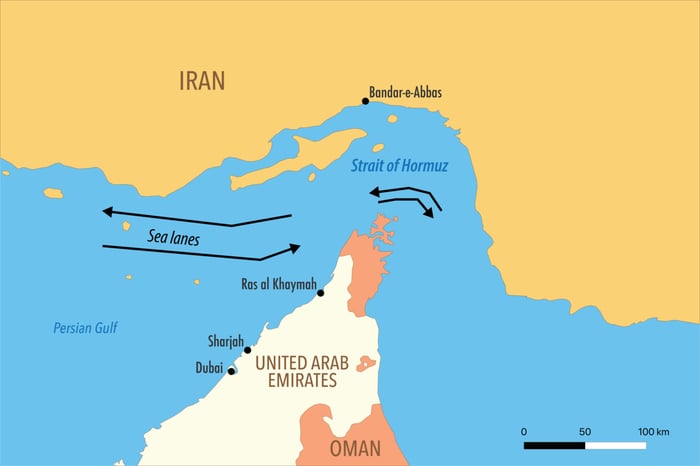
Image source: Getty Images.
A big blow to OPEC
The Organization of Petroleum Exporting Countries (OPEC) formed in 1960 to "coordinate and unify the petroleum policies among member countries." OPEC had five founding members -- Iran, Iraq, Kuwait, Saudi Arabia, and Venezuela -- and has grown over the years to its current group of a dozen countries. The UAE joined its ranks in 1967. It will now exit the group on May 1. It joins several other countries that have left the group over the years, including Qatar (2019) and Angola (2024). The UAE is also leaving OPEC+, a group of 10 non-member nations -- including Russia, Mexico, and Oman -- that work with OPEC to coordinate supply.
The UAE's decision to leave OPEC is a major blow to the group. It's currently the third-largest producer behind Saudi Arabia and Iraq. It has the capacity to produce nearly 4.9 million barrels of oil per day, though its actual output has remained below that level due to OPEC output quotas.
The UAE decided to exit OPEC following a comprehensive review of its production output and future capacity. It believes that leaving OPEC is in its best national interests. The country plans to act responsibly by gradually bringing new production capacity online in alignment with demand and market conditions. However, the move will take the handcuffs off the UAE's oil industry, enabling the country to increase production as it sees fit. That could put some downward pressure on oil prices in the future as OPEC will no longer have a say in how much oil the UAE produces.
The UAE's way forward
The UAE, through its national oil company, ADNOC, has been investing heavily to increase its production capacity. It set a target to reach 5 million barrels per day by 2027, three years ahead of its initial target. The country believes it could increase production to 6 million barrels per day if the market required more output. That would be about 6% of total global demand, making the UAE the fourth-largest global producer behind the U.S., Saudi Arabia, and Russia.
The UAE and ADNOC aren't going it alone. They partner with several leading global energy companies. For example, ExxonMobil (NYSE: XOM) is one of the largest U.S. investors in the country, through joint ventures with ADNOC and others. Exxon's assets in the UAE and Qatar currently comprise 20% of its global production capacity. That has been an issue this year as supply disruptions due to the war impacted its first-quarter production by 6%. However, Exxon could benefit from the UAE's decision to leave OPEC, as it could increase production to support ADNOC and other partners.
Occidental Petroleum (NYSE: OXY) also operates in the UAE. The company has a joint venture with ADNOC on Al Hosn Gas, one of the largest gas developments in the Middle East. Occidental also holds the rights to about 2.5 million acres in the country, which hold several exploration blocks. In 2023, Occidental started producing oil from Onshore Block 3. Additionally, Occidental supplies gas to markets in the UAE through Dolphin Energy, which transports gas produced in Qatar to the UAE and Oman. Occidental should also benefit from the UAE's decision to leave OPEC, as it could open more investment opportunities in the country.
A major development
The UAE's decision to leave OPEC could have a major impact on the oil market. The group will no longer control the UAE's output, enabling it to increase production as it sees fit. That could drive oil prices lower in the future. Meanwhile, the decision could provide more production growth opportunities for U.S. oil companies, including Exxon and Occidental Petroleum, benefiting those oil stocks in the long run.
Should you buy stock in ExxonMobil right now?
Before you buy stock in ExxonMobil, consider this:
The Motley Fool Stock Advisor analyst team just identified what they believe are the 10 best stocks for investors to buy now… and ExxonMobil wasn’t one of them. The 10 stocks that made the cut could produce monster returns in the coming years.
Consider when Netflix made this list on December 17, 2004... if you invested $1,000 at the time of our recommendation, you’d have $492,752!* Or when Nvidia made this list on April 15, 2005... if you invested $1,000 at the time of our recommendation, you’d have $1,327,935!*
Now, it’s worth noting Stock Advisor’s total average return is 991% — a market-crushing outperformance compared to 201% for the S&P 500. Don't miss the latest top 10 list, available with Stock Advisor, and join an investing community built by individual investors for individual investors.
See the 10 stocks »
*Stock Advisor returns as of April 28, 2026.
Matt DiLallo has no position in any of the stocks mentioned. The Motley Fool recommends Occidental Petroleum. The Motley Fool has a disclosure policy.
Recommended Articles


