


History Has a $1 Trillion Warning for SpaceX and Its Prospective Shareholders
Key Points
This may represent the year of the mega-initial public offering (IPO), headlined by Elon Musk's SpaceX, which is seeking a valuation of up to $2 trillion.
Wall Street's largest IPOs have historically fallen flat after their debuts.
Furthermore, SpaceX's price-to-sales ratio is triggering historic bubble warnings.
- 10 stocks we like better than S&P 500 Index ›
If you thought the dot-com era was the peak for initial public offerings (IPOs) on Wall Street, you haven't seen anything yet.
This year has an opportunity to go down as the greatest ever for mega-IPOs. Both leading artificial intelligence (AI) large language model (LLMs) developers, OpenAI and Anthropic, are tinkering with the idea of going public before the year ends. But the crème-de-la-crème of public debuts is expected to be Elon Musk's SpaceX.
Will AI create the world's first trillionaire? Our team just released a report on the one little-known company, called an "Indispensable Monopoly" providing the critical technology Nvidia and Intel both need. Continue »
Image source: Getty Images.
SpaceX is on the verge of becoming the world's largest-ever IPO
On April 1, SpaceX confidentially filed for an IPO, putting the wheels in motion for what should be the biggest IPO in history by a substantial sum. Various reports suggest SpaceX is seeking a $75 billion capital raise, with a market value of between $1.75 trillion and $2 trillion.
To put this figure into perspective, the largest global IPO in history is integrated oil and gas titan Saudi Aramco, which doesn't trade on U.S. exchanges. When Saudi Aramco went public in December 2019, it raised $29.4 billion. SpaceX could potentially raise close to three times this amount, depending on investor interest.
The good news is that investor enthusiasm for the SpaceX IPO should be off the charts.
For starters, it encompasses two of the largest addressable markets on the planet: space and artificial intelligence. McKinsey & Company views the global space economy as a $1.8 trillion global opportunity by 2035, while PwC analysts foresee AI creating $15.7 trillion in global economic value by 2030. Even if these figures have overshot the mark, they demonstrate how high the long-term ceiling is for these game-changing trends.
There's also the Elon Musk factor. Musk took electric-vehicle maker Tesla public in 2010 and turned it into a trillion-dollar company. Musk's lofty visions within the context of space infrastructure, AI data centers, LLMs, and social media (SpaceX also owns social media platform X) should drive sustained, supercharged sales growth.
While there are several ways to gain exposure to SpaceX prior to its upcoming IPO, history suggests a $1 trillion warning looms large for investors.
Image source: Getty Images.
Wall Street's largest IPOs have historically flopped out of the gate
Let me preface the following discussion with a qualifying statement: the past can't predict the future with 100% accuracy. But in the case of the world's largest IPOs, history has been shown to rhyme on more than one occasion.
When large or brand-name companies file to go public, it's not uncommon for investors to be overzealous. The problem is that the luster of newly public companies quickly wears off, based on what history tells us.
Since 1999, we've witnessed five mammoth IPOs domestically, as well as the aforementioned Saudi Aramco debut overseas. Here's what the scoreboard looked like six months after their respective public debuts:
- Alibaba Group: Down 9%
- Visa: Up 23%
- Meta Platforms (NASDAQ: META)(formerly Facebook): Down 38%
- General Motors: Down 8%
- United Parcel Service: Down 11%
- Saudi Aramco: Down 15%
On average, the largest IPOs were down around 10% six months after their debut, which would translate into a potential loss of $200 billion in market cap for SpaceX.
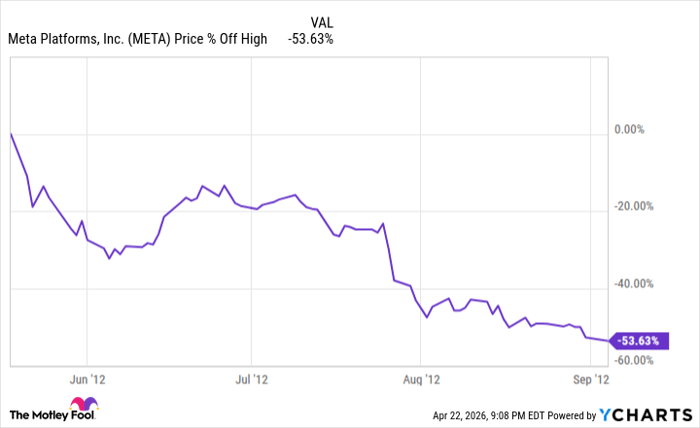
META data by YCharts. Return data from May 18, 2012, to Sept. 4, 2012.
But the closest apples-to-apples comparison from an innovative standpoint is Meta Platforms. Just 3.5 months after Meta's IPO, its shares had plunged by 54%. Although Meta has handily outperformed the benchmark S&P 500 (SNPINDEX: ^GSPC) over the long term, the months following its public debut were dicey, at best.
Meta's underperformance was a direct reflection of its IPO being overpriced, and of investors doubting whether the company could adjust to shifting dynamics (e.g., users shifting from desktop to mobile devices).
SpaceX brings similar concerns to the table. It's operating in highly capital-intensive industries and, with a prospective valuation of $1.75 trillion to $2 trillion, is being priced for perfection among trends we know are imperfect. If SpaceX follows a similar path to Facebook, it could shed $1 trillion in market value in the months following its debut.
SpaceX's price-to-sales ratio points to a historic bubble
However, the past performance of large-scale IPOs isn't the only historical headwind for SpaceX. One time-tested valuation metric -- the price-to-sales (P/S) ratio -- suggests that SpaceX is in trouble.
To be fair, SpaceX hasn't yet released a prospectus ahead of its IPO, so there isn't a lot of hard operational data for investors to pore over. But earlier this year, Reuters reported that SpaceX generated $15 billion to $16 billion in sales in 2025. Keep in mind that this figure doesn't include xAI or social media platform X.
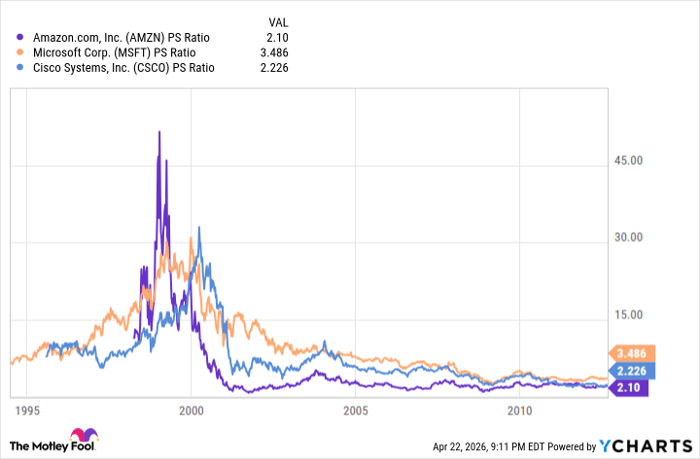
If SpaceX corrals enough investor interest to reach a $2 trillion valuation, it would be trading at a trailing 12-month P/S ratio of 125! Let's put this figure into perspective.
AMZN PS Ratio data by YCharts.
Before the dot-com bubble burst in early 2000, several high-profile companies at the leading edge of the internet revolution peaked at P/S ratios ranging from 30 to 45, with a bit of wiggle room at each end of the spectrum. This arbitrary line in the sand helped identify dot-com-era tops for Microsoft, Cisco Systems, and Amazon.
This arbitrary valuation peak has held true through numerous subsequent next-big-thing trends. In other words, history shows that trailing 12-month P/S ratios above 30 aren't sustainable over extended periods.
Although there's a high probability that SpaceX's prospectus, including xAI and X, will lower the company's P/S ratio below 125, there's an equally good chance that it's still well above 30.
It's not uncommon for publicly traded companies at the forefront of a game-changing trend to eventually shed 50% or more of their value if their P/S ratio exceeds 30. If this bit of history proves accurate, SpaceX could lose $1 trillion (or more) of its market cap.
Though SpaceX might be the most popular IPO we've ever seen, popularity doesn't necessarily translate to profits on Wall Street.
Should you buy stock in S&P 500 Index right now?
Before you buy stock in S&P 500 Index, consider this:
The Motley Fool Stock Advisor analyst team just identified what they believe are the 10 best stocks for investors to buy now… and S&P 500 Index wasn’t one of them. The 10 stocks that made the cut could produce monster returns in the coming years.
Consider when Netflix made this list on December 17, 2004... if you invested $1,000 at the time of our recommendation, you’d have $498,522!* Or when Nvidia made this list on April 15, 2005... if you invested $1,000 at the time of our recommendation, you’d have $1,276,807!*
Now, it’s worth noting Stock Advisor’s total average return is 983% — a market-crushing outperformance compared to 200% for the S&P 500. Don't miss the latest top 10 list, available with Stock Advisor, and join an investing community built by individual investors for individual investors.
See the 10 stocks »
*Stock Advisor returns as of April 26, 2026.
Sean Williams has positions in Amazon, Meta Platforms, and Visa. The Motley Fool has positions in and recommends Amazon, Cisco Systems, Meta Platforms, Microsoft, Tesla, United Parcel Service, and Visa. The Motley Fool recommends Alibaba Group and General Motors. The Motley Fool has a disclosure policy.
Recommended Articles


