


Meet the Biggest Threat to Nvidia in AI Chips. It's Not AMD, Intel, or Broadcom.
Key Points
Alphabet's Tensor Processing Units have been used by tech giants such as Apple and Meta Platforms, as well as AI start-ups like Anthropic.
The tech giant is expected to corner a significant share of the AI chip market in the long run.
- 10 stocks we like better than Alphabet ›
Nvidia (NASDAQ: NVDA) has been the dominant player in the artificial intelligence (AI) chip market over the past three and a half years. Market research firm IDC estimates that it still controls a whopping 81% of the market, despite rising competition from Intel, Advanced Micro Devices, Broadcom, and others over the years.
The good news for Nvidia investors is that it continues to grow rapidly even as rivals have been landing lucrative contracts with hyperscalers and AI companies. AI chips from AMD, Broadcom, and Intel have all been selected for deployment in the infrastructure being developed by OpenAI, Anthropic, Meta Platforms, Microsoft, Amazon, and others.
Will AI create the world's first trillionaire? Our team just released a report on the one little-known company, called an "Indispensable Monopoly" providing the critical technology Nvidia and Intel both need. Continue »
Nvidia has estimated that it will sell a total of $1 trillion worth of chips based on the Blackwell and Vera Rubin architectures in 2026 and 2027. That estimate is well above the $100 billion AI chip revenue that Broadcom is anticipating next year from its application-specific integrated circuits (ASICs). AMD, meanwhile, expects its data center chip revenue to reach $100 billion annually by 2030.
So, Nvidia's scale in AI chips is unmatched. However, there is an emerging threat to it that investors shouldn't ignore -- Alphabet (NASDAQ: GOOG) (NASDAQ: GOOGL). This Magnificent Seven company could make a dent in Nvidia's AI chip market share in the long run.

Image source: Alphabet
Alphabet's long history of developing in-house processors is paying off
The data center chips that Google developed in-house, known as Tensor Processing Units (TPUs), were first deployed to handle internal AI workloads in 2015. The company notes that the TPUs were specifically built for running AI workloads. They've come a long way since then. Google announced its seventh-generation TPU, known as Ironwood, in November.
The company claims that Ironwood is "purpose-built for the most demanding workloads," including the training of large AI models and high-volume AI inference, among other applications. Google made significant improvements to its latest TPU, promising a 4x increase in performance per chip for both training and inference applications as compared to the previous generation.
What's more, Google also offers Axion central processing units (CPUs) -- Arm-based custom AI processors that it claims are 2 times better in price-to-performance terms than chips made on the x86 architecture by Intel and AMD. Coming back to Ironwood, Google has reportedly closed the gap with Nvidia's Blackwell processors.
Not surprisingly, Google's TPUs are in great demand from customers. As reported by The Information in January, Apple is reportedly considering using Google's TPUs to train a more advanced Siri. In fact, Apple revealed a couple of years ago that it used TPUs, not Nvidia's chips, to train AI models for Apple Intelligence.
So, it won't be surprising to see Apple tapping Google's chips once again to support its AI ambitions. However, Google has moved beyond Apple and signed big deals with Anthropic and Meta Platforms to deploy its TPUs and power their AI infrastructure.
AI company Anthropic announced in October 2025 that it will purchase up to 1 million TPUs from Google, as it looks to build 1 gigawatt (GW) of computing capacity in 2026. Anthropic said that the deal is "worth tens of billions of dollars," and said it chose TPUs for their "strong price-performance and efficiency."
In February, it emerged that Meta Platforms had reportedly signed a multibillion-dollar deal to rent Google's TPUs to run AI workloads. Alphabet CEO Sundar Pichai revealed last year that the company is witnessing "substantial demand" for AI infrastructure products. The company believes that TPUs will continue to see strong demand, which is why it is taking steps to meet it by diversifying its supply chain and reportedly bringing in a new ASIC designer, Marvell Technology, to build more chips.
Should Nvidia investors be worried?
DA Davidson analyst Gil Luria asserted in December that Alphabet could capture 20% of the AI chip market if it were to sell its TPUs to third parties. Recent developments indicate that it is willing to do that. Luria added that TPUs could become a $900 billion business for Google in the long run.
If Google eventually captures 20% of the AI chip market, it could become the second-biggest player in AI chips, and dent the 81% share that Nvidia currently commands by a big margin. Assuming the likes of Broadcom and AMD also continue to chip away at Nvidia's share, there is a possibility of its market share shrinking even further.
However, taking a significant share away from Nvidia would be easier said than done. The company has been gearing up for the next phase of AI: agentic applications and inference. It has already announced a massive revenue pipeline for 2026 and 2027. And analysts' consensus estimates suggest that its robust sales growth will continue beyond the next couple of years.
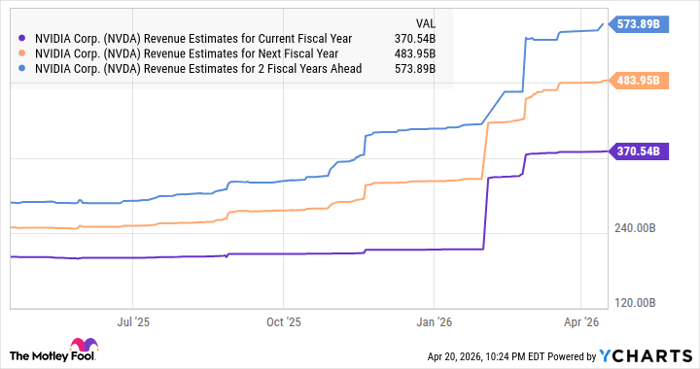
NVDA Revenue Estimates for Current Fiscal Year data by YCharts.
So, while Alphabet could become a thorn in Nvidia's side, the massive spending on AI chips, which is expected to hit $1 trillion in revenue in 2030, could ensure healthy long-term growth in the semiconductor designer's data center business.
Should you buy stock in Alphabet right now?
Before you buy stock in Alphabet, consider this:
The Motley Fool Stock Advisor analyst team just identified what they believe are the 10 best stocks for investors to buy now… and Alphabet wasn’t one of them. The 10 stocks that made the cut could produce monster returns in the coming years.
Consider when Netflix made this list on December 17, 2004... if you invested $1,000 at the time of our recommendation, you’d have $500,572!* Or when Nvidia made this list on April 15, 2005... if you invested $1,000 at the time of our recommendation, you’d have $1,223,900!*
Now, it’s worth noting Stock Advisor’s total average return is 967% — a market-crushing outperformance compared to 199% for the S&P 500. Don't miss the latest top 10 list, available with Stock Advisor, and join an investing community built by individual investors for individual investors.
See the 10 stocks »
*Stock Advisor returns as of April 25, 2026.
Harsh Chauhan has no position in any of the stocks mentioned. The Motley Fool has positions in and recommends Advanced Micro Devices, Alphabet, Amazon, Apple, Broadcom, Intel, Marvell Technology, Meta Platforms, Microsoft, and Nvidia. The Motley Fool has a disclosure policy.
Recommended Articles


