


Prediction: Even If the Strait of Hormuz Reopens Tomorrow, the Helium Crisis Will Haunt Artificial Intelligence (AI) Stocks for Months
Key Points
The damage to Qatar's helium extraction infrastructure will create a multiyear global supply shortage.
A key step in semiconductor production relies on helium, and there is no substitute.
ExxonMobil is a major helium supplier, and its facilities are located on U.S. soil.
- 10 stocks we like better than Linde ›
Here's something that hasn't made enough headlines: The Iran ceasefire didn't fix the world's helium shortage problem. The Strait of Hormuz being militarily contested is how the crisis started. But what actually happened to the physical infrastructure that produces the world's helium is a completely separate story, and that story has a timeline that will extend well beyond any diplomatic agreement.
On March 2, QatarEnergy declared force majeure at its Ras Laffan Industrial City, pausing operations at a facility that has the world's single largest concentration of helium production infrastructure. That month, Iranian drone and missile strikes damaged the facility, and then struck it again. Qatar accounts for roughly 30% to 38% of the world's helium supply. That supply is now offline, and it's unclear when operations will resume. Experts estimate repairs could take three to five years.
Will AI create the world's first trillionaire? Our team just released a report on the one little-known company, called an "Indispensable Monopoly" providing the critical technology Nvidia and Intel both need. Continue »
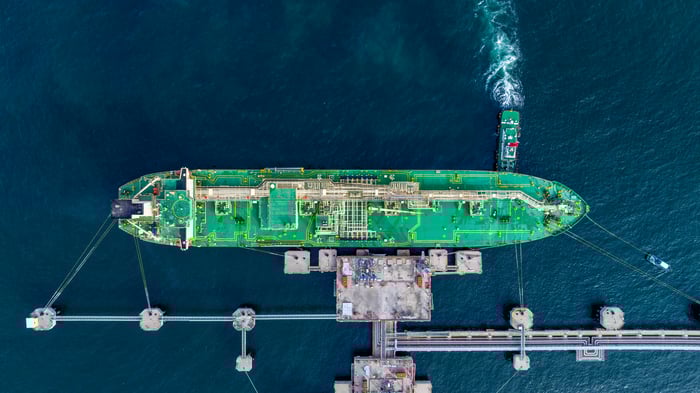
Image source: Getty Images.
Why helium is crucial to the AI sector
Helium plays a role in semiconductor fabrication that has no substitute. During the etching process -- the step that removes unwanted material from silicon wafers to form transistor structures -- helium is blown over the back of the wafer to draw heat away and maintain precise temperature consistency. The gas's unique thermal conductivity makes it irreplaceable in that specific function. The Semiconductor Industry Association warned in 2023 that any disruption to the helium supply chain would create "shocks to the global semiconductor manufacturing industry." That warning was theoretical then. It isn't anymore.
Chipmakers don't stockpile much helium at their fabs -- most facilities keep roughly a week's supply on site. Some chipmakers reportedly hold approximately six months of strategic reserves at the supply chain level, but once that buffer is exhausted, chip yields will drop and output will slow.
Meanwhile, roughly 200 specialized cryogenic shipping containers -- the only units capable of transporting liquid helium -- were effectively stranded in Qatar or in transit when the Strait of Hormuz was closed. These containers cost approximately $1 million apiece, and there aren't many spare ones sitting elsewhere. Even if traffic through the Strait fully resumed today, those containers would need to be repositioned, rerouted, and refilled before Asian chip foundries could receive new supply.
Stocks in the crossfire
While the beneficiaries of this crisis are relatively easy to identify, the list of companies exposed to real pain from it is longer and more consequential for most investors. Micron Technology (NASDAQ: MU) is one of the most direct U.S. names to watch: It manufactures DRAM and high-bandwidth memory (HBM) chips in fabs that depend on continuous helium inflows.
All the high-bandwidth memory that could have been produced through 2026 under normal circumstances was already sold out in advance before a single missile hit Ras Laffan; a helium-driven production slowdown would compound the current shortage into a tech-sector crisis.
Micron's peers in the memory sector, hard drive makers Seagate Technology (NASDAQ: STX) and Western Digital (NASDAQ: WDC) are in similarly uncomfortable positions, but for somewhat different reasons: Every hard drive above 10 terabytes uses helium as an internal gas, and both companies have already reported 20% to 30% price increases on their 2026 production allocations due to the supply shock.
The stocks that might benefit
The clearest beneficiary from a helium shortage is ExxonMobil (NYSE: XOM). Its LaBarge, Wyoming, facility accounts for roughly 20% of the world's helium supply normally. Spot helium prices surged from roughly $500 per thousand cubic feet before the war began to between $1,000 and $1,200 in the weeks following the Ras Laffan shutdown.
Linde (NASDAQ: LIN) is an industrial gas story that most investors are missing entirely. When helium supply is this constrained and inelastic, meaning buyers have no substitute and cannot reduce demand, whoever holds the distribution network holds the pricing power. Linde is the world's largest industrial gas company, with existing long-term helium distribution contracts across the semiconductor, medical, and aerospace sectors. Air Products and French peer Air Liquide are in similar structural positions.
Should you buy stock in Linde right now?
Before you buy stock in Linde, consider this:
The Motley Fool Stock Advisor analyst team just identified what they believe are the 10 best stocks for investors to buy now… and Linde wasn’t one of them. The 10 stocks that made the cut could produce monster returns in the coming years.
Consider when Netflix made this list on December 17, 2004... if you invested $1,000 at the time of our recommendation, you’d have $524,786!* Or when Nvidia made this list on April 15, 2005... if you invested $1,000 at the time of our recommendation, you’d have $1,236,406!*
Now, it’s worth noting Stock Advisor’s total average return is 994% — a market-crushing outperformance compared to 199% for the S&P 500. Don't miss the latest top 10 list, available with Stock Advisor, and join an investing community built by individual investors for individual investors.
See the 10 stocks »
*Stock Advisor returns as of April 18, 2026.
Micah Zimmerman has no position in any of the stocks mentioned. The Motley Fool has positions in and recommends Micron Technology and Western Digital. The Motley Fool recommends Linde. The Motley Fool has a disclosure policy.
Recommended Articles


