


Most Investors Have Never Heard of This Semiconductor Stock. That's About to Change.
Key Points
Electricity costs are soaring, largely because artificial intelligence data centers are consuming so much of it.
As a result, data center owners and operators are considering all options to reduce their total operating costs.
Navitas Semiconductor has cleverly figured out how to deliver a significant step-up in power efficiency.
- 10 stocks we like better than Navitas Semiconductor ›
Most investors are familiar with major chipmaker names like Nvidia and Broadcom. And rightfully so. Not only are these companies among the biggest in the business, but their hardware is the heart and soul of the artificial intelligence (AI) revolution.
As time marches on, though, smaller semiconductor specialists are finding ways to make a difference, making a name for themselves and rewarding investors in the process. Navitas Semiconductor (NASDAQ: NVTS) is one of these outfits. Here's what you need to know.
Will AI create the world's first trillionaire? Our team just released a report on the one little-known company, called an "Indispensable Monopoly" providing the critical technology Nvidia and Intel both need. Continue »
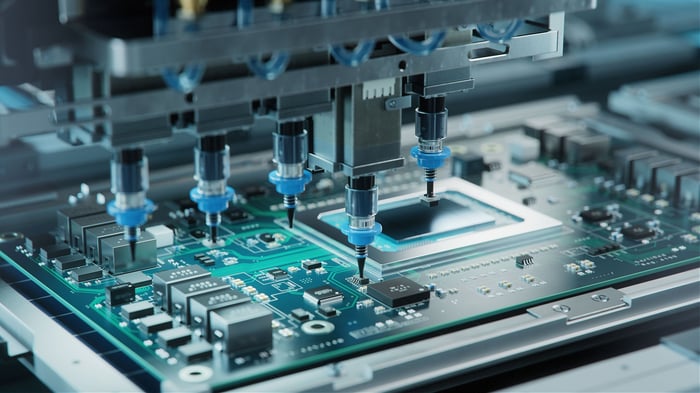
Image source: Getty Images.
What's Navitas Semiconductor?
Unlike the aforementioned Nvidia, Navitas Semiconductor doesn't design and sell computer processors. Rather, its core business is the design and manufacture of silicon carbide-based and gallium nitride-based chips and circuitry that manage, convert, and deliver power to processors and other electronic components.
That won't mean much to a lot of people, but this will: Silicon carbide and gallium nitride are far more power-efficient and durable than the materials (like ordinary silicon) being used in most modern-day electronics and electrically powered equipment. You'll increasingly find its tech inside electric vehicle chargers, mobile devices, solar power systems, and yes, AI data centers. In fact, for perspective, the company's new gallium nitride-based 10 kW 800-volt–to–50-volt DC-DC converter meant for use in data centers offers up to 98.5% power efficiency.
And the need for such efficiency has never been greater.
Data centers' ever-worsening downside
Although AI is doing some amazing things, it's coming at a cost. It takes an enormous amount of electricity to power AI data centers. A single GPU handling artificial intelligence duties requires about five times as much power as a processor found inside a typical home or work computer, while an average AI data center can consume enough electricity to power a decent-sized town.
The industry isn't done growing, either. Based on data from the International Energy Agency, Pew Research reports that the electricity U.S. data centers alone currently use is set to double by 2030.
This fast-growing consumption, of course, is pushing energy prices higher. Numbers from the U.S. Bureau of Labor Statistics indicate the nation's average cost of electricity has risen more than 40% over the past six years and more than 15% in just the past three, in step with the rapid proliferation of data centers.
In other words, every cost-cutting measure matters and is now being viewed as an investment rather than an expense.
An erratic tailwind is still a tailwind
While the philosophical tailwind is in place, that doesn't mean every industry that can benefit from more power-efficient electricity use is embracing Navitas Semiconductor's technology. It's somewhat expensive, which is part of the reason last year's revenue was down 45% from 2024's top line. The company's bottom line also remains in the red.
Nevertheless, the stock's been performing well -- if erratically -- since last April's multi-year low, as the need for better electricity-management solutions becomes clear.
To this end, Mordor Intelligence expects the global silicon carbide market to grow by nearly 11% per year through 2031, while the gallium nitride semiconductor business grows at an average annual pace of nearly 17% for the same time frame. Navitas is well-positioned to capture at least its fair share of this growth.
Should you buy stock in Navitas Semiconductor right now?
Before you buy stock in Navitas Semiconductor, consider this:
The Motley Fool Stock Advisor analyst team just identified what they believe are the 10 best stocks for investors to buy now… and Navitas Semiconductor wasn’t one of them. The 10 stocks that made the cut could produce monster returns in the coming years.
Consider when Netflix made this list on December 17, 2004... if you invested $1,000 at the time of our recommendation, you’d have $524,786!* Or when Nvidia made this list on April 15, 2005... if you invested $1,000 at the time of our recommendation, you’d have $1,236,406!*
Now, it’s worth noting Stock Advisor’s total average return is 994% — a market-crushing outperformance compared to 199% for the S&P 500. Don't miss the latest top 10 list, available with Stock Advisor, and join an investing community built by individual investors for individual investors.
See the 10 stocks »
*Stock Advisor returns as of April 18, 2026.
James Brumley has no position in any of the stocks mentioned. The Motley Fool has positions in and recommends Broadcom and Nvidia. The Motley Fool has a disclosure policy.
Recommended Articles


