


Dividend Stocks Are Beating the Market in 2026. Here Is Why That Makes Sense Right Now.
Key Points
Dividend stocks have dramatically lagged since late 2022.
With worries that AI stocks won’t be able to justify their steep valuations, investors are rethinking what their portfolios should look like.
Even if there’s not a great deal to worry about here, growth stocks’ risk-versus-reward profiles at this time don’t look all that different than those of dividend stocks.
- These 10 stocks could mint the next wave of millionaires ›
Despite the recent market recovery, 2026 so far hasn't exactly been a great one for stocks as a whole. As of the latest look, the SPDR S&P 500 ETF Trust (NYSEMKT: SPY) and its underlying S&P 500 index (SNPINDEX: ^GSPC) are up just over 4% for the year. Both have also been volatile and still seem vulnerable.
Not every name has struggled this year, however. Thanks to a strong start right out of the gate, dividend stocks are well up. Indeed, the Schwab U.S. Dividend Equity ETF (NYSEMKT: SCHD) -- built to mirror the Dow Jones U.S. Dividend 100™ Index -- has performed particularly well. It's up 13% since the end of 2025, and holding its ground.
Will AI create the world's first trillionaire? Our team just released a report on the one little-known company, called an "Indispensable Monopoly" providing the critical technology Nvidia and Intel both need. Continue »
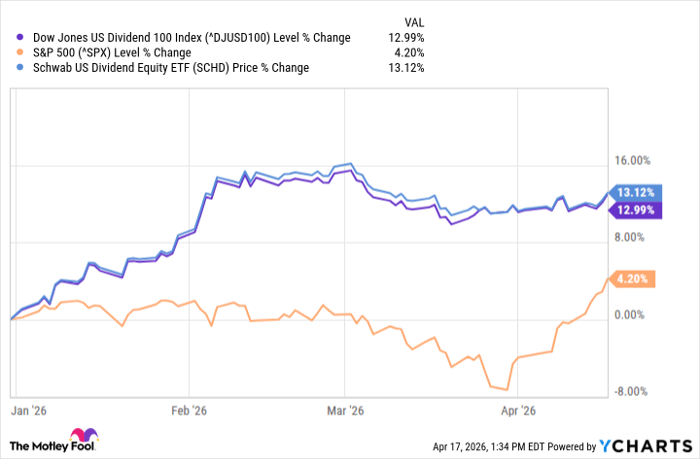
Data by YCharts.
This performance disparity actually makes a lot of sense.
Role reversal
Contrary to a common assumption, most of the time, all of the market's stocks (regardless of sector, style, or size) rise and fall as a whole. Some rise or fall more than others. But they all tend to move in the same general direction. Every now and then, though, things get ... strange.
That's largely been the case since late 2022, when OpenAI's ChatGPT first launched, with AI-mania fully taking hold shortly thereafter. Value stocks and dividend stocks have made some bullish progress from that point, but growth stocks have gained more than twice as much as value stocks since then, and more than five times as much as true dividend stocks.
As the old adage goes, though, nothing lasts forever. Things change.

Image source: Getty Images.
The change in this instance is an obvious one. That is, investors are rethinking the value of artificial intelligence relative to its cost. Plenty of people were shell-shocked by how much companies like Oracle, Microsoft, and Alphabet were intending to spend on AI infrastructure again this year, with not quite enough to show for their AI investments so far. This dynamic, paired with lingering inflation that could lead to a full-blown recession, has suddenly had investors thinking defensively again. Cash dividends -- as modest as they may be -- from dividend stocks are better than simply watching your growth stock holdings lose ground.
Looking ahead
The conundrum, of course, is that we may well avoid entering such an economic headwind, reigniting interest in growth stocks at the expense of value names in general, and dividend payers in particular (most decent dividend stocks are also value stocks).
Even if we are able to sidestep a recession, however, somehow it feels like the very best and most bullish days of the artificial intelligence revolution are in the rearview mirror. Going forward, even the most aggressive of investors are apt to be more discerning and willing to buy and hold dividend payers that they may not have been interested in owning between 2023 and 2025.
In other words, there's a strong case for buying dividend stocks that are outperforming this year. The Schwab U.S. Dividend Equity ETF would be an easy way to gain instantaneous and well-diversified exposure to this group.
Where to invest $1,000 right now
When our analyst team has a stock tip, it can pay to listen. After all, Stock Advisor’s total average return is 1,016%* — a market-crushing outperformance compared to 197% for the S&P 500.
They just revealed what they believe are the 10 best stocks for investors to buy right now, available when you join Stock Advisor.
See the stocks »
*Stock Advisor returns as of April 18, 2026.
James Brumley has positions in Alphabet. The Motley Fool has positions in and recommends Alphabet, Microsoft, and Oracle. The Motley Fool has a disclosure policy.
Recommended Articles


