


Want to Invest $1,000 in SpaceX? Here's What History Has to Say.
Key Points
Historical data shows that IPOs underperform the broader market by nearly 20% over three years, on average, with results varying widely by company type.
Recent mega-IPOs like Meta Platforms (formerly Facebook), Uber, and Rivian demonstrate wildly different outcomes -- from 16x returns to 80% losses.
- These 10 stocks could mint the next wave of millionaires ›
SpaceX has officially filed for what could be the largest initial public offering (IPO) in American history, targeting a valuation of $2 trillion -- making it larger than Elon Musk's Tesla. That kind of number gets investors excited, but before you set aside $1,000 for opening day, it's worth looking at what the data actually says about buying into IPOs at these kinds of valuations.
What the historical data tells us about IPO performance
Jay Ritter, a finance professor at the University of Florida who's spent decades studying IPOs -- his nickname is "Mr. IPO" -- has built one of the most comprehensive data sets on IPO performance around. Ritter's research shows that, on average, IPOs underperform comparable public companies, and in the first three years, lose to the broader market by nearly 20%.
Will AI create the world's first trillionaire? Our team just released a report on the one little-known company, called an "Indispensable Monopoly" providing the critical technology Nvidia and Intel both need. Continue »
Image source: Getty Images.
Of course, this is just an average, and different kinds of companies tend to perform very differently -- SpaceX belongs to a few of these subcategories. SpaceX has massive revenue, and these companies barely underperform, off by just 2.3%. On the other hand, as a (mostly) non-tech company, it's part of another cohort that underperforms by nearly 25%.
What if we get more specific? Let's consider some recent IPOs that are comparable -- large scale, high retail interest, high valuation. What would $1,000 invested at IPO be worth today?
The good: Meta's blockbuster IPO success story
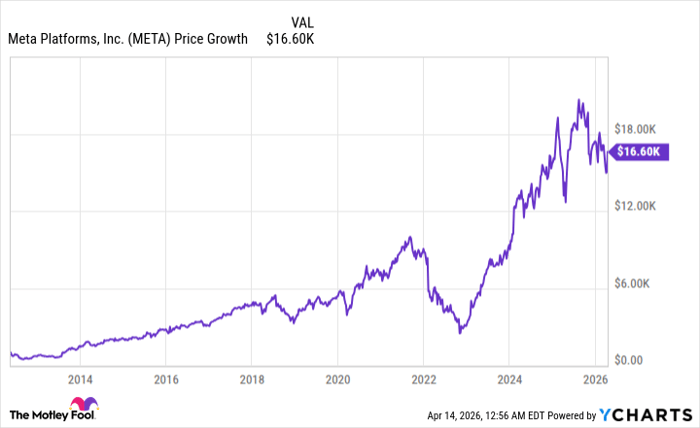
Meta Platforms (May 2012 -- IPO at $38): Meta (then Facebook) went public at a $104 billion valuation with roughly $1 billion in revenue. While there was an initial dip that took years to recover from, Meta IPO investors went on to experience absolutely fantastic gains. Your $1,000 invested at IPO would be worth about $16,600 today.
META data by YCharts
The bad: Uber's underwhelming returns
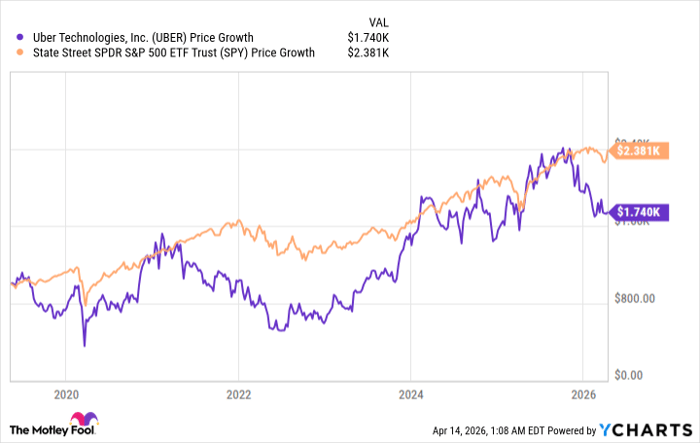
Uber Technologies (May 2019 -- IPO at $45): Uber went public at an $82 billion valuation. Seven years later, shares trade around $72. Your $1,000 would be worth roughly $1,740 today -- about a 60% total return over seven years. That's not terrible by any means, but it failed to keep up with the market. The same investment in, say, the State Street SPDR S&P 500 ETF Trust would be worth $2,380 today.
UBER data by YCharts
The ugly: Rivian's cautionary tale
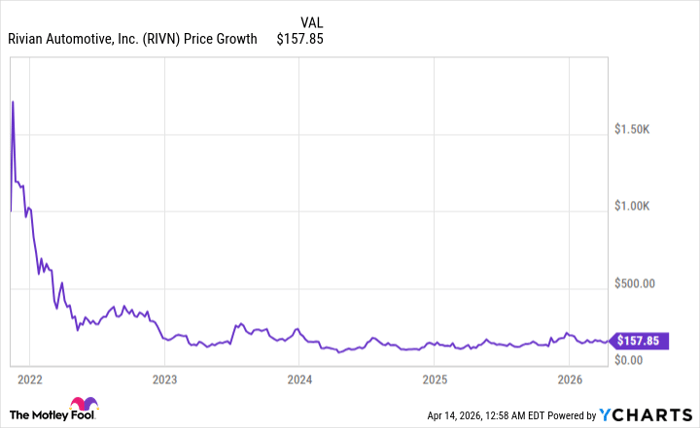
Rivian Automotive (November 2021 -- IPO at $78): Rivian went public at a $66.5 billion valuation with virtually no revenue, but a whole lot of hype. The stock briefly rocketed above $170 in the post-IPO frenzy, but shares sit around $15.50 today. Your $1,000 would have turned into about $198 -- an 80% loss.
RIVN data by YCharts
Why big IPOs often disappoint retail investors
IPOs often underperform for a few structural reasons that apply directly to SpaceX.
First, the easy money has already been made. By the time SpaceX goes public at a $2 trillion valuation, the venture capitalists, early employees, and private-market investors have already captured the exponential growth phase.
Second, IPOs, especially those with massive retail interest, tend to go public during windows of maximum optimism. Companies and bankers aren't stupid -- they choose to sell when enthusiasm -- and often hype -- is highest. That means retail investors are often buying at inflated valuations.
The bottom line on the SpaceX IPO
I'm not saying SpaceX is a bad company -- far from it. I mean, it builds reusable rockets -- that's incredible. It's one of the most impressive private companies in a generation. But being a great company and being a great IPO investment are two very different things.
Between Ritter's data and a slew of examples of recent mega-IPOs underperforming, I would suggest you wait before putting $1,000 into the SpaceX IPO. I think it's likely the price will pop quickly, then reverse course and trade well under its IPO price. That would be a smarter time to jump in.
Where to invest $1,000 right now
When our analyst team has a stock tip, it can pay to listen. After all, Stock Advisor’s total average return is 1,016%* — a market-crushing outperformance compared to 197% for the S&P 500.
They just revealed what they believe are the 10 best stocks for investors to buy right now, available when you join Stock Advisor.
See the stocks »
*Stock Advisor returns as of April 17, 2026.
Johnny Rice has positions in SPDR S&P 500 ETF Trust. The Motley Fool has positions in and recommends Meta Platforms, Tesla, and Uber Technologies. The Motley Fool has a disclosure policy.
Recommended Articles


