


Trump's Iran Strategy Is Redrawing the Map for Oil -- 3 Energy Stocks Built to Outlast the Headlines
Key Points
Archrock is a behind-the-scenes LNG infrastructure play with long-term, fee-based contracts that benefit from structurally rising U.S. gas exports.
Ovintiv is aggressively returning cash to shareholders, capitalizing on strong oil prices while acknowledging long-term uncertainty.
HF Sinclair profits from volatility itself, with a refining model that can win whether oil prices rise or fall.
- 10 stocks we like better than Archrock ›
News of a temporary ceasefire in the Iran war sent oil prices down by more than 15% in a single session in early April. Headlines declared the energy trade crisis was over. Investors who bought oil stocks for the war premium began panic-selling. And right on cue, most of the conversation about energy stocks pivoted back to "What happens next?"
That's the wrong question for a long-term investor. The right question is: Which energy companies were already well-positioned before the Iran war and are now even better-positioned because of what the conflict revealed?
Will AI create the world's first trillionaire? Our team just released a report on the one little-known company, called an "Indispensable Monopoly" providing the critical technology Nvidia and Intel both need. Continue »
The answer to this more detailed question isn't the supermajors, as their stocks already spiked and their valuations are not cheap. The value here is in a layer below: companies whose businesses were structurally strengthened by the disruption, and whose stock prices didn't fully reflect it going in or coming out. Let's take a closer look at three energy stocks built to outlast this short-term disruption.
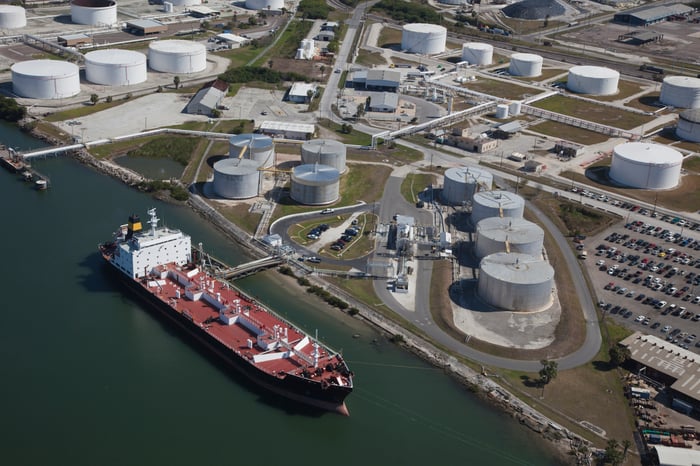
Image source: Getty Images.
1. Archrock is the backbone of a market that won't slow down
The Iran war did something to the natural gas market that most people haven't fully absorbed yet: It exposed how dependent the global energy system is on U.S. liquefied natural gas (LNG) exports as a useful alternative. When the Strait of Hormuz was effectively closed, and Persian Gulf energy flows ground to a halt, the world looked to American liquefied natural gas to fill the gap. That demand didn't disappear when the ceasefire was announced. It accelerated.
Archrock (NYSE: AROC) sits at an unglamorous but essential point in that infrastructure: It provides the compression services that move natural gas from the wellhead to the pipeline to the export terminal. Without compression, gas doesn't move. The Energy Information Administration (EIA) now projects U.S. LNG exports to rise from 15.1 billion cubic feet per day in 2025 to 18.1 billion cubic feet per day by 2027. Archrock has 85% of its 2026 production capacity already contracted, and it has begun booking capacity for 2027 deliveries.
This stock is attractive because it has a fee-based infrastructure story with multiyear visibility, insulated from commodity swings because Archrock's contracts run approximately six years. Management says the company has shifted some production toward large-horsepower, electric-motor-driven compression to better serve the highest-demand customers. U.S. natural gas production is on track for its sixth consecutive record year.
The Iran conflict didn't create that trend. It just proved, in the most dramatic way possible, why it matters.
2. Ovintiv is paying shareholders like it's running out of time -- because oil might be
There is tension at the center of Ovintiv's (NYSE: OVV) story: It's an oil and gas producer with great assets, operating in an industry where the long-term regulatory and energy transition picture is uncertain. Ovintiv's leadership understands this. The company spent 2025 and early 2026 aggressively simplifying its portfolio, selling its Anadarko Basin assets, acquiring NuVista to strengthen its Canadian Montney position, and concentrating resources in two of the highest-margin basins in North America: the Permian and the Montney.
Then, in February 2026, it announced a new shareholder return framework: at least 75% of free cash flow to be returned to shareholders in 2026, backed by a $3 billion share repurchase program. That's a company that believes the best use of its cash is in the hands of its shareholders, not buried in incremental production.
The Iran war came along and provided a tailwind for Ovintiv -- oil surged well above $100 a barrel for weeks. Even with the ceasefire pulling prices back toward $90, the global supply picture remains tighter than pre-war levels. There are conflicting stories about whether the Strait of Hormuz is fully open, and the Iran conflict has not ended. It really is just paused.
For a producer with a cost structure aided by its concentration in the Permian and Montney, current prices leave substantial free cash flow even in a partial price retreat. Ovintiv isn't betting that oil will stay high forever. It's returning cash now, while the window is open.
3. HF Sinclair wins when oil prices are high and when they fall
Most people think energy stocks simply track oil prices, but HF Sinclair (NYSE: DINO) is different. As a refiner, it profits from the spread between crude costs and refined product prices. When disruptions tighten crude supply without hurting demand, that spread can widen.
HF Sinclair operates seven U.S.-based refineries with 678,000 barrels per day of capacity, plus a growing lubricants and renewables business. Its 2026 acquisition of Industrial Oils Unlimited expanded its higher-margin specialties segment, and Morningstar flagged the stock as undervalued last year.
When oil surged above $100 during the Iran conflict, margins tightened. As prices fall toward $90, refining profit margins improve. HF Sinclair is positioned to perform in both environments.
Should you buy stock in Archrock right now?
Before you buy stock in Archrock, consider this:
The Motley Fool Stock Advisor analyst team just identified what they believe are the 10 best stocks for investors to buy now… and Archrock wasn’t one of them. The 10 stocks that made the cut could produce monster returns in the coming years.
Consider when Netflix made this list on December 17, 2004... if you invested $1,000 at the time of our recommendation, you’d have $581,304!* Or when Nvidia made this list on April 15, 2005... if you invested $1,000 at the time of our recommendation, you’d have $1,215,992!*
Now, it’s worth noting Stock Advisor’s total average return is 1,016% — a market-crushing outperformance compared to 197% for the S&P 500. Don't miss the latest top 10 list, available with Stock Advisor, and join an investing community built by individual investors for individual investors.
See the 10 stocks »
*Stock Advisor returns as of April 17, 2026.
Micah Zimmerman has no position in any of the stocks mentioned. The Motley Fool has no position in any of the stocks mentioned. The Motley Fool has a disclosure policy.
Recommended Articles


