


The Iran War Shock Emphasizes Exactly Why a Low‑Cost S&P 500 ETF Belongs at the Core of Every Long‑Term Portfolio
Key Points
Though many investors are still bracing for a recession, Wall Street has proven resilient so far.
The S&P 500 ETF is a particularly strong choice during periods of uncertainty.
Long-term investors can take advantage of the stability and potentially lucrative returns this investment offers.
- 10 stocks we like better than S&P 500 Index ›
After a consistent downslide since February, the S&P 500 (SNPINDEX: ^GSPC) made a comeback this week and just reached a new record high. As of this writing, the index is now up close to 3% so far this year and nearly 32% over the last 12 months.
Much of the recent volatility stems from the war in Iran, which has driven oil prices higher and sent ripples through global markets. While experts are still warning that higher inflation could slow the economy and potentially trigger a recession, Wall Street appears resilient.
Will AI create the world's first trillionaire? Our team just released a report on the one little-known company, called an "Indispensable Monopoly" providing the critical technology Nvidia and Intel both need. Continue »
If there's a lesson investors can take away from the recent stock market shock and almost immediate recovery, it's that an S&P 500 ETF is a powerhouse investment in uncertain times.

Image source: Getty Images.
A lucrative investment that can still limit risk
One of the primary advantages of investing in an S&P 500 ETF is its widespread diversification. This type of fund holds stocks from 500 of the largest U.S. companies, providing exposure to industry leaders across all market sectors.
This level of diversification can help balance risk and reward. If one industry is hit harder during periods of volatility, there are plenty of other stocks to help prop up the fund. At the same time, the index's wide reach also provides access to sectors experiencing sudden growth.
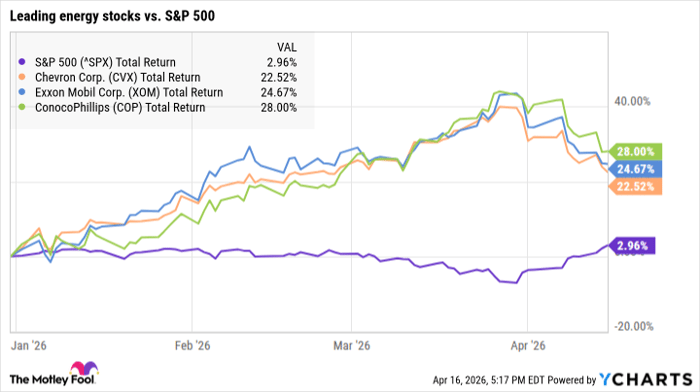
For example, many investors have been heavily focused on tech stocks in recent years, as the sector has experienced astonishing growth driven by advances in artificial intelligence. But since the conflict in the Middle East began, many energy stocks have popped.
^SPX data by YCharts
ExxonMobil, Chevron, and ConocoPhillips, for example, are leading energy stocks in the S&P 500, and they've all significantly outperformed the index so far this year. This may have somewhat improved the S&P 500's overall performance, preventing even steeper drawdowns as other industries took a turn for the worse.
By investing in an S&P 500 ETF, investors gain exposure to all of these large energy stocks, as well as the ever-popular tech giants and companies from more established, recession-proof industries.
Take the guesswork out of investing
If the last few weeks have shown us anything, it's that the market can be incredibly unpredictable in the short term.
Many investors may have considered selling their stocks when the market began to sink, but those who held on through the volatility have profited the most from this recovery. Historically, this approach has proven to be lucrative.
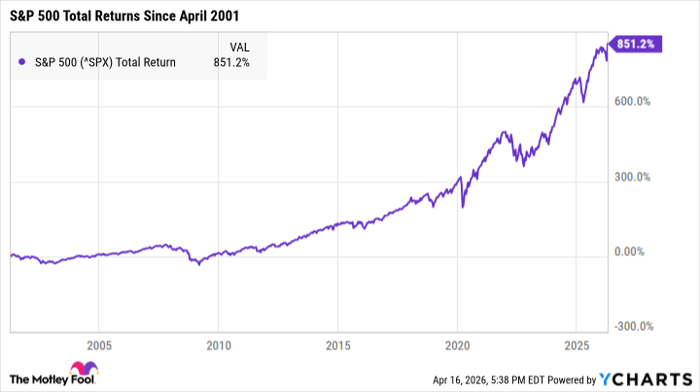
In the last 25 years alone, the S&P 500 has earned total returns of more than 850%. Keep in mind that during that period, the U.S. experienced major downturns like the tail end of the dot-com bubble burst, the Great Recession, the COVID-19 crash, and the bear market in 2022 spurred by runaway inflation.
^SPX data by YCharts
If you had invested $5,000 in an S&P 500 ETF 25 years ago, you'd have around $48,000 today. That's assuming you made no additional contributions in that time. By investing smaller amounts regularly, you could potentially earn even more.
Throughout its history, the S&P 500 itself has earned an average rate of return of around 10% per year. At that rate, if you were investing $200 per month, here's approximately how much you could accumulate over time:
| Number of Years | Total Portfolio Value |
|---|---|
| 10 | $38,000 |
| 15 | $76,000 |
| 20 | $137,000 |
| 25 | $236,000 |
| 30 | $395,000 |
Data source: Author's calculations via investor.gov.
There are no guarantees in the stock market, but the S&P 500 offers a century's worth of history surviving even the worst recessions, crashes, bear markets, and everything in between.
To be clear, the S&P 500 ETF is not immune to short-term volatility, so investors should still brace themselves for regular ups and downs. However, despite many previous wars, inflation surges, tech bubbles, and other unprecedented events, the index has continued to thrive over several decades.
Nobody knows what the market will do in the coming months, but the S&P 500 has proven time and time again that it has staying power. For investors seeking both stability and potentially lucrative long-term returns, an S&P 500 ETF could be a smart buy right now.
Should you buy stock in S&P 500 Index right now?
Before you buy stock in S&P 500 Index, consider this:
The Motley Fool Stock Advisor analyst team just identified what they believe are the 10 best stocks for investors to buy now… and S&P 500 Index wasn’t one of them. The 10 stocks that made the cut could produce monster returns in the coming years.
Consider when Netflix made this list on December 17, 2004... if you invested $1,000 at the time of our recommendation, you’d have $581,304!* Or when Nvidia made this list on April 15, 2005... if you invested $1,000 at the time of our recommendation, you’d have $1,215,992!*
Now, it’s worth noting Stock Advisor’s total average return is 1,016% — a market-crushing outperformance compared to 197% for the S&P 500. Don't miss the latest top 10 list, available with Stock Advisor, and join an investing community built by individual investors for individual investors.
See the 10 stocks »
*Stock Advisor returns as of April 17, 2026.
Katie Brockman has no position in any of the stocks mentioned. The Motley Fool has no position in any of the stocks mentioned. The Motley Fool has a disclosure policy.
Recommended Articles


