


This Monopoly Stock Powers Every AI Chip on the Planet, and It's Down Over 14% This Month
Key Points
ASML has a monopoly on the EUV lithographs required for advanced chip production.
The only potential competitor is a Chinese prototype that is unlikely to be ready for production until 2028 or 2030.
The company's new orders doubled quarter over quarter at the end of 2025 and it has very strong financials.
- 10 stocks we like better than ASML ›
It's rare to find a company that has a true monopoly on its industry.
It's even rarer when that company has no meaningful competition in any form ready to break into the market and claim some of it.
Will AI create the world's first trillionaire? Our team just released a report on the one little-known company, called an "Indispensable Monopoly" providing the critical technology Nvidia and Intel both need. Continue »
And it's rarer still when that company isn't resting on its laurels and is still innovating on the product or service that made it a monopoly in the first place.
Yet, ASML Holding N.V. (NASDAQ: ASML) is all of those things and more.
It's the world's only provider of the extreme ultraviolet (EUV) lithography machines needed to produce the semiconductors that every artificial intelligence (AI) chip needs to function.
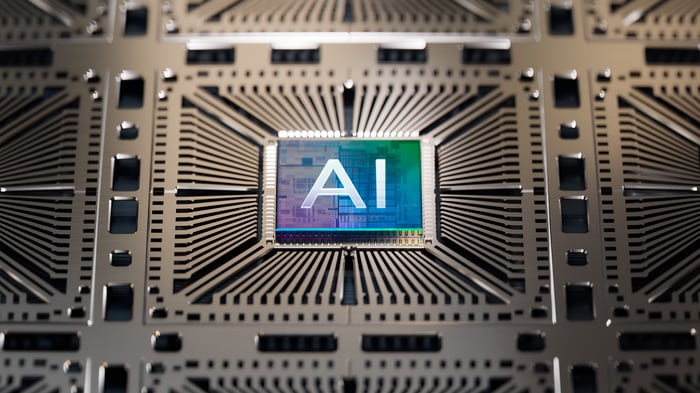
Image source: Getty Images.
The only potential competitor to ASML's machines is a Chinese prototype that was unveiled in December but that won't be ready for primetime until 2028 or 2030.
Even then, ASML is still innovating with its EUV technology and it's planning to boost the power of its machines to increase chip production 50% by the end of the decade. So, even if China's competitor goes to mass production, ASML's machines will still be more advanced by years.
The shares roughly doubled during the past year until this month, when they declined 14% in a market dragged down by geopolitical tensions.
Though the average analyst price projection for a year from now is for a 24% gain, the top estimates have ASML at almost $2,000 per share, a 60% gain. This makes the recent dip look like a decent buying opportunity. Here's why you should consider it.
Behind the scenes
ASML is an odd company for many reasons, but one of the most interesting is the fact that it operates quietly behind the scenes of the entire tech industry. Every manufacturer producing semiconductor chips of 7 nanometers (nm) or smaller needs its EUV lithographs.
There is simply no other option.
And 7nm and smaller chips are what AI relies upon as well as many smartphones and other consumer electronics you use daily.
Each machine is roughly the size of a bus and costs $400 million dollars. Once completed, it takes seven Boeing 747s or 25 trucks to get a single machine to the customer who ordered it.
The lithographs use an incredibly powerful and precise laser to etch patterns into silicon to turn it into semiconductor chips. Older deep ultraviolet (DUV) lithographs produced by a handful of other companies work in a similar way, but are incapable of the same precision as ASML's EUV lithograph.
And with semiconductor chips in incredibly high demand, in particular memory chips, companies around the world are clamoring for ASML's machines.
On March 24, SK Hynix, one of three companies that dominate the global memory hardware industry, ordered $8 billion worth of EUV lithographs from ASML to scale up its memory chip production.
SK Hynix isn't alone. When ASML reported its Q4 and full-year 2025 results at the end of January, the most impressive figure wasn't the company's revenue, profit, or even its margin -- it was the fact that ASML's net bookings more than doubled from 5,399 in Q3 2025 to 13,158 in Q4 2025.
For the full year, ASML saw its orders increase from 18,899 in 2024 to 28,035 in 2025.
Demand is high and accelerating and it showed in the rest of ASML's earnings report.
Quietly dominating the entire tech industry
The whole of 2025 saw ASML's revenue top 32.6 billion euros ($37.3 billion), up 15% from 2024. Its earnings per share (EPS) for the year rose 28% over 2024.
On top of that, despite the fact that its machines are incredibly expensive to produce, ASML has a very healthy net profit margin of 29%. And it runs a very healthy balance sheet with a total debt-to-equity ratio of 0.22.
While ASML's current price/earnings-to-growth (PEG) ratio is at 2.2 at present, it still seems like a decent value. Because numbers like the PEG ratio only really tell you something when you have other companies in the same industry to compare.
But ASML is one of a kind. It's simultaneously the most overvalued and undervalued company in its industry because it's really the only company in its industry.
Given that the only potential competitor is still years away from mass production, and will still likely be considerably less capable than ASML's machines when the first ones do roll off the assembly line, I think ASML will remain the king of the hill for the foreseeable future.
Consider adding a few shares to your portfolio while it's down. Because I don't think it's staying down for too long.
Should you buy stock in ASML right now?
Before you buy stock in ASML, consider this:
The Motley Fool Stock Advisor analyst team just identified what they believe are the 10 best stocks for investors to buy now… and ASML wasn’t one of them. The 10 stocks that made the cut could produce monster returns in the coming years.
Consider when Netflix made this list on December 17, 2004... if you invested $1,000 at the time of our recommendation, you’d have $503,861!* Or when Nvidia made this list on April 15, 2005... if you invested $1,000 at the time of our recommendation, you’d have $1,026,987!*
Now, it’s worth noting Stock Advisor’s total average return is 884% — a market-crushing outperformance compared to 179% for the S&P 500. Don't miss the latest top 10 list, available with Stock Advisor, and join an investing community built by individual investors for individual investors.
See the 10 stocks »
*Stock Advisor returns as of March 31, 2026.
James Hires has no position in any of the stocks mentioned. The Motley Fool has positions in and recommends ASML and Boeing. The Motley Fool has a disclosure policy.
Recommended Articles


