


Is This Popular Quantum Computing Stock Heading for an 80% Crash?
Key Points
Quantum computing could transform certain industries, but commercialization might be further off than investors think.
Rigetti Computing has built some of the most accurate quantum systems to date, and yet its revenue plummeted last year.
Rigetti stock is already down 72% from its record high, but it's still trading at an unsustainable valuation.
- 10 stocks we like better than Rigetti Computing ›
Quantum computers use a concept called superposition to simulate multiple different solutions to a problem at once, so they can reach conclusions from enormous data sets much faster than classical computers. Therefore, they have the potential to transform industries like science and cryptography.
Quantum computing stocks were red-hot in 2025, as investors piled into the sector believing this revolutionary technology was inching closer to commercialization. But even the best quantum systems are still making too many errors to solve real-world problems, so the initial euphoria from last year has evaporated.
Will AI create the world's first trillionaire? Our team just released a report on the one little-known company, called an "Indispensable Monopoly" providing the critical technology Nvidia and Intel both need. Continue »
Rigetti Computing (NASDAQ: RGTI) is one of the industry's leaders, and it's already generating real revenue from its quantum systems. However, its stock is currently down more than 70% from last year's peak, as investors appear to have overestimated the company's growth trajectory. Unfortunately, it's still trading at a sky-high valuation. Here's why further losses of more than 80% might be on the horizon.

Image source: Getty Images.
A long road to commercialization
A quantum computer's gate fidelity largely determines its usefulness in the real world. It measures the accuracy of each quantum operation, and a higher reading means fewer errors. Rigetti boasts the industry's largest multichip quantum computer, Cepheus-1-36Q. This computer has achieved a gate fidelity of 99.5%, meaning it makes one error in every 200 operations.
That's pretty good by industry standards, but Cepheus-1-36Q still makes far too many errors to reliably solve complex real-world problems. In fact, according to tech investment firm Ark Investment Management, the best quantum computers won't be powerful enough or accurate enough to crack the benchmark public encryption algorithm known as "RSA-2048" until the year 2063, based on the current rate of progress.
According to Ark's research, Google parent Alphabet is reducing quantum error rates by 40% every four years. If this can be improved to a 40% reduction every two years, the company says that quantum systems might be useful for cryptographic decryption by 2044 instead.
Breaking the traditional encryption methods that secure modern digital infrastructure could change the way we think about security, money, and the internet overall, and create highly valuable opportunities in the process.
Rigetti's revenue plummeted last year
Rigetti is in an advantageous position because it built an entire supply chain internally. It has its own fabrication facility, its own quantum programming language, and even its own cloud platform. Therefore, the company can bring new systems to market and monetize them much faster than its competitors.
Rigetti makes money by selling on-premises quantum systems outright, and also by leasing quantum computing capacity to customers through its cloud platform. However, the company generated just $7.1 million in total revenue during 2025, which was a tiny amount for a $5.3 billion company. To make matters worse, that was actually a 34% decline compared to 2024, when revenue came in at $10.8 million.
Developing quantum systems is a very expensive exercise. Rigetti had $86.7 million in total operating costs last year, with $61.3 million going toward research and development alone. Given the company's minuscule revenues, it wound up with a whopping $216.2 million loss at the bottom line on a generally accepted accounting principles (GAAP) basis.
Even after excluding one-off and non-cash expenses, Rigetti still generated an adjusted (non-GAAP) loss of $50.5 million in 2025. Even though the company ended the year with $589.8 million in cash and equivalents, it will have to find significantly more revenue in the near future, or it will be forced to dramatically cut costs to curb its substantial losses.
Why Rigetti stock could lose 80% of its current value
Despite the 72% decline in Rigetti stock so far, it's still trading at an eyewatering price-to-sales (P/S) ratio of 703, which isn't sustainable long-term. For context, Nvidia stock trades at a P/S ratio of just 19.9, and it's one of the highest-quality companies in the world.
Rigetti's valuation even makes Palantir Technologies look cheap, even though Palantir is expensive in its own right with a P/S ratio of 92.1.
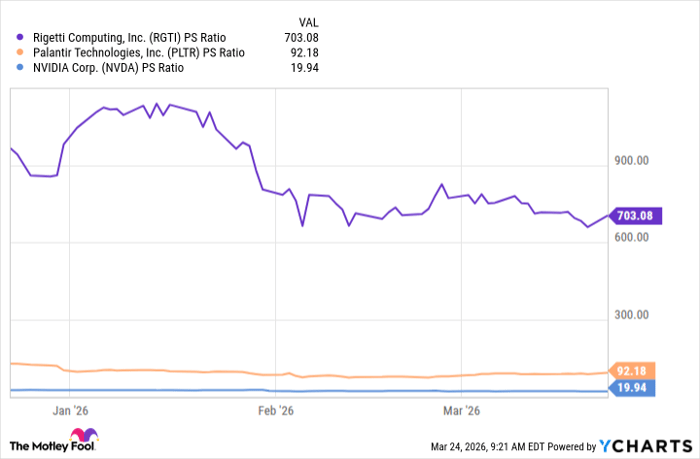
RGTI PS Ratio data by YCharts.
Rigetti stock would have to decline by another 87% just to match Palantir's valuation, and it still wouldn't be cheap at that point, especially with the company's revenue shrinking last year.
This coming December, Rigetti plans to deploy a new quantum system with a gate fidelity of 99.7%. The company recently achieved a gate fidelity of 99.9% when testing a new prototype, but management says it will be three years before the same results can be replicated in commercial settings. These are positive developments, but it's clear that Rigetti won't be generating meaningful revenue (relative to its market cap) in the foreseeable future. So I think further downside is the path of least resistance for its stock.
Should you buy stock in Rigetti Computing right now?
Before you buy stock in Rigetti Computing, consider this:
The Motley Fool Stock Advisor analyst team just identified what they believe are the 10 best stocks for investors to buy now… and Rigetti Computing wasn’t one of them. The 10 stocks that made the cut could produce monster returns in the coming years.
Consider when Netflix made this list on December 17, 2004... if you invested $1,000 at the time of our recommendation, you’d have $497,659!* Or when Nvidia made this list on April 15, 2005... if you invested $1,000 at the time of our recommendation, you’d have $1,095,404!*
Now, it’s worth noting Stock Advisor’s total average return is 912% — a market-crushing outperformance compared to 185% for the S&P 500. Don't miss the latest top 10 list, available with Stock Advisor, and join an investing community built by individual investors for individual investors.
See the 10 stocks »
*Stock Advisor returns as of March 26, 2026.
Anthony Di Pizio has no position in any of the stocks mentioned. The Motley Fool has positions in and recommends Alphabet, Nvidia, and Palantir Technologies. The Motley Fool has a disclosure policy.
Recommended Articles


