


Micron Just Beat Earnings by a Mile. Here's Why the Stock Fell Anyway.
Key Points
The memory chip manufacturer handily topped its fiscal second-quarter estimates.
Investors weren’t mentally prepared for the process and the sheer scope of the near-term spending on an opportunity that’s arguably bigger than most people are appreciating.
This stock’s recent weakness isn’t apt to persist or take on a life of its own for one obvious reason.
- 10 stocks we like better than Micron Technology ›
Micron Technology (NASDAQ: MU) shares should have jumped following last Wednesday's post-close release of its fiscal Q2 earnings. Revenue of $23.9 billion nearly tripled year over year, handling topping analysts' estimates of $20.1 billion, while per-share earnings of $12.20 trounced estimates of $9.31. Guidance for the quarter currently underway was also impressive.
Yet, MU stock tumbled out of the gate Thursday, and after a brief rebound later that session, joined the marketwide sell-off on Friday. What gives?
Will AI create the world's first trillionaire? Our team just released a report on the one little-known company, called an "Indispensable Monopoly" providing the critical technology Nvidia and Intel both need. Continue »
Several factors played a role in the pullback, including pessimism surrounding most artificial intelligence (AI) stocks. There's one overarching reason this ticker didn't make the forward progress it seemingly should have following Micron's second-quarter news, though. And contrary to a common assumption, it's not worries of slowing growth. It's also not its big spending plans on production capacity that will crimp margins.
Rather, the stumbling block is something far simpler.
Image source: Getty Images.
It was never really about any of the numbers
This fiscal year's (ending in August) expected $25 billion-plus worth of capital expenditures is well up from last year's $13.8 billion, with fiscal 2027's capex projected to "step up meaningfully to support HBM and DRAM-related investments."
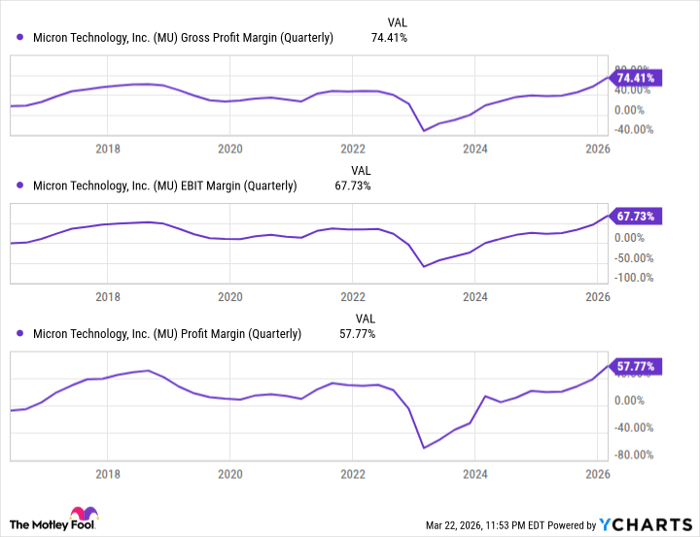
Most investors also recognize that the current shortage of memory chips is likely to end sooner rather than later, meaning the company's pricing power -- and therefore profit margins like last quarter's gross profit margins of nearly 75% and operating margin rate of 69% -- may never be stronger than they are right now, since nothing attracts competition like enormous profits. (That's what CFRA Research analyst Angelo Zino expects anyway.)
Data by YCharts.
The chief reason Micron shares have struggled since the report's release, however, isn't the numbers. It's because of the 550% share price run-up since last April's low. This ticker was arguably ripe for profit-taking regardless of what the company's management said or didn't say regarding the foreseeable future.
Sometimes you just have to trust your gut
The last time most investors saw anything quite like the AI revolution underway right now was the dot-com boom of the late 1990s. Too many technology stocks' valuations reached uncomfortable levels then too, but the fear of missing out was simply too great.
However, the crowd briefly second-guesses its own bullishness sometimes. That's the crux of what's happening here. And not for the first time. And not just with Micron shares.
Here's the hard part for investors: One of these times, this stock isn't going to simply bounce back as it has from those other stumbles.
Still, priced at less than 25 times 2027's consensus earnings of $17.54 per share, that time doesn't seem like it's going to be now or in the near future. Indeed, as Micron's CFO Mark Murphy pointed out during last week's Q2 earnings conference call, "We are generating return on capital at this point over 30%, headed toward 50%."
Yes, the memory shortage will eventually be fixed, but AI's growing need for memory chips is bigger than any potential economic headwind. And it likely will be for a while. Industry research outfit DataM Intelligence predicts the memory business will grow by more than 12% per year through 2031, in fact, jibing with an outlook from IMARC Group. And that's with a bunch of new production capacity coming online in the meantime.
Should you buy stock in Micron Technology right now?
Before you buy stock in Micron Technology, consider this:
The Motley Fool Stock Advisor analyst team just identified what they believe are the 10 best stocks for investors to buy now… and Micron Technology wasn’t one of them. The 10 stocks that made the cut could produce monster returns in the coming years.
Consider when Netflix made this list on December 17, 2004... if you invested $1,000 at the time of our recommendation, you’d have $503,592!* Or when Nvidia made this list on April 15, 2005... if you invested $1,000 at the time of our recommendation, you’d have $1,076,767!*
Now, it’s worth noting Stock Advisor’s total average return is 913% — a market-crushing outperformance compared to 185% for the S&P 500. Don't miss the latest top 10 list, available with Stock Advisor, and join an investing community built by individual investors for individual investors.
See the 10 stocks »
*Stock Advisor returns as of March 24, 2026.
James Brumley has no position in any of the stocks mentioned. The Motley Fool has positions in and recommends Micron Technology. The Motley Fool has a disclosure policy.
Recommended Articles


