


2 Artificial Intelligence (AI) Stocks That Wall Street Loves but Most Investors Haven't Heard Of
Key Points
Many businesses are benefiting from AI -- among them, Tower Semiconductor and Hut 8.
Tower's analog components are finding strong demand amid AI's need for speed.
Hut 8 shifted from using its computing power for cryptocurrency mining to AI.
- 10 stocks we like better than Tower Semiconductor ›
Artificial intelligence (AI) touches many industries, offering you plenty of AI businesses to invest in. But with so many opportunities available, narrowing the choices can be tough. That's when it's helpful to see the AI stocks capturing Wall Street's attention.
Two that have attracted investments from Wall Street firms are Tower Semiconductor (NASDAQ: TSEM) and Hut 8 (NASDAQ: HUT). Many retail investors may not have heard of this duo. They aren't grabbing AI headlines the way megacap stocks like Nvidia are.
Will AI create the world's first trillionaire? Our team just released a report on the one little-known company, called an "Indispensable Monopoly" providing the critical technology Nvidia and Intel both need. Continue »
Even so, Tower Semiconductor and Hut 8 possess attributes that make them worthy of consideration. After all, there are reasons behind Wall Street's interest in them.

Image source: Getty Images.
Tower Semiconductor's AI appeal
Tower Semiconductor has drawn plenty of Wall Street attention. For example, Hood River Capital Management scooped up over 1.5 million shares in the company last year, while Rockingstone Advisors poured more than $5 million into the stock.
Tower has been a boon for investors. Its shares are up more than 300% over the past 12 months through March 19. The reason for the stock surge is its role in the artificial intelligence ecosystem.
The company specializes in manufacturing analog integrated circuits and other products for industries such as automotive, aerospace, and defense. Its photonic integrated circuits (PICs) use light to transmit data across a network at a blazing-fast 1.6 terabits per second. According to CEO Russell Ellwanger on the company's Q4 earnings call, Tower is "by far the majority supplier of 1.6T silicon PICs."
This is important for multiple reasons. AI requires massive amounts of data to execute tasks, and this data needs to be processed quickly and efficiently. Tower's PICs facilitate this.
As a result, the company reported record fourth-quarter revenue of $440 million, up 14% year over year. Tower is poised to see sales soar in the coming years as older data infrastructure is upgraded to support AI.
Hut 8's power advantage
I discovered Hut 8 thanks to Wall Street's interest in it. Hedge fund Flight Deck Capital initiated a new position in the stock worth about $10 million during the fourth quarter. Investment company Oasis Management invested over $100 million in the stock last year.
This contributed to Hut 8 shares soaring nearly 300% in the past 12 months through March 19. The company was once focused on cryptocurrency mining, but repurposed its computing capabilities toward powering AI systems. Competitors in the space performed the same pivot. CoreWeave was also a crypto miner before turning its computing capacity to AI, and sales skyrocketed.
But what sets Hut 8 apart is its focus on electricity. Computing equipment is only useful with energy. AI's enormous power demands could cause an electricity shortage by 2030, according to the U.S. Department of Energy.
Hut 8 doesn't have to worry about that. At the end of 2025, it had secured over 1 gigawatt of energy capacity across 15 North American facilities. That's enough to power thousands of homes. But the company isn't stopping there. It plans to acquire roughly another 8.5 gigawatts.
Hut 8 is capturing customers, as demonstrated by its rapid revenue growth. Sales totaled $235.1 million in 2025, up from $162.4 million in 2024. However, constructing AI data centers is not cheap. It exited 2025 with a net loss of $248 million compared to net income of $331.4 million in the prior year.
That said, Hut 8's balance sheet is solid. At the end of 2025, total assets were $2.8 billion, while total liabilities were $1.1 billion.
Is now the time to buy Tower Semiconductor and Hut 8 stocks?
Wall Street's excitement over Tower Semiconductor and Hut 8, and the resulting share price increases, have elevated their valuations. In Tower's case, this is evident in its price-to-earnings ratio of about 85.
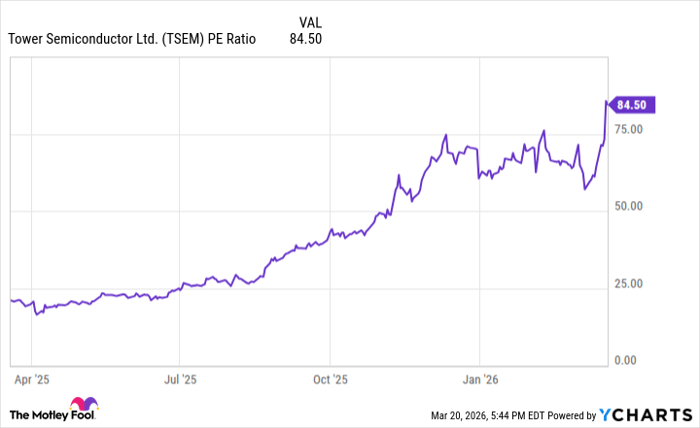
TSEM PE Ratio data by YCharts.
The chart reveals Tower's earnings multiple is at a high point for the past year. Given this, the ideal approach is to wait for the share price to drop before deciding to buy.
As for Hut 8, its lack of profitability means valuation must be assessed using the price-to-sales ratio, which sits at a lofty 23. This suggests the company's growth potential is already priced into the stock.
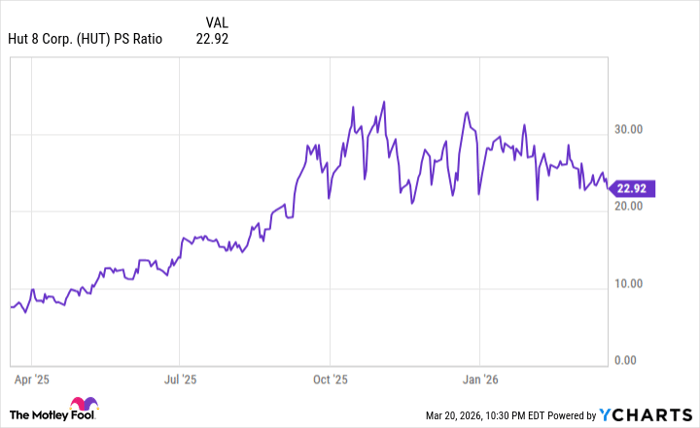
HUT PS Ratio data by YCharts.
Although the chart shows Hut 8's sales multiple is down from the heights reached a few months ago, the stock is very volatile, as indicated by its beta of about 6, so it's worth waiting for a further stock price dip before deciding to invest.
Should you buy stock in Tower Semiconductor right now?
Before you buy stock in Tower Semiconductor, consider this:
The Motley Fool Stock Advisor analyst team just identified what they believe are the 10 best stocks for investors to buy now… and Tower Semiconductor wasn’t one of them. The 10 stocks that made the cut could produce monster returns in the coming years.
Consider when Netflix made this list on December 17, 2004... if you invested $1,000 at the time of our recommendation, you’d have $503,592!* Or when Nvidia made this list on April 15, 2005... if you invested $1,000 at the time of our recommendation, you’d have $1,076,767!*
Now, it’s worth noting Stock Advisor’s total average return is 913% — a market-crushing outperformance compared to 185% for the S&P 500. Don't miss the latest top 10 list, available with Stock Advisor, and join an investing community built by individual investors for individual investors.
See the 10 stocks »
*Stock Advisor returns as of March 24, 2026.
Robert Izquierdo has positions in Nvidia. The Motley Fool has positions in and recommends Nvidia. The Motley Fool has a disclosure policy.
Recommended Articles


