


If You Only Own Tech Stocks, Jim Cramer Has a Blunt Warning for You in 2026
Key Points
Over the last three years, rising demand for artificial intelligence (AI) has fueled market-beating gains in technology stocks.
Current market conditions are making it clear that investors can no longer generate growth from a high concentration in chip or data center stocks.
Cramer's advice is to start looking at companies and industries integrating AI into their workflows.
- 10 stocks we like better than Nvidia ›
Jim Cramer is one of the most recognizable personalities in financial news programming. As the longtime host of the evening television show Mad Money, Cramer's stock analysis is guaranteed to come with loads of enthusiasm and rapid-fire delivery.
Prior to his media career, Cramer managed a hedge fund. This hands-on experience in portfolio management helped him form disciplined investing rules that can be applied during both bull and bear markets.
Will AI create the world's first trillionaire? Our team just released a report on the one little-known company, called an "Indispensable Monopoly" providing the critical technology Nvidia and Intel both need. Continue »
Whether it's identifying growth trends, understanding sector dynamics, or breaking down market psychology, investors should pay attention to Cramer's advice. While he's not infallible, his perspective still carries a lot of weight on Wall Street -- often playing some influence in the moves made by both institutional and retail investors.
While investing in technology stocks has been a near-guaranteed way to profit over the last few years, Cramer issued a stark warning for how investors should approach this sector in 2026. Let's dig into Cramer's views on the technology market right now and explore what he thinks makes a winning portfolio.
Image source: Getty Images.
Jim Cramer's warning about technology stocks echoes time-tested investing advice
Over the last few months, Cramer has expressed concerns about growth stocks -- particularly artificial intelligence (AI) companies. His primary concern is that the days of generating market-beating gains in just any run-of-the-mill chip or data center stock are quickly vanishing.
Whether it's increased regulatory scrutiny, shifting investor expectations, or the effects of monetary policy, a tech-heavy approach leaves investors dangerously exposed to outsize volatility when enthusiasm or economic conditions suddenly change.
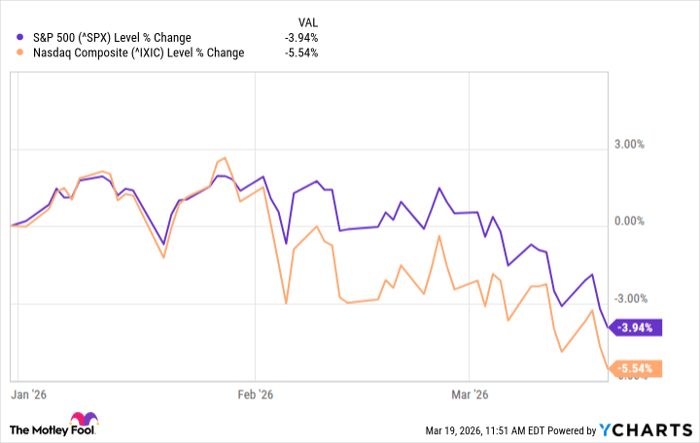
Recent stock market trends validate Cramer's caution. After several years of explosive growth, AI and software stocks entered a notable drawdown in 2026. This selling pressure is a harsh reminder that even the most transformative technologies still face periods of valuation de-ratings from time to time.
To drive this point home, consider the difference in performance between the S&P 500 and the Nasdaq Composite this year.
^SPX data by YCharts.
The Nasdaq, which is largely dominated by technology and growth stocks, has dropped more steeply than the broader S&P 500. The S&P 500 has a more balanced composition across 11 sectors, providing investors with strong resilience and broad diversification across the economy. This underscores the idea that spreading risk is essential for cushioning losses when one area of the market weakens.
What types of AI investments does Jim Cramer like for 2026?
Rather than opting for the usual suspects in AI infrastructure, Cramer suggests that smart investors look at which companies are actively deploying artificial intelligence into their workflows to enhance productivity and reduce costs.
In other words, he's telling investors to think about the companies in traditional industries -- like logistics, manufacturing, industrials, retail, healthcare, and financial services -- that are supercharging their operations through AI.
Whether it's predictive maintenance, supply chain optimization, automated customer service agents, or drug discovery, AI can lower labor costs, boost output, and expand profit margins for companies well beyond the pure-play technology innovators themselves.
Some of Cramer's top non-tech AI stock picks for 2026 include Procter & Gamble (NYSE: PG), Caterpillar (NYSE: CAT), Johnson & Johnson (NYSE: JNJ), American Express (NYSE: AXP), and Boeing (NYSE: BA).
The preference for these blue chip stocks over the AI hyperscalers makes sense at the moment. Big tech has already enjoyed enormous valuation expansion throughout the AI revolution. While their growth prospects remain compelling, these mega-cap tech giants now have to prove that their capital spending will bear fruit in a fiercely competitive landscape.
On the other hand, companies integrating AI for operational leverage offer investors a more durable investment case amid ongoing volatility in the stock market. In essence, AI is becoming a productivity multiplier at the enterprise level. This is an easier narrative to support than the central AI speculation story right now.
What Cramer is trying to explain here is that a diversified portfolio can still provide exposure to AI's transformative power through steadier vehicles that can weather broader capital rotations.
There is still value to be found in AI pure-plays
With all this said, Cramer hasn't completely closed the door on pure-play AI stocks. One company that Cramer has consistently supported throughout the AI boom is Nvidia (NASDAQ: NVDA).
Just days ago, Cramer dedicated some time on his show to explain how Nvidia's growth relative to its peers and the broader technology landscape is on another level. Yet, the stock is becoming cheaper on a forward earnings basis. In a way, it's almost as if the market is pricing Nvidia more like a maturing value stock than a hypergrowth company now.
By pairing Nvidia with positions in the workflow-efficiency plays mentioned above, investors can gain subtle exposure to multiple layers of the AI value chain -- capturing both the hardware and software enablers and the practical application integrators.
This type of allocation allows investors to participate in AI's future upside without over-indexing to undiversified concentration risk.
Should you buy stock in Nvidia right now?
Before you buy stock in Nvidia, consider this:
The Motley Fool Stock Advisor analyst team just identified what they believe are the 10 best stocks for investors to buy now… and Nvidia wasn’t one of them. The 10 stocks that made the cut could produce monster returns in the coming years.
Consider when Netflix made this list on December 17, 2004... if you invested $1,000 at the time of our recommendation, you’d have $495,179!* Or when Nvidia made this list on April 15, 2005... if you invested $1,000 at the time of our recommendation, you’d have $1,058,743!*
Now, it’s worth noting Stock Advisor’s total average return is 898% — a market-crushing outperformance compared to 183% for the S&P 500. Don't miss the latest top 10 list, available with Stock Advisor, and join an investing community built by individual investors for individual investors.
See the 10 stocks »
*Stock Advisor returns as of March 23, 2026.
American Express is an advertising partner of Motley Fool Money. Adam Spatacco has positions in Nvidia. The Motley Fool has positions in and recommends Boeing, Caterpillar, and Nvidia. The Motley Fool recommends Johnson & Johnson. The Motley Fool has a disclosure policy.
Recommended Articles


