


Fed Chair Jerome Powell Just Defied President Donald Trump -- and He's Poised to Do So Again in His Final Meeting as Chair
Key Points
For most of his second term, President Donald Trump has wanted the Federal Reserve to lower interest rates.
While the Fed has cut rates on numerous occasions, it's been on pause more recently.
With Powell's term as Fed chair winding down, he's likely to disappoint Trump one last time.
- These 10 stocks could mint the next wave of millionaires ›
The interest-rate-setting Federal Open Market Committee (FOMC) once again left rates unchanged at its recent meeting, inside the range of 3.50% to 3.75%. The move was widely expected by the broader market, but once again defied President Donald Trump's request for the Fed to cut rates.
Trump's frustration is nothing new. The 47th president has been calling on Fed Chair Jerome Powell and the FOMC to lower rates for most of his second term. With Powell's term as chair of the Federal Reserve board set to end in May, he's likely to disappoint Trump at least one more time, at least as chair.
Will AI create the world's first trillionaire? Our team just released a report on the one little-known company, called an "Indispensable Monopoly" providing the critical technology Nvidia and Intel both need. Continue »
Why the Fed left rates unchanged
As most know, the Fed's dual mandate is to use monetary policy to achieve both stable consumer prices and maximum employment. However, for several years, these goals have been at odds with one another. Inflation has remained elevated while the labor market has started to deteriorate a bit, though it is still quite healthy historically, with an unemployment rate of 4.4%.
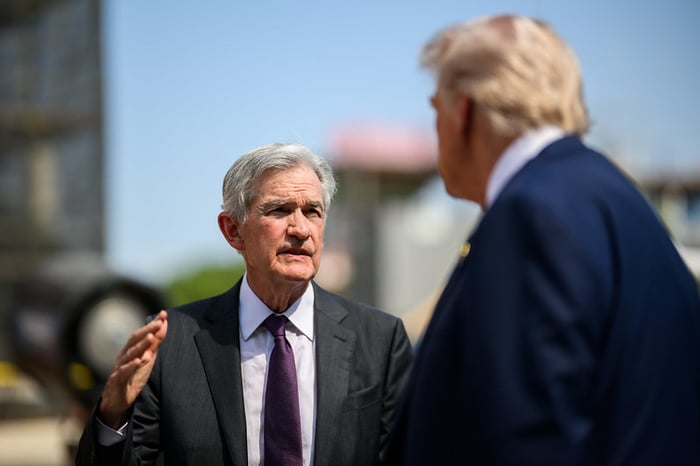
Official White House photo by Daniel Torok.
At Powell's post-meeting conference, he noted that the Fed remains concerned about elevated inflation. The conflict in Iran has made the situation even more uncertain, as surging oil prices are bound to make things more costly for both consumers and businesses.
"The thing I really want to emphasize is, nobody knows," Powell said of the war in Iran. "The economic effects could be bigger, they could be smaller, they could be much smaller, they could be much bigger. We just don't know."
But inflation data has not been good lately, with both the Personal Consumption Expenditures price index (the Fed's preferred gauge of inflation) and wholesale inflation remaining elevated in February. While energy is not included in core inflation, it's still likely to affect the headline numbers once March data is released next month.
On the labor side of the equation, the U.S. economy actually lost about 92,000 jobs in February (and prior months' totals were revised down), much worse than expected. However, Powell said this could have to do with the fact that the labor market is no longer increasing for the first time in history, much of which Powell attributed to immigration policy. Still, he said the Fed would continue to watch the low job growth.
Don't count on a rate cut next month
The Fed will meet again in a little over a month, but don't expect the FOMC to cut interest rates. According to the CME Group, which tracks 30-day fed funds futures, nearly 94% of traders (as of March 19) are betting that the Fed will leave rates unchanged at its next meeting, which would be Powell's final meeting as chair of the Federal Reserve Board.
However, Powell's term on the Fed board lasts until 2028, and Powell recently said he plans to remain on the board until the U.S. Department of Justice drops its investigation into Powell's testimony regarding the renovation of the Fed's headquarters.
The trajectory of interest rates could, of course, change. But I think we would really need to see unsettling labor market data -- including a higher unemployment rate, another month of decline in jobs, and a more significant increase in jobless claims -- to get the Fed to feel like it needs to take action to bolster the labor market.
With the recent surge in oil prices, inflation data will likely not be pretty next month, and there's still a chance core inflation will rise as well. With the Fed's dual mandate still at odds, it likely makes sense for the Fed to continue to do nothing at its next meeting.
In fact, the market believes the Fed will be on cruise control for some time. As of this writing, the market doesn't expect a rate cut until the middle of 2027, though these probabilities change constantly, and I expect the situation to remain fluid given all the uncertainties in the present environment.
Where to invest $1,000 right now
When our analyst team has a stock tip, it can pay to listen. After all, Stock Advisor’s total average return is 898%* — a market-crushing outperformance compared to 183% for the S&P 500.
They just revealed what they believe are the 10 best stocks for investors to buy right now, available when you join Stock Advisor.
See the stocks »
*Stock Advisor returns as of March 23, 2026.
Bram Berkowitz has no position in any of the stocks mentioned. The Motley Fool recommends CME Group. The Motley Fool has a disclosure policy.
Recommended Articles


