


Should You Buy the iShares Core S&P 500 ETF During the Stock Market Sell-Off? Here's What History Says.
Key Points
The S&P 500 features 500 of the highest quality companies listed on American stock exchanges.
The index has delivered a compound annual return of 10.6% since its inception in 1957, but it's currently in the throes of a sell-off.
The iShares Core S&P 500 ETF tracks the performance of the index, and history suggests now might be a great time to buy.
- 10 stocks we like better than iShares Core S&P 500 ETF ›
The S&P 500 (SNPINDEX: ^GSPC) stock market index closed at 6,506 on Friday, March 20, marking a 7% decline from its all-time high. Sell-offs of this magnitude are relatively common, but with economic uncertainty on the rise and geopolitical tensions raging in the Middle East, there is a risk of further downside from here.
But throughout history, investors who treated periods of weakness as buying opportunities have reaped significant rewards over the long term. Purchasing an S&P 500 index fund is one of the simplest and most cost-effective ways to capitalize on the recent market sell-off, because it provides investors with exposure to some of the fastest-growing companies in areas like artificial intelligence (AI), alongside defensive companies in sectors like financials and healthcare.
Will AI create the world's first trillionaire? Our team just released a report on the one little-known company, called an "Indispensable Monopoly" providing the critical technology Nvidia and Intel both need. Continue »
The iShares Core S&P 500 ETF (NYSEMKT: IVV) is an exchange-traded fund (ETF) that directly tracks the index by holding the same stocks and maintaining similar weightings. Should investors buy it now?

Image source: Getty Images.
Recent volatility highlights the benefits of diversification
The S&P 500 hosts 500 companies from 11 different sectors of the economy, and it has a very strict entry criteria. To qualify for selection, companies must be profitable, and they must maintain a market capitalization of at least $22.7 billion. But even after ticking those boxes, a special committee has the final say over which companies make the cut.
The S&P 500 is weighted by market capitalization, so the largest companies in the index have a greater influence over its performance than the smallest. The "Magnificent Seven" stocks, which include Nvidia, Apple, Alphabet, Microsoft, Amazon, Meta Platforms, and Tesla, have a combined market cap of $19.3 trillion, so they represent a whopping 32.7% of the total value of the index.
Investors who exclusively owned those companies likely outperformed the broader market over the last few years, particularly since the AI boom started gathering momentum in early 2023. However, these stocks often underperform during periods of market weakness, as investors cash in gains to reduce risk. Therefore, while the S&P 500 is down 7% from its record high, the Magnificent Seven stocks are down by an average of 12% over the same period.
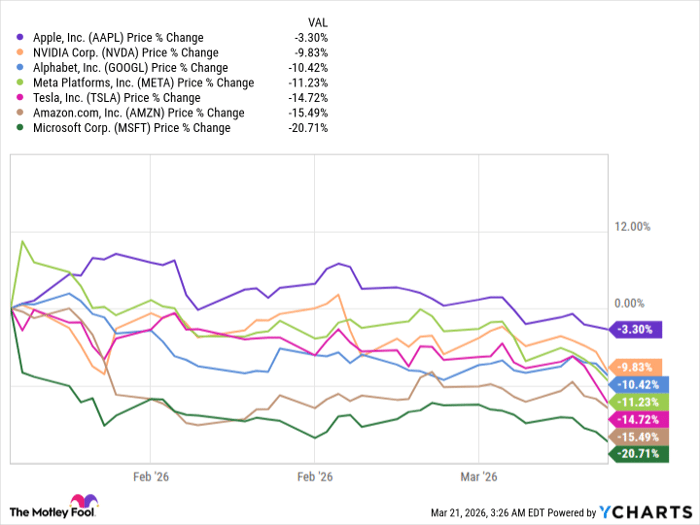
AAPL data by YCharts
This highlights the benefits of diversification. While the S&P 500 hosts an abundance of growth stocks, it also maintains exposure to several defensive sectors of the economy, featuring companies with resilient business models and reliable cash flow. For example:
|
S&P 500 Sector |
Sector Weighting |
Notable Companies |
|---|---|---|
|
Financials |
12.35% |
Berkshire Hathaway, JP Morgan Chase, Visa |
|
Healthcare |
9.35% |
Eli Lilly, Johnson & Johnson, AbbVie |
|
Industrials |
8.87% |
Caterpillar, GE Aerospace, RTX |
|
Utilities |
2.52% |
NextEra Energy, The Southern Company, Constellation Energy |
Data source: iShares. Sector weightings are accurate as of March 19, 2026, and are subject to change.
The iShares Core S&P 500 ETF is a cost-effective way to invest in the entire S&P 500. It has an expense ratio of just 0.03%, which is the proportion of the fund deducted each year to cover management costs, so an investment of $10,000 would incur an annual fee of just $3.
History suggests there is rarely a bad time to invest
According to Capital Group, the S&P 500 experiences a 5% sell-off once per year on average, and those drawdowns morph into steeper 10% corrections every two and a half years or so. Bear markets, which are defined by peak-to-trough declines of 20% or more, are much rarer, but they still tend to happen once every six years.
Simply put, volatility is a normal part of the investing process; think of it as the price of admission for the opportunity to earn significant returns over the long run. Even after accounting for every sell-off, correction, and bear market, the S&P 500 has still produced a compound annual return of 10.6% since its inception in 1957. Therefore, investors who stayed the course, especially during the most challenging periods, have done extremely well over the long term.
It's impossible to consistently time the market, so there is no reliable way to tell whether the current 7% decline in the S&P 500 will worsen. However, history suggests the index is very likely to trade higher in five years, 10 years, and 15 years from now, so its current price might look like a bargain when reflecting back on this moment in the future.
Therefore, now might be a great time to buy the iShares Core S&P 500 ETF. Investors who are uncomfortable with the elevated levels of volatility could scale into the ETF with small, consistent monthly purchases, rather than deploying a lump sum of money today.
Should you buy stock in iShares Core S&P 500 ETF right now?
Before you buy stock in iShares Core S&P 500 ETF, consider this:
The Motley Fool Stock Advisor analyst team just identified what they believe are the 10 best stocks for investors to buy now… and iShares Core S&P 500 ETF wasn’t one of them. The 10 stocks that made the cut could produce monster returns in the coming years.
Consider when Netflix made this list on December 17, 2004... if you invested $1,000 at the time of our recommendation, you’d have $495,179!* Or when Nvidia made this list on April 15, 2005... if you invested $1,000 at the time of our recommendation, you’d have $1,058,743!*
Now, it’s worth noting Stock Advisor’s total average return is 898% — a market-crushing outperformance compared to 183% for the S&P 500. Don't miss the latest top 10 list, available with Stock Advisor, and join an investing community built by individual investors for individual investors.
See the 10 stocks »
*Stock Advisor returns as of March 23, 2026.
JPMorgan Chase is an advertising partner of Motley Fool Money. Anthony Di Pizio has no position in any of the stocks mentioned. The Motley Fool has positions in and recommends AbbVie, Alphabet, Amazon, Apple, Berkshire Hathaway, Caterpillar, Constellation Energy, GE Aerospace, JPMorgan Chase, Meta Platforms, Microsoft, NextEra Energy, Nvidia, RTX, Tesla, and Visa and is short shares of Apple. The Motley Fool recommends Johnson & Johnson. The Motley Fool has a disclosure policy.
Recommended Articles


