


Could Oracle Become America's Next $1 Trillion Technology Stock?
Key Points
Oracle operates some of the world's fastest and most cost-effective data centers for processing artificial intelligence (AI) workloads.
The company has a staggering $553 billion order backlog for computing capacity, but there are concerns about the makeup of that figure.
Oracle stock looks attractive at the current level, but if a trip to the $1 trillion club is in the cards, it could take a few years.
- 10 stocks we like better than Oracle ›
As I write this, nine American companies have a market capitalization of $1 trillion or more. Most of them are from the technology and technology-adjacent sectors, which are generating phenomenal growth thanks to emerging industries like artificial intelligence (AI).
Oracle (NYSE: ORCL) came within a whisker of joining the exclusive $1 trillion club last year when its market cap briefly topped $940 billion, but its valuation has since tumbled to around $480 billion following a 49% collapse in its stock price.
Will AI create the world's first trillionaire? Our team just released a report on the one little-known company, called an "Indispensable Monopoly" providing the critical technology Nvidia and Intel both need. Continue »
Oracle is building some of the best AI data center infrastructure in the world, but there have been concerns about its growing debt, and also that some of its biggest customers won't be able to fulfill their massive orders for computing capacity. Fortunately, the company's operating results for its recent fiscal 2026 third quarter (ended Feb. 28) put some of those worries on the back burner.
Can Oracle stock turn around from here and stage another run to the $1 trillion club?

Image source: Getty Images.
Industry-leading AI infrastructure
AI development requires a substantial amount of computing power, which is why most of it happens inside large, centralized data centers. They house thousands of specialized chips called graphics processing units (GPUs), which are primarily supplied by Nvidia and Advanced Micro Devices. Most businesses can't afford to build this infrastructure in-house because it costs billions of dollars, so they choose to rent it from cloud providers like Oracle instead.
Oracle's data centers are among the best in the world. They use the company's proprietary remote direct memory access (RDMA) networking technology, which moves data between chips and devices more quickly than traditional Ethernet networks. Most AI developers pay for cloud computing capacity by the minute, so faster processing speeds can result in substantial cost savings over the long term.
Oracle's infrastructure also offers tremendous scale, allowing developers to activate over 100,000 of Nvidia's GPUs to run the most powerful AI models. As a result, some of the AI industry's top players are lining up to access Oracle's data centers, including OpenAI, Meta Platforms, and Elon Musk's xAI.
Oracle Cloud Infrastructure revenue growth is accelerating
Oracle generated $17.2 billion in total revenue during its fiscal 2026 third quarter, which was a 17% increase from the year-ago period. But revenue from the Oracle Cloud Infrastructure (OCI) segment, specifically, rocketed higher by 84% to a record $4.9 billion.
The OCI segment could be growing even faster, but Oracle can't build data centers fast enough to meet demand from AI developers. In fact, it ended the third quarter with a whopping $553 billion in remaining performance obligations (RPO), which more than quadrupled year over year. RPO is like an order backlog, reflecting the value of signed contracts for services that haven't been delivered yet. Therefore, it's a good indicator of future potential revenue.
But there are concerns about the composition of Oracle's RPO. Last September, The Wall Street Journal reported that $300 billion of the company's backlog was attributable to ChatGPT creator OpenAI alone, which is effectively a start-up. OpenAI only has $25 billion in annualized revenue, and it's losing truckloads of money, so there are valid questions as to whether it can actually fulfill its commitment to rent $300 billion worth of computing capacity.
These concerns are amplified by the fact that Oracle is financing the construction of some of its data centers using debt, so there could be serious consequences if its customers fail to come through. These are the main reasons its stock has plummeted from last year's peak.
Will Oracle be the next trillion-dollar tech stock?
Oracle generated earnings of $5.57 per share over the last four quarters on a generally accepted accounting principles (GAAP) basis, placing its stock at a price-to-earnings (P/E) ratio of 29.5 as I write this. That's a slight discount to the Nasdaq-100 index, which trades at a P/E ratio of 30.9, suggesting Oracle might be undervalued relative to its peers in the technology space.
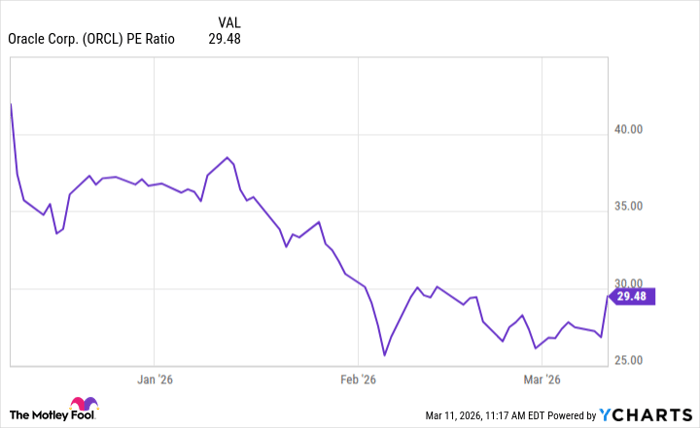
ORCL PE Ratio data by YCharts
If we assume Oracle's P/E ratio remains constant, the company will have to grow its annual earnings by 108% in order for its market capitalization to move from $480 billion to $1 trillion. For some perspective, Oracle's earnings grew by 17% during fiscal 2025, and they are on track to grow by a further 32% in fiscal 2026. That means even at the current pace of 32%, it would take around three years to generate enough earnings growth to justify a trip to the $1 trillion club.
However, Oracle might be in the best position to achieve a trillion-dollar valuation before any other American tech stock currently in the running. Micron Technology is the next-largest technology company in line, but it has a ways to go given its current valuation of $450 billion. Even Palantir Technologies, which is a growth powerhouse, is way down the ranks with a current market cap of $360 billion.
There are some non-technology companies likely to get there before Oracle, though. Pharmaceutical giant Eli Lilly is valued at $900 billion right now, and investment bank JP Morgan Chase is worth $775 billion.
Should you buy stock in Oracle right now?
Before you buy stock in Oracle, consider this:
The Motley Fool Stock Advisor analyst team just identified what they believe are the 10 best stocks for investors to buy now… and Oracle wasn’t one of them. The 10 stocks that made the cut could produce monster returns in the coming years.
Consider when Netflix made this list on December 17, 2004... if you invested $1,000 at the time of our recommendation, you’d have $508,607!* Or when Nvidia made this list on April 15, 2005... if you invested $1,000 at the time of our recommendation, you’d have $1,122,746!*
Now, it’s worth noting Stock Advisor’s total average return is 933% — a market-crushing outperformance compared to 188% for the S&P 500. Don't miss the latest top 10 list, available with Stock Advisor, and join an investing community built by individual investors for individual investors.
See the 10 stocks »
*Stock Advisor returns as of March 14, 2026.
JPMorgan Chase is an advertising partner of Motley Fool Money. Anthony Di Pizio has no position in any of the stocks mentioned. The Motley Fool has positions in and recommends Advanced Micro Devices, JPMorgan Chase, Meta Platforms, Micron Technology, Nvidia, Oracle, and Palantir Technologies. The Motley Fool has a disclosure policy.
Recommended Articles


