


Look Beyond Tariffs! If a Stock Market Crash Ensues Under President Donald Trump, One or More of 3 Catalysts Is Likely to Trigger It.
Key Points
The Dow Jones Industrial Average, S&P 500, and Nasdaq Composite have delivered higher annualized returns under Donald Trump than most other presidents over the last century.
While Trump's tariff and trade policy often make headlines, it's not the stock market's biggest threat.
An Iran war oil price shock, a historic level of division within the Fed, and an exceptionally pricey stock market are all capable of triggering a stock market crash.
- 10 stocks we like better than S&P 500 Index ›
Based purely on statistics, Wall Street has been thrilled to have President Donald Trump in the White House. When his first, non-consecutive term ended in January 2021, the iconic Dow Jones Industrial Average (DJINDICES: ^DJI), broad-based S&P 500 (SNPINDEX: ^GSPC), and innovation-fueled Nasdaq Composite (NASDAQINDEX: ^IXIC) had rallied by 57%, 70%, and 142%, respectively.
Since Trump's inauguration on Jan. 20, 2025, the Dow, S&P 500, and Nasdaq Composite had gained 9%, 12%, and 14%, through the closing bell on March 6, 2026. While the S&P 500 or Dow Jones Industrial Average have finished higher in 26 of the last 33 presidential terms, the annualized return of Wall Street's major stock indexes has been notably higher than the average under Donald Trump.
Will AI create the world's first trillionaire? Our team just released a report on the one little-known company, called an "Indispensable Monopoly" providing the critical technology Nvidia and Intel both need. Continue »

President Trump readying to deliver remarks to the press. Image source: Official White House Photo by Molly Riley.
But this doesn't mean there aren't headwinds brewing for the stock market. At any given time, one or more catalysts are threatening to pull the rug out from beneath investors.
While investors may be inclined to point the finger at the president's tariff and trade policy as a possible elevator-down catalyst for stocks, tariffs are far from the biggest issue Wall Street is contending with. If a stock market crash were to ensue under President Trump, one or more of three catalysts (none of which has to do with tariffs) would likely trigger it.
The Iran war risks sparking an oil price shock for the ages
A little over two weeks ago, the prospect of a geopolitical event roiling Wall Street was slim. But on Feb. 28, U.S. and Israeli armed forces began attacks against Iran. This conflict, widely known as the "Iran war," threatens to end the outsize stock returns that investors have become accustomed to with Trump in the Oval Office.
According to data compiled by Carson Group's Chief Market Strategist, Ryan Detrick, there have been over 40 major geopolitical events, including wars, assassination attempts, invasions, terrorist attacks, and financial crises, since the early stages of World War II. Many of these events did not lead to a stock market crash, with the S&P 500 higher 12 months later 65% of the time.
Here's a list of major geopolitical events since WWII.
-- Ryan Detrick, CMT (@RyanDetrick) February 28, 2026
Up a median of 5% six months later. All of them felt really bad at the time. pic.twitter.com/Jb3QXL0L05
However, the events that led to elevator-down moves for the Dow Jones Industrial Average, S&P 500, and Nasdaq Composite often had one common denominator: oil.
When the event in question disrupted or threatened to disrupt oil production or transportation, it often led to steep, emotion-driven selling on Wall Street. For instance, we witnessed the S&P 500 tumble 44% in 11.5 months when the Arab members of OPEC banned oil exports in October 1973 to countries supporting Israel (the U.S. among them). The benchmark S&P 500 also plunged 13% in three weeks after Iraq invaded Kuwait in August 1990.
When the supply of oil is constrained, the spot price of crude typically soars. In the initial days of the Iran war, the Strait of Hormuz was closed to virtually all oil exports. Approximately 20% of the world's daily liquid petroleum travels through the Strait of Hormuz. Unsurprisingly, the spot price of West Texas Intermediate (WTI) crude skyrocketed 36% in the week after the attacks began.
Crude oil price spikes have historically led to increases in inflation, lower consumer spending, and a weaker labor market. If WTI continues to climb, or even levels off above $90/barrel, it would likely put the Federal Reserve's rate-easing cycle on ice.
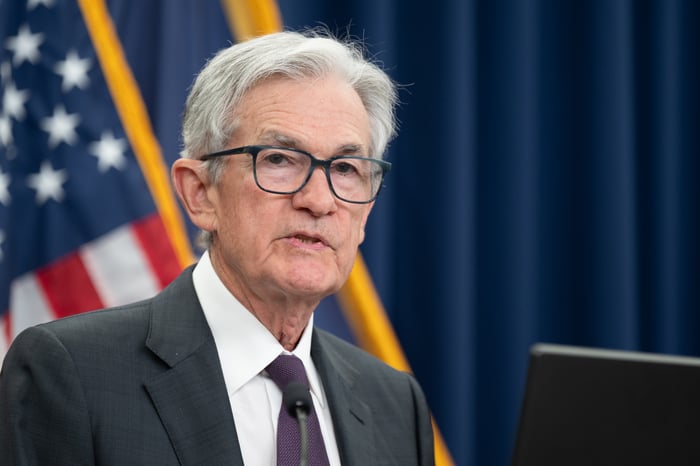
Jerome Powell's term as Fed chair ends in two months. Image source: Official Federal Reserve Photo.
Dubious history at the Federal Reserve can upend the Trump bull market rally
Usually, the Federal Reserve is a stabilizing force for Wall Street. But since the midpoint of July, the bedrock of the stock market has turned into one of its biggest liabilities.
The Federal Open Market Committee (FOMC) -- the 12-person body, including Fed Chair Jerome Powell, responsible for setting the nation's monetary policy -- has two tasks: maximize employment and stabilize prices. It attempts to achieve its goals by adjusting the federal funds target rate and undertaking open-market operations, such as buying and selling U.S. Treasury bonds and/or mortgage-backed securities.
Since the FOMC is basing its decisions on backward-looking economic data, it's fairly common for the nation's central bank to be behind the curve. In other words, the Fed is often late and reactive with its decision-making rather than proactive.
Investors tend to give the FOMC plenty of leeway when making monetary policy decisions, as long as all 12 members are in agreement. But when dissents come into play, the credibility of America's foremost financial institution in the eyes of Wall Street can quickly erode.
On the one hand, Jerome Powell has the lowest dissent rate of any Fed chair over the last 48 years. However, each of the previous five FOMC meetings has featured at least one dissent.
Anna is correct below when she says:
-- Jim Bianco (@biancoresearch) September 17, 2025
"I have not seen a meeting with so much contradictions."
---
This meeting was a mess.
See the labels in the dot plot below.
One member of the FOMC thinks the Fed is going to HIKE rates this year. One (Stephen Miran) thinks it is going to cut... https://t.co/TRUQmD5I2E pic.twitter.com/qPlJGL57ln
The bigger worry is that dubious history was made in October and December when dissents were recorded in opposite directions. While the FOMC voted in favor of a 25-basis-point cut to the federal funds target rate in both meetings, at least one member pushed for no cut, while another wanted a more aggressive 50-basis-point reduction.
If the FOMC remains historically divided, it's unlikely to be good news for Wall Street.
And don't forget, Powell's term as Fed chair ends in two months, and his nominated replacement, Kevin Warsh, may come with unintended consequences.
History repeats with the second-priciest stock market in 155 years
Although the Iran War is currently dominating headlines, stock valuations may be the biggest catalyst for a stock market crash.
There isn't a one-size-fits-all blueprint when evaluating and valuing publicly traded companies or the broader market. This means what one investor finds pricey might be viewed as a bargain by another. The subjectivity of valuing equities is one of the primary reasons short-term directional moves in the Dow, S&P 500, and Nasdaq Composite are so difficult to predict with high accuracy.
But there is one time-tested valuation tool that, under a very select set of circumstances, has a flawless track record of foreshadowing what's to come for stocks: the Shiller Price-to-Earnings (P/E) Ratio, also known as the Cyclically Adjusted P/E Ratio (CAPE Ratio).
What makes the Shiller P/E so useful is that it accounts for 10 years of average, inflation-adjusted earnings. In comparison, the favorite valuation tool of investors, the P/E ratio, is based on trailing 12-month earnings. Whereas a recession can easily trip up the traditional P/E ratio, this isn't the case with the S&P 500's Shiller P/E Ratio.
S&P 500 Shiller PE Ratio hits 2nd highest level in history 🚨 The highest was the Dot Com Bubble 🤯 pic.twitter.com/Lx634H7xKa
-- Barchart (@Barchart) December 28, 2025
Although the CAPE Ratio wasn't introduced until the late 1980s, it's been back-tested to January 1871. Over the previous 155 years, it's averaged 17.34. But over the last five months, it's been vacillating between 39 and 41, marking the second-priciest stock market on record.
While the Shiller P/E can't tell investors when a stock market correction or crash event will occur, history couldn't be clearer about what happens to stocks when this time-tested valuation tool exceeds 30 during a continuous bull market. The Dow Jones Industrial Average, S&P 500, and/or Nasdaq Composite eventually plunged 20% to 89% following the five previous instances when the CAPE Ratio topped 30.
Even though Trump's tariffs are a popular talking point, look beyond them if you want to unearth the real risks for the current bull market.
Should you buy stock in S&P 500 Index right now?
Before you buy stock in S&P 500 Index, consider this:
The Motley Fool Stock Advisor analyst team just identified what they believe are the 10 best stocks for investors to buy now… and S&P 500 Index wasn’t one of them. The 10 stocks that made the cut could produce monster returns in the coming years.
Consider when Netflix made this list on December 17, 2004... if you invested $1,000 at the time of our recommendation, you’d have $508,607!* Or when Nvidia made this list on April 15, 2005... if you invested $1,000 at the time of our recommendation, you’d have $1,122,746!*
Now, it’s worth noting Stock Advisor’s total average return is 933% — a market-crushing outperformance compared to 188% for the S&P 500. Don't miss the latest top 10 list, available with Stock Advisor, and join an investing community built by individual investors for individual investors.
See the 10 stocks »
*Stock Advisor returns as of March 14, 2026.
Sean Williams has no position in any of the stocks mentioned. The Motley Fool has no position in any of the stocks mentioned. The Motley Fool has a disclosure policy.
Recommended Articles


