


Iran Fears Crushed Korean Chip Stocks. Here's 1 Thing American Memory Investors Should Watch.
Key Points
Higher oil prices have a disproportionate impact on South Korean businesses.
Oil-price spikes caused by the war in Iran prompted the stocks of memory-chip makers Samsung and SK Hynix to plummet.
- 10 stocks we like better than Micron Technology ›
In the wake of the first airstrikes on Iran last week, South Korea's stock market melted down. The Korea Stock Exchange Composite index (KOSPI) -- which tracks all the stocks traded on South Korea's Korea Stock Exchange -- plunged more than 18% over just two days, its worst weekly performance since 2008.
The drop was largely due to double-digit declines in the share prices of the top global providers of memory chips -- tech behemoth Samsung Electronics and memory chipmaker SK Hynix. Together, these two stocks collectively account for more than 33% of the KOSPI.
Will AI create the world's first trillionaire? Our team just released a report on the one little-known company, called an "Indispensable Monopoly" providing the critical technology Nvidia and Intel both need. Continue »
Could the same thing happen to U.S. chipmakers, like memory-chip maker Micron Technology (NASDAQ: MU) or semiconductor behemoth Nvidia (NASDAQ: NVDA)? It's unlikely.
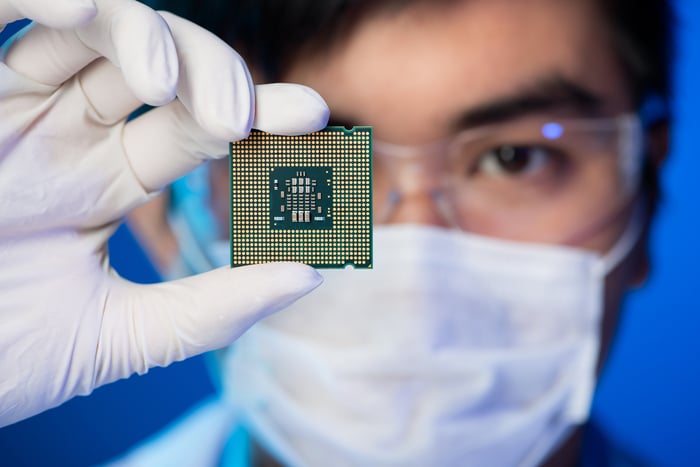
Image source: Getty Images.
South Korea's economy is uniquely sensitive to changes in oil prices. In fact, the country is the world's fourth-largest importer of oil. Its manufacturing-heavy economy is also reliant on exports, making it particularly sensitive to energy prices.
That said, South Korea is dominant within the global market for DRAM, a key type of memory for artificial intelligence (AI) processes. Together, Samsung and SK Hynix control 67% of the global DRAM market. Global demand for DRAM is so high right now that even if high oil prices forced them to increase their chip prices, it probably wouldn't dent their memory-chip businesses much.
However, investors might want to keep an eye on any news about potential price hikes, which could provide a slight benefit to Micron, the third-largest DRAM chipmaker in the world. A prolonged crisis could even benefit Samsung rival Nvidia, though that's a bit less likely.
As for whether the same situation could hit U.S. markets, it's unlikely. The two largest U.S. stocks -- currently Nvidia and Apple -- only account for about 14% of the S&P 500. Meanwhile, the U.S. is a net exporter of oil and gas and has a much more diversified economy than the small Asian nation.
Should you buy stock in Micron Technology right now?
Before you buy stock in Micron Technology, consider this:
The Motley Fool Stock Advisor analyst team just identified what they believe are the 10 best stocks for investors to buy now… and Micron Technology wasn’t one of them. The 10 stocks that made the cut could produce monster returns in the coming years.
Consider when Netflix made this list on December 17, 2004... if you invested $1,000 at the time of our recommendation, you’d have $508,607!* Or when Nvidia made this list on April 15, 2005... if you invested $1,000 at the time of our recommendation, you’d have $1,122,746!*
Now, it’s worth noting Stock Advisor’s total average return is 933% — a market-crushing outperformance compared to 188% for the S&P 500. Don't miss the latest top 10 list, available with Stock Advisor, and join an investing community built by individual investors for individual investors.
See the 10 stocks »
*Stock Advisor returns as of March 13, 2026.
John Bromels has positions in Apple, Micron Technology, and Nvidia. The Motley Fool has positions in and recommends Apple, Micron Technology, and Nvidia and is short shares of Apple. The Motley Fool has a disclosure policy.
Recommended Articles


