


Contrarian Take: Vanguard's 3 Worst-Performing Equity ETFs in 2026 Are All Buys in March
Key Points
The sell-off in growth stocks is weighing heavily on major indexes, and even more so on growth-focused ETFs.
However, the long-term potential rewards far outweigh the risks of investing in top-growth stocks.
The financial sector is a great buy for companies with wide moats and upside potential independent of AI.
- 10 stocks we like better than Vanguard World Fund - Vanguard Mega Cap Growth ETF ›
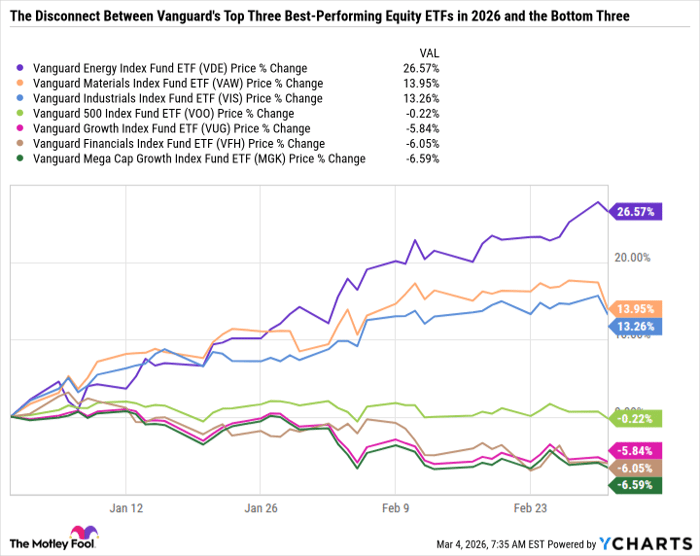
What a difference a calendar year can make. Exchange-traded funds (ETFs) with outsize exposure to growth stocks crushed the S&P 500 over the past few years. But so far this year, it's the sectors with heavy assets -- such as energy and materials -- that are producing the best gains.
Mutual fund giant Vanguard offers 65 low-cost equity-focused ETFs. The three worst-performing year to date are the Vanguard Mega Cap Growth ETF (NYSEMKT: MGK), the Vanguard Growth ETF (NYSEMKT: VUG), and the Vanguard Financials ETF (NYSEMKT: VFH).
Will AI create the world's first trillionaire? Our team just released a report on the one little-known company, called an "Indispensable Monopoly" providing the critical technology Nvidia and Intel both need. Continue »
Here's why all three ETFs are falling, and why they are excellent buys in March.

Image source: Getty Images.
Two ETFs to buy the dip on growth stocks
When stock prices outpace earnings growth, valuations can become inflated, opening the door to a sell-off.
Nvidia is an excellent example of this dynamic. The stock price is unchanged from seven months ago, but Nvidia has substantially grown sales and earnings over that period -- including 20% quarter-over-quarter revenue growth in the quarter reported Feb. 25. Nvidia's earnings are outpacing its stock price, which has led to its valuation to fall by so much that it is now cheaper than the S&P 500 based on forward earnings.
But Wall Street cares more about where a stock could be headed than about past results. And some investors fear that companies are spending too much on artificial intelligence (AI) and that these investments will take time to pay off or will fall short of expectations.
The Vanguard Mega Cap Growth ETF has been one of the most effective ETFs for investing in leading AI, cloud computing, and hyperscaler stocks. It's basically a bet that the largest tech-focused companies will continue to outperform the S&P 500, which is exactly what has happened over the long term.
By concentrating so much on a handful of stocks -- including Nvidia, Apple, Alphabet, Microsoft, Amazon, Meta Platforms, Tesla, Broadcom, Eli Lilly -- the fund has doubled in just three years and is up 421.9% in the past decade compared to a 305.7% gain for the S&P 500. But in 2026, it is Vanguard's worst-performing equity ETF.
VDE data by YCharts
A very similar fund, the Vanguard Growth ETF, is doing only slightly better. It's basically a less concentrated version of its Mega Cap cousin, with roughly double the holdings. But it's still heavily dependent on the performance of its largest holdings, with 66.2% of its weighting in the ten largest.
Drastic shifts in investor sentiment and market noise can create incredible buying opportunities for long-term investors. At times like this, I like to channel Charlie Munger by using inversion thinking: Instead of only arguing why growth stocks are buys now, what would have to go so wrong for leading tech stocks to produce poor returns over the next three to five years?
Is the risk of a multi-year downturn in AI spending so great that it outshines the productivity gains of generative AI or the potential payoff of agentic and physical AI? Are Amazon and Microsoft going to overexpand their AI infrastructure build-out to the point where they can't book cloud capacity?
If growth stocks remain beaten down but earnings continue to grow, they will eventually become too cheap to ignore. The Vanguard Mega-Cap Growth ETF and Vanguard Growth ETF are excellent ways to buy the dip on a basket of leading growth stocks in March without feeling like you have to try to time the market by waiting for the perfect opportunity to strike.
A cyclical sector chock-full of long-term growth potential
As poorly as tech has performed in 2026, financials are even worse. Granted, financials have been one of the best-performing sectors in recent years. So like tech stocks, part of the pullback may be valuation-related. Still, the financial sector is one of the best ways for investors who want to benefit from economic expansions without as much exposure to AI tech stocks.
Many financial stocks have wide moats that insulate them from disruption. It's impossible to replace the network effects that derive from Visa's payment processing network, or the sheer scale and complexity of JPMorgan Chase's operations and trillions in assets.
The Vanguard Financials ETF (NYSEMKT: VFH) is one of the best ways to get broad-based exposure to the sector. It is far more diversified than the previously discussed growth stock-heavy funds, with meaningful holdings in leading banks, regional banks, investment banks, payment processors, insurance companies, and more.
However, it's worth noting that the financial sector is vulnerable to recessions, economic growth declines, or weak consumer spending. But over time, the sector tends to do very well, making the sell-off in financial stocks a great buying opportunity for risk-tolerant investors who don't mind volatility.
Should you buy stock in Vanguard World Fund - Vanguard Mega Cap Growth ETF right now?
Before you buy stock in Vanguard World Fund - Vanguard Mega Cap Growth ETF, consider this:
The Motley Fool Stock Advisor analyst team just identified what they believe are the 10 best stocks for investors to buy now… and Vanguard World Fund - Vanguard Mega Cap Growth ETF wasn’t one of them. The 10 stocks that made the cut could produce monster returns in the coming years.
Consider when Netflix made this list on December 17, 2004... if you invested $1,000 at the time of our recommendation, you’d have $534,008!* Or when Nvidia made this list on April 15, 2005... if you invested $1,000 at the time of our recommendation, you’d have $1,090,073!*
Now, it’s worth noting Stock Advisor’s total average return is 949% — a market-crushing outperformance compared to 190% for the S&P 500. Don't miss the latest top 10 list, available with Stock Advisor, and join an investing community built by individual investors for individual investors.
See the 10 stocks »
*Stock Advisor returns as of March 9, 2026.
JPMorgan Chase is an advertising partner of Motley Fool Money. Daniel Foelber has positions in Nvidia. The Motley Fool has positions in and recommends Alphabet, Amazon, JPMorgan Chase, Meta Platforms, Microsoft, Nvidia, Tesla, Vanguard Growth ETF, and Visa. The Motley Fool recommends Broadcom. The Motley Fool has a disclosure policy.
Recommended Articles


