


Space Force Makes the Obvious Choice, Halts Rocket Launches at Boeing's and Lockheed's Space Business
Key Points
United Launch Alliance's (ULA) Vulcan rocket has suffered two anomalies in four launches.
The Space Force has decided two is too many and is pausing launches while searching for a fix.
What does it mean for Boeing and Lockheed Martin, the two major investors in the ULA?
- 10 stocks we like better than Lockheed Martin ›
United Launch Alliance had high hopes for its new Vulcan Centaur rocket, but they're starting to fall apart -- literally.
As recently as two years ago, United Launch Alliance (ULA), the space launch venture jointly owned by Boeing (NYSE: BA) and Lockheed Martin (NYSE: LMT), had hoped to be launching anywhere from 20 to 30 Vulcans annually by now. It's actually launched just four times in two years.
Will AI create the world's first trillionaire? Our team just released a report on the one little-known company, called an "Indispensable Monopoly" providing the critical technology Nvidia and Intel both need. Continue »
Worse, as I described last month, two of the four Vulcans ULA has managed to launch experienced anomalies during flight. Although Vulcan's inaugural launch back in January 2024 went off without a hitch, in October 2024, Launch 2 suffered an anomaly when one of the nozzles that directs exhaust flow from Vulcan's two solid rocket boosters fell off during launch.
Launch 3 then proceeded nominally in 2025, only to be followed by Launch 4 in February 2026 -- which had another problem with its solid rocket boosters. Nothing fell off this time, but the engine exhaust apparently burned through the booster nozzle this time, again endangering the spacecraft.
For ULA, which has reservations for 25 Vulcan launches for the Department of Defense on the books, plus more than three dozen launches for Amazon servicing its Leo satellite constellation, this poses a two-pronged problem.
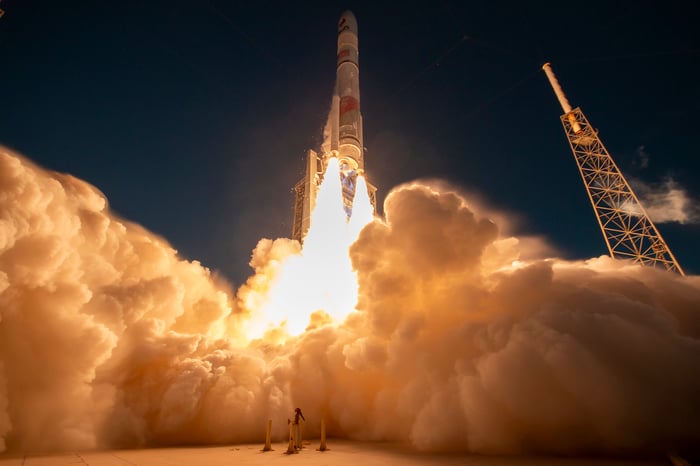
Image source: United Launch Alliance.
Problem 1: The U.S. government
It's considered suboptimal when rockets start spontaneously falling apart mid-flight. While ULA has dodged two such bullets, the law of averages could eventually catch up to this rocket company, and the next such anomaly could be disastrous.
To prevent that from happening, U.S. Space Force has decided to hit pause on further Vulcan flights "until this anomaly is solved." As portfolio acquisition executive Col. Eric Zarybnisky explained late last month, "We will not be launching Vulcan missions" until they've solved the solid rocket booster problem.
How long will that take? Well, it won't be quick. While Col. Zarybnisky says he doesn't "have any details" right now, this early in the investigation, he envisions "a many-months process" before Vulcan can fly again. And it's worth noting that it took more than 10 months after the second Vulcan flight (and first Vulcan anomaly) before the rocket flew its third mission.
Problem 2: If the U.S. government doesn't trust ULA, why should Amazon?
The Space Force pausing its use of Vulcan doesn't necessarily mean that other customers cannot launch on the ULA rocket. Amazon in particular, rushing to get its Leo communications satellites into orbit so that it can compete with SpaceX, might be tempted to throw caution to the wind. But it's more likely that commercial customers will follow the Pentagon's lead on this one.
Chances are, no one will be launching on Vulcan until the Space Force gives ULA the green light to resume launching the rocket.
What it means for Boeing and Lockheed stocks
Although owned by two publicly traded space stocks, ULA itself does not directly disclose its revenue and profit numbers. Best guesses from financial data powerhouses such as S&P Global Market Intelligence have ULA generating annual revenue of perhaps $1.5 billion, with 50% going to Lockheed and 50% to Boeing.
What is clear is that if Vulcan gets laid up for "many months" and ULA is left launching only the few Atlas V rockets it still has in inventory for much of 2026, the companies' revenue will take a hit. The good news for Boeing and Lockheed shareholders is that this won't necessarily result in a big hit to their stocks.
Why not? Consider Lockheed specifically, which has a dedicated "Space" business division we can look at (in contrast to Boeing, which groups its space revenue in the same bucket as "defense" and "security"). Last year, Lockheed's space division generated $13.4 billion in revenue and converted almost precisely 10% of that -- $1.345 billion, according to S&P data -- into operating profit.
Assuming ULA contributed only $750 million to Lockheed's "space" revenue, though, that's only about 5.6% of the total. Even if ULA's contributions were cut in half by Vulcan's pause, it would barely scratch the surface of Lockheed's (or Boeing's) overall business.
So is the Vulcan mess bad news for these space stocks? Sure it is.
But it's just a scratch. I'm sure it'll buff right out.
Should you buy stock in Lockheed Martin right now?
Before you buy stock in Lockheed Martin, consider this:
The Motley Fool Stock Advisor analyst team just identified what they believe are the 10 best stocks for investors to buy now… and Lockheed Martin wasn’t one of them. The 10 stocks that made the cut could produce monster returns in the coming years.
Consider when Netflix made this list on December 17, 2004... if you invested $1,000 at the time of our recommendation, you’d have $534,008!* Or when Nvidia made this list on April 15, 2005... if you invested $1,000 at the time of our recommendation, you’d have $1,090,073!*
Now, it’s worth noting Stock Advisor’s total average return is 949% — a market-crushing outperformance compared to 192% for the S&P 500. Don't miss the latest top 10 list, available with Stock Advisor, and join an investing community built by individual investors for individual investors.
See the 10 stocks »
*Stock Advisor returns as of March 8, 2026.
Rich Smith has no position in any of the stocks mentioned. The Motley Fool has positions in and recommends Amazon and Boeing. The Motley Fool recommends Lockheed Martin. The Motley Fool has a disclosure policy.
Recommended Articles


