


Where Will Eli Lilly Stock Be in 10 Years?
Key Points
Eli Lilly is a market darling at the moment because of its industry-leading GLP-1 drugs.
The stock looks priced for perfection despite a well-known drug cycle.
- 10 stocks we like better than Eli Lilly ›
Eli Lilly (NYSE: LLY) wasn't the first to market with a GLP-1 drug. However, its Mounjaro (for diabetes) and Zepbound (for weight loss) drugs have proven more effective than competing products. That's moved Eli Lilly to the head of the pack, but investors may be a bit too excited about the company's prospects. In 10 years, the story around this stock is likely to be very different.
Success is Eli Lilly's big problem
Sales of Mounjaro rose 99% in 2025. Zepbound's sales rose an even more impressive 175%. Eli Lilly is the clear leader in the GLP-1 drug space with these highly successful drugs.
Will AI create the world's first trillionaire? Our team just released a report on the one little-known company, called an "Indispensable Monopoly" providing the critical technology Nvidia and Intel both need. Continue »
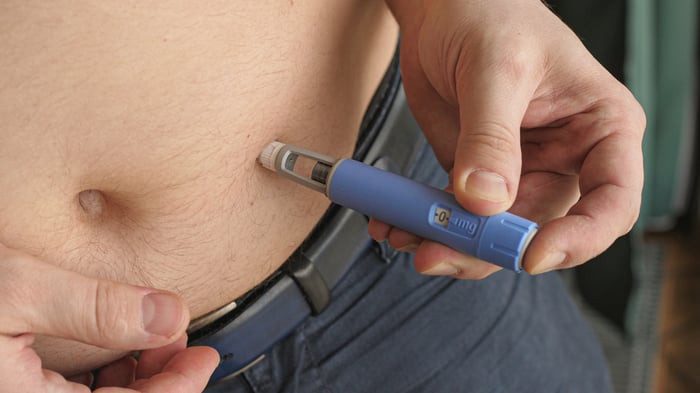
Image source: Getty Images.
That's good news, but investors are well aware of the company's success. The stock's price-to-earnings ratio is a very high 44. By comparison, stocks in the S&P 500 have an average P/E of 28, and the average pharmaceutical stock's P/E is just under 23.
Investors excited about GLP-1 drugs have priced a lot of good news into Eli Lilly's stock. Notably, Mounjaro and Zepbound currently account for 56% of the company's revenue and most of its growth. Buying Eli Lilly right now is a bet that the company's GLP-1 success continues.
What about the competition and patent protection?
The problem with buying Eli Lilly at its current valuation is that the pharmaceutical sector has a clear history to look back on. While Eli Lilly is the GLP-1 leader today, Novo Nordisk was first to market with a GLP-1 drug. Eli Lilly's product is more effective and, thus, is selling better. Novo Nordisk is still innovating, and other competitors, like Pfizer, are also looking at the GLP-1 space. Eli Lilly could be knocked from its throne just as easily as Novo Nordisk was, in a highly competitive sector.
That alone should have investors worried about what Eli Lilly's business will look like in 10 years. But there's an even more specific threat to consider. Drugs are granted patent protection for only a limited period of time. In a decade, Eli Lilly could be staring down generic competition, which would normally reduce the revenue a branded drug generates. Even in the best-case scenario, Eli Lilly's GLP-1 success is time-limited.
Eli Lilly is aware of these issues and is spending today to build its drug pipeline for the future. However, investors buying Eli Lilly at its current valuation need to consider what the future might look like if, more likely when, the company's fortunes turn for the worse.
Should you buy stock in Eli Lilly right now?
Before you buy stock in Eli Lilly, consider this:
The Motley Fool Stock Advisor analyst team just identified what they believe are the 10 best stocks for investors to buy now… and Eli Lilly wasn’t one of them. The 10 stocks that made the cut could produce monster returns in the coming years.
Consider when Netflix made this list on December 17, 2004... if you invested $1,000 at the time of our recommendation, you’d have $534,008!* Or when Nvidia made this list on April 15, 2005... if you invested $1,000 at the time of our recommendation, you’d have $1,090,073!*
Now, it’s worth noting Stock Advisor’s total average return is 949% — a market-crushing outperformance compared to 192% for the S&P 500. Don't miss the latest top 10 list, available with Stock Advisor, and join an investing community built by individual investors for individual investors.
See the 10 stocks »
*Stock Advisor returns as of March 7, 2026.
Reuben Gregg Brewer has no position in any of the stocks mentioned. The Motley Fool has positions in and recommends Pfizer. The Motley Fool recommends Novo Nordisk. The Motley Fool has a disclosure policy.
Recommended Articles


