


Why Visa Stock Got Clocked Today
Key Points
A viral Substack post raised concerns about the rapid and disruptive effects of AI implementation.
The researcher behind it warned that agentic AI would threaten the business models of top companies in several different sectors.
- 10 stocks we like better than Visa ›
A rather alarming analysis of the disruptive effects of artificial intelligence (AI) on white-collar jobs sent the stock market into a panic on Monday. This helped push down the share prices of numerous prominent companies across several sectors. Most notably in the financial industry, Visa (NYSE: V) took it on the chin with an almost 5% decline on the day.
Doom scenario
On Sunday, an independent research firm, Citrini Research, published an article on Substack hypothesizing about the far-reaching effects of greater AI implementation.
Will AI create the world's first trillionaire? Our team just released a report on the one little-known company, called an "Indispensable Monopoly" providing the critical technology Nvidia and Intel both need. Continue »
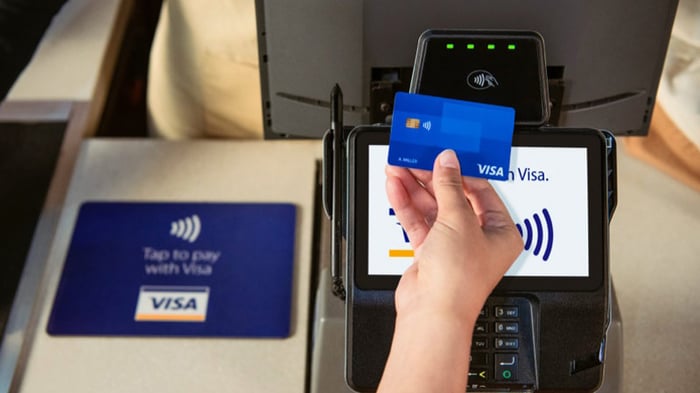
Image source: Visa.
In the piece, which it labels "a scenario, not a prediction," Citrini wrote a hypothetical economic and stock market digest dated June 30, 2028. In it, it "reported" that the U.S. unemployment rate had reached over 10%, and the S&P 500 index was down by 38% from its all-time high in October 2026.
That lofty unemployment number will, of course, be due largely to the take-up of AI and its displacement of human labor. As Citrini wrote, "It should have been clear all along that a single GPU cluster in North Dakota generating the output previously attributed to 10,000 white-collar workers in midtown Manhattan is more economic pandemic than economic panacea."
The researcher singled out several high-profile companies that would be particularly vulnerable to disruption. One was Visa, as the company's main revenue stream -- the service and processing fees it collects from transactions effected on its network -- would be threatened by agentic AI models optimizing forms of commerce that didn't require such charges.
Overblown concerns?
There's no doubt that AI will be a disruptive force in the economy and threaten the business models of more than a few traditional companies.
I'm not so sure it'll have such an explosive effect on Visa, not least because a great many consumers actually enjoy shopping, and doing so directly. They also don't seem too bothered by those transaction fees, which are in the low single-digit percentages. I wouldn't push the panic button on the card giant's stock, at least not yet.
Should you buy stock in Visa right now?
Before you buy stock in Visa, consider this:
The Motley Fool Stock Advisor analyst team just identified what they believe are the 10 best stocks for investors to buy now… and Visa wasn’t one of them. The 10 stocks that made the cut could produce monster returns in the coming years.
Consider when Netflix made this list on December 17, 2004... if you invested $1,000 at the time of our recommendation, you’d have $424,262!* Or when Nvidia made this list on April 15, 2005... if you invested $1,000 at the time of our recommendation, you’d have $1,163,635!*
Now, it’s worth noting Stock Advisor’s total average return is 904% — a market-crushing outperformance compared to 194% for the S&P 500. Don't miss the latest top 10 list, available with Stock Advisor, and join an investing community built by individual investors for individual investors.
See the 10 stocks »
*Stock Advisor returns as of February 23, 2026.
Eric Volkman has no position in any of the stocks mentioned. The Motley Fool has positions in and recommends Visa. The Motley Fool has a disclosure policy.
Recommended Articles


